

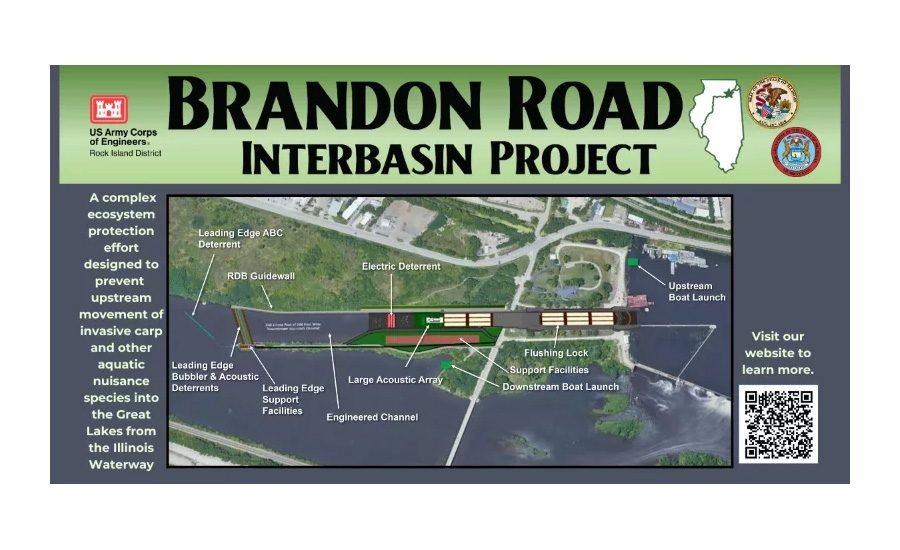

A $1.2 billion project to keep Asian carp and other invasive species from entering the Great Lakes is facing another setback. The project has been stalled and is under review by the Trump administration, according to Michigan and Illinois lawmakers.
Democratic senators from both states are calling on the administration to lift control of the planned Brandon Road Interbain project near Joliet, Illinois, saying the delay threatens the Great Lakes ecosystem and the regional economy. In a Jan. 15 letter to the White House budget director and the U.S. Army Corps of Engineers, the senators called for an end to the review and the release of federal funds already approved by Congress.
“The current review is unnecessary and could cause delays that put the Great Lakes ecosystem and fishing industry at risk,” wrote Sens. Dick Durbin and Tammy Duckworth of Illinois and Sens. Gary Peters and Elissa Slotkin of Michigan.
Lawmakers warned that the delay could slow the awarding of construction contracts and increase project costs. “The current pause and review could increase the cost and slow the project’s final completion date, increasing the likelihood that invasive carp could enter the Great Lakes,” they wrote.
The pause contradicts a presidential memo signed by President Donald Trump in May 2025 that ordered federal agencies to “achieve maximum speed and efficiency” to prevent Asian carp from reaching the Great Lakes.
Michigan Gov. Gretchen Whitmer (D) met with Trump before the memo was released to seek support for the project, noting that the Great Lakes contain 20 percent of the world’s surface fresh water.
In August 2025, the Chicago Tribune reported that Trump threatened to withhold support for the project unless Illinois Governor JB Pritzker also asked for help.
Asian carp, a group of invasive fish species including bighead carp and silver carp, are known for their rapid reproduction and aggressive feeding habits. If they become established in the Great Lakes, they could compete with native fish for food, disrupt food webs, and permanently alter aquatic ecosystems. The species also threaten recreational boating and fishing, and their spread could significantly harm the Great Lakes’ $7 billion fishing economy, the senators said.
The senators point out that the project, which has historically had bipartisan support, has already suffered years of delays. The Corps completed studies and public outreach before finalizing the plan in 2019. Congress authorized the project in 2020, allocated $225 million for construction in 2022 and provided an additional $47 million in 2023. Illinois and Michigan, the project’s non-federal sponsors, have invested more than $100 million.
Expressing concern in March 2025 that federal funding was being withheld at the time, Illinois postponed closing on a property needed for the project, later acquiring the 50 acres that allowed the project to move forward.
The first phase of the project includes site preparation and installation of layered technologies at Brandon Road Lock and Dam. These include a bubble barrier designed to remove small fish caught under barges or carried in their path, along with an acoustic deterrent that emits painful sound waves to repel the fish.
Future phases are expected to include an electric barrier, additional acoustic deterrents and a washout lock intended to push remaining eggs and larval fish downstream.
The Corps’ latest April 2025 construction update notes that site preparation began in January 2025 when Miami Marine Services and Michels Construction Inc. of Milwaukee, Wis., began tree removal and rock excavation. More than 85% of the 30,000 cubic meters of material had been excavated by April 6, and work was expected to be completed by the end of April.
A request for comment on the Corps pause in Rock Island, Illinois was sent to Corps headquarters in Washington DC, which did not respond. The White House also did not respond to requests for comment.
