

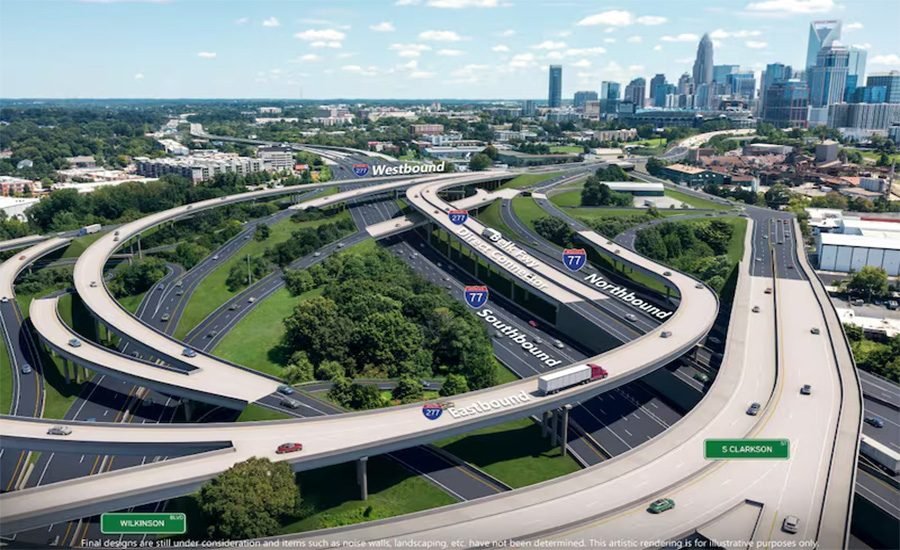
The North Carolina Department of Transportation confirmed in early February that it will move forward with an elevated express lane concept for the I-77 South corridor through Charlotte. The decision follows more than a year of sometimes contentious public engagement and moves the project toward environmental review.
In a Feb. 4 update, NCDOT said the elevated option came after evaluating multiple alternatives for the roughly 11-mile stretch of the interstate between I-277 and the South Carolina line, where dense development and limited right-of-way restrict conventional widening.
RELATED
Best Midwest Projects of 2025: Best Road/Bridge: I-75, Segment 3
“NCDOT’s priority is to deliver transportation improvements in partnership with the region that respect the history of the [project] neighborhoods,” Felix Obregon, division engineer for NCDOT Division 10, said in a statement.
“Community feedback has been instrumental in shaping this project, and the elevated design option balances regional mobility needs with significant reductions in environmental and neighborhood impacts,” he added.
The decision represents a defining change in the engineering profile of the project. By placing managed express lanes in the structure through the most restricted segments, the plan transforms what would otherwise have been a highway widening into a bridge-intensive urban megaproject, with the design effort expected to focus on foundations, columns, superstructure systems, in-structure drainage and a live-traffic construction scenario.
According to an NCDOT project video, the southbound portion of I-77 currently carries about 160,000 vehicles per day and includes 13 interchanges and multiple bridges, most of which are expected to be upgraded as part of the project, underscoring the scale and structural complexity of the corridor.
Looking for quick answers on construction and engineering topics?
Try Ask ENR, our new intelligent AI search tool.
Ask ENR →
Although the final geometry has not been released, the elevated approach involves a corridor dominated by long viaduct segments, frequent placement of piers and interchange flyovers, rather than continuous at-grade widening. For contractors, this shifts the risk to subsurface conditions, utility conflicts, traffic maintenance and long-term inspection obligations, rather than earthmoving quantities.
An urban construction of reference

An NCDOT diagram illustrates two elevated, side-mounted and stacked express lane concepts showing how managed lanes could be built above or alongside existing general-use lanes, depending on the corridor’s limitations.
Representation courtesy of NCDOT.
The elevated approach aligns the project, at least in concept if not in final scale, with other large managed lane programs in densely populated urban corridors, such as the LBJ TEXpress in Dallas and the I-75 Northwest Corridor Express Lanes in Atlanta, where the elevation reduced property take and kept traffic flowing during construction.
Like these projects, I-77 South is positioned as a long-term investment in capacity and reliability rather than a short-term congestion fix.
The project originated from a locally led study by the Charlotte Regional Transportation Planning Organization, in keeping with North Carolina’s policy that toll projects begin at the regional level.
NCDOT estimates the cost of the project at approximately $3.2 billion, a planning-level figure that reflects bridge structures, interchange reconstruction and long-term operations. The department has indicated that it hopes to follow a public-private partnership delivery model, with procurement following the completion of environmental approvals.
The high-profile decision comes as the project moves through the National Environmental Policy Act process, overseen by the Federal Highway Administration. The environmental documentation is still under development and NCDOT has not yet released a draft document or issued a record of decision. Agency officials have said public hearings related to the environmental review are expected later this year.
RELATED
Fluor will begin work next year on the I-35 ‘Congestion Reducer’ in San Antonio
Sell a skeptical audience
Community response remains mixed. At meetings held in late January and early February, residents acknowledged that the elevated concept could reduce commuting compared to widening the grade, but raised concerns about noise, air quality and visual impacts associated with large viaducts near neighborhoods.
“If you just think about people in general and how people want to live, then nobody wants to look out their window and see a big concrete bridge,” said McCrorey Heights homeowner Shauna Bell, who spoke at a public meeting, according to Spectrum News 1 Charlotte. “No one wants to be outside and have more air pollution or more noise pollution.”
Comments on NCDOT’s YouTube channel reflect the range of views. One commenter asked, “Why not build commuter rail on existing Norfolk Southern tracks? Save the $3.2 billion.” Another wrote, “This is probably the best solution…for a metro the size of Charlotte, the I-77/US 74/I-277 interchange is horrible.”
Transportation advocates have also questioned the project’s underlying assumptions. Shannon Binns, executive director of Sustain Charlotte, a local advocacy group, said the decision highlights broader debates about how investments in urban mobility are prioritized.
“As of today, there is no publicly available record showing that NCDOT ever studied a traffic alternative for I-77 South before recommending toll lanes,” Binns said in a statement.
NCDOT has said that alternatives such as tunnels or fully depressed roads were evaluated and ruled out as financially unfeasible at this stage, citing the cost and long-term maintenance burdens associated with building underground freeways in other US cities.
From a recruiting standpoint, the high concept effectively defines the type of teams likely to compete. The project’s scale, structural intensity and long-term operational requirements are expected to favor concessionaires with experience in urban viaduct construction, managed lane toll systems and lifecycle asset management, rather than conventional highway widening.
Construction is not expected to begin until the end of the decade, pending federal approvals and the completion of purchases.
