

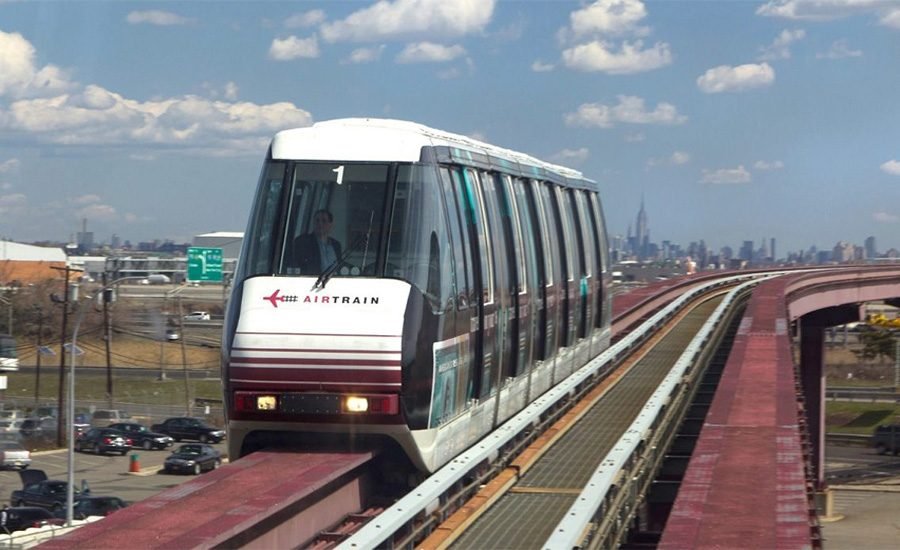
The Port Authority of New York and New Jersey is restarting the replacement of the AirTrain Newark system as a roughly $3.5 billion program after bids for an earlier $2 billion contract came back well above expectations.
Cost overruns forced the agency to abandon its original delivery model and rethink how the project could be built in a construction market that has changed significantly since the effort was conceived.
Originally authorized in 2019 as a single design, build, operate and maintain (DBOM) procurement, the AirTrain replacement was intended to transfer construction, systems and long-term operational risk to a private consortium.
Proposals received in 2022 reflected a changed reality that far exceeded expectations amid escalating pandemic-era costs, supply chain disruption and a sharp pullback in contractor risk appetite for the megaproject, according to a September 2025 Port Authority redevelopment filing. The agency canceled the procurement as planned and returned to the drawing board
ENR has previously reported on the previous iterations of the AirTrain Newark replacement, including the original acquisition and subsequent design activity, before the effort was halted and returned to work. What has emerged now is not fundamentally different, but a different way of doing it.
Under the revamped program, the Port Authority has broken up work into smaller packages, separated system technology from civil infrastructure and early stage work to reduce risk — changes that, along with inflation, account for much of the program’s total cost, which jumped to $3.5 billion.
The revised approach is now being incorporated into the authority’s current 10-year capital plan, with early design and procurement expected to move forward during the current capital plan period. According to Port Authority documents, major works are planned later in the decade.
A central constraint shaping the staging and sequencing that has remained constant is that the current AirTrain must remain operational throughout construction without interruption.

A Port Authority program map outlines the proposed scope of the AirTrain Newark replacement, showing new and existing alignments, planned stations, construction areas and a maintenance and control facility as part of the revamped $3.5 billion program.
| Map courtesy of the Port Authority of New York and New JerseyWhy replacement, not rehabilitation? The existing AirTrain Newark system, a first-generation automated people mover approximately three miles long and in service since 1996, has reached a point in its life cycle where control system obsolescence, non-compliant electronics and declining reliability outweigh the benefits of incremental rehabilitation.
According to industry practice for first-generation automated carriers, upgrading software-based train control and diagnostics to legacy platforms is typically impractical in airport environments, where outages directly disrupt terminal operations.
Port Authority officials have publicly acknowledged the reassessment. Speaking at ENR’s New York/New Jersey Infrastructure Forum last fall, Newark Liberty Redevelopment Director Ralph J. D’Apuzzo said the AirTrain replacement remains part of the airport’s broader modernization program and that lessons from previous megaproject acquisitions are informing the authority’s strategy and delivery scope.
Under the new framework, the Port Authority is expected to use a design and build structure for the main civil elements, with automated people movement systems procured separately. Environmental approvals have been completed for the replacement corridor, with federal funds available through the Federal Aviation Administration’s Airport Improvement Program.
For contractors, the reset positions the AirTrain Newark replacement as a major future airport infrastructure opportunity that encompasses the construction of elevated guides and stations, structural concrete and steel, electrical and communications work, and fully automated integration of people movements.
While no construction start date has been set, capital plan projections place most of the work in the late 2020s, with additional procurement authorizations expected through future board actions.
