

✕
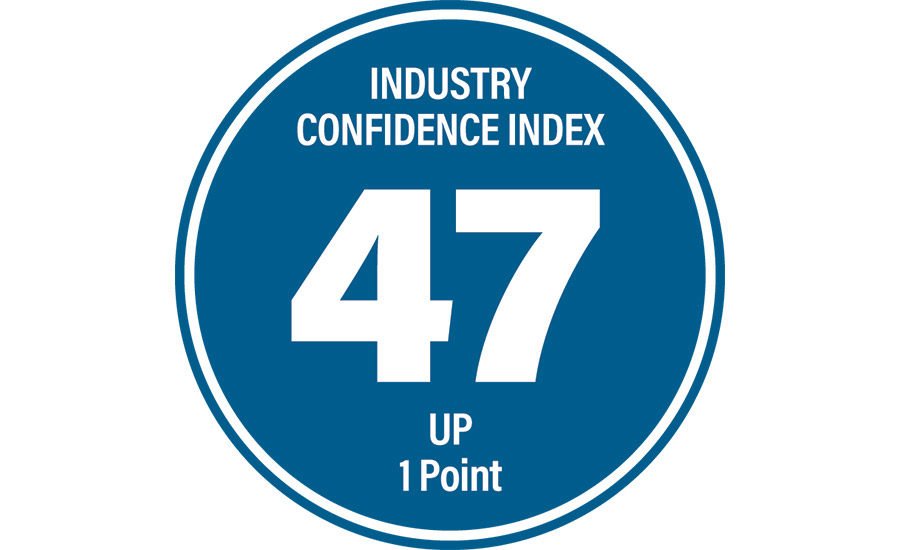
ENR’s Construction Industry Confidence Index shows that construction industry executive confidence is largely unchanged from last quarter, with many companies reporting that they are awaiting the results of the November general election. Just under half of CICI respondents mentioned that the election results will affect their confidence levels in their comments. The CICI rose one point to a rating of 47 in the third quarter.
The confidence index measures executive sentiment about where the current market will be in the next three to six months and over a period of 12 to 18 months, on a scale of 0 to 100. A rating above 50 shows a market in growth The measure is based on responses from US executives at major general contractors, subcontractors and design firms on ENR’s top lists to surveys sent between Aug. 5 and Sept. 16.
Confidence in the economy fell 11.4% to 39 this quarter. Last quarter, 27.4% of CICI respondents saw a declining economy. This quarter this figure rises to 37.8%. Businesses are also significantly more pessimistic about the economy three to six months from now, with 40.5% seeing a declining economy in that range, up from 29.0% last quarter.

Design firms report much higher trust than GCs and CMs or subcontractors. Confidence among design firms rose slightly to 55 in the third quarter from 54 in the second quarter. GC/CM confidence also rose, to a 43 this quarter from a score of 37 last quarter. Subcontractors saw the biggest change, as their rating fell to 45 in the third quarter from 51 in the second quarter. The confidence of subcontractors has fallen by 26.7% since the first quarter.

Source: ENR/BNP Media
Companies operating in the Midwest and Southeast report the highest confidence, with both regions scoring 52. The most pessimistic are companies operating in the Rocky Mountain States, with a rating of 40.
Confidence in the distribution/warehousing sector fell 25.0% to 36 this quarter. Only the retail trade (33) and commercial offices (22) sectors have a lower score. Confidence remains highest in the energy (76) and transport (71) sectors.
These results largely match those of the Construction Financial Management Association (CFMA) Confindex survey in Princeton, NJ. Each quarter, CFMA consults with CFOs of general and civil contractors and subcontractors about markets and business conditions. The resulting Confindex is based on four separate financial and market components, each rated on a scale of 1 to 200. A rating of 100 indicates a stable market; higher ratings indicate market growth.
Most Confindex indices saw negligible movement between Q2 and Q3. The global Confindex rose just under 2% to a rating of 108. The “financial conditions” and “current conditions” indexes fell less than 2%, with ratings of 107 and 104, respectively.
The biggest move was seen in the “outlook for the year” and “business conditions” indexes, which rose to a rating of 114 and a rating of 110, respectively.
The rise in “outlook for the year,” in particular, may be a sign that CFOs believe they have largely weathered the storm, says Anirban Basu, chief executive of Sage Policy Group and an adviser to the CFMA. “I think CFOs are encouraged that their companies have managed to stay busy during a period during which monetary policy was actively tightened. [And] now they expect interest rates to drop,” he says. On September 18, the Federal Reserve voted to cut interest rates by 50 basis points, or 0.5%.
“If someone had told me a couple of years ago that the Federal Reserve would raise the upper limit of the Fed funds rate from 0.25% to 5.5% and the construction industry would hardly have seen affected, I’d say that’s nonsense,” says Basu. .
The percentage of CFMA survey respondents who reported being very or very worried fell to 17% in Q3 from 31% last quarter. Of these companies, 64% are very or very concerned about the labor shortage. “That doesn’t speak to an industry about to go into some sort of recession, does it? [Firms] they still need more workers to do the work they do, and that suggests they are busy and expect to stay busy,” says Basu.
The percentage of CICI survey respondents who said their customers’ access to finance was “much more difficult” than a year ago fell to 6.3% in Q3, from 14.5% in 2T
Is the recession still kicking in?
Basu still sees signs of a slowdown in economic activity early next year. The Sahm Rule, developed by economist Claudia Sahm, is triggered when the three-month average U.S. unemployment rate rises 0.5% or more from its 12-month low. This average only reaches 0.57%. Applied to data from the 1970s, it has been consistent with every recession, Basu explains. “The idea is that if unemployment starts to rise too quickly, the labor market becomes messy, because layoffs lead to layoffs,” he adds.
Basu also points to the inverted yield curve. “The two-year Treasury rate has been above the 10-year Treasury rate, but that’s not reversed, and recessions often start right around the time it’s not reversed” , he says
