

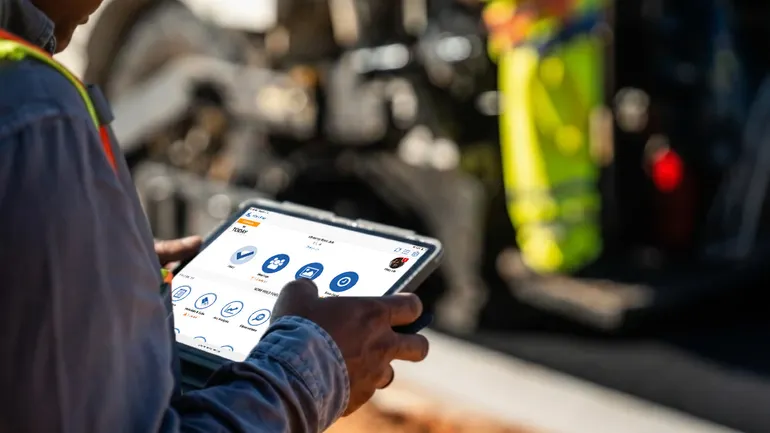
Construction technology has changed dramatically over the past two to three years, and understanding what’s coming next, along with what contractors should be doing now, has never been more important.
What’s different today is that AI and data are no longer “the next big thing.” They are quickly becoming the baseline for how contractors protect margins, increase productivity and make faster decisions with lighter equipment. The conversation has shifted from buzzwords to real benefits in the workplace.
The rapid maturity of construction AI
According to a 2025 Dodge Construction Network study, 87% of contractors believe AI will have a significant impact on their business. What stands out the most is not just the belief, but the speed. A few years ago, companies were experimenting with AI. Today, many use it daily workflowsand the gap between test and scale continues to narrow.
You don’t need to be an AI expert to benefit. However, the longer companies wait, the harder it will be to catch up.
Here are several practical forces that make AI inevitable:
- Lack of manpower in the field and in the office
- Margin pressure from competition and rising costs
- Inflation and geopolitical volatility, especially painful for long-term jobs
- An abundance of digital tools and data, creating both opportunity and overwhelm
Importantly, contractors are not adopting AI to replace workers. The real goal is to make existing teams more productive while keeping risk low. The real interest is in reducing time spent on data entry, improving data accuracy and freeing people up to focus on higher value work.
The real problem: adoption is growing faster than trust
A striking contradiction in the industry is that while most contractors already use AI in some form, only a small percentage are considered “above average” in technological advancement. This gap tells a critical story. The challenge is not whether AI is being used, but whether teams trust it, understand it and can safely implement it.
Confidence, not ability, is the bottleneck.
Digitization = automation?
AI does not live in a vacuum. It represents the next phase of a broader trend of digitizing paper-based processes through laptops, iPads and field data capture, which is now evolving into automation that reduces manual work.
Two facilitators have made this change possible:
- Better connectivity (5G, satellite, expanding broadband)
- Cloud workflows where field and office share real-time environments
That said, there is a major problem among contractors right now caused by too many applications, too many logins, and the fact that these systems are largely disconnected. No organization wants to go cart hunting to find out which tool has which answer. While many vendors claim they “integrate,” real-world integrations are often expensive and/or ineffective.
As the user experience becomes more efficient, it only makes sense for strategies to involve consolidations. Contractors want platforms that talk to each other, ultimately reducing the number of systems workers have to learn.
Five ways to prepare your business for AI success
Successful AI integration isn’t about the software you invest in, it’s about the foundation you build.
Here are five strategic moves to make sure your business is ready to scale:
- Start with people and process, then technology – identify workflow issues before investing in AI.
- Target manual, slow, and disconnected workflows: Anywhere a human acts like a computer is an opportunity for automation.
- Invest in data quality and standardization: Better results in AI require better inputs.
- Train early and treat training as risk mitigation – this should not be seen as an overload, nor should it be optional. This is how you can climb safely.
- Embrace AI where ROI is evident today and build your way to big wins – document workflows, reporting and scheduling are strong starting points.
The final result next year
Here is the reality. Much of what is called “AI” today is not real AI. Many tools are simply rules-based automation wrapped in trendy marketing. Contractors should be skeptical, but not discouraged.
AI is poised to transform construction faster than previous technological changes. The cloud took years to reshape workplaces. AI is moving on a much shorter timeline. What will ultimately drive this change is consistent data entry, high data quality and reliable capture systems.
Construction companies that start early, focusing on fundamentals rather than hype, will gain a lasting competitive advantage as data analytics and real-time decision-making reshape how the industry operates.
More information about HCSS copilotthe first natural language AI tool of its kind in the civil construction market.
