

✕
Drivers who scatter to dart across three lanes of traffic as they merge onto the freeway. Vehicles slowing to a crawl due to extremely curved exit ramps. Commuters enduring agonized backups as three freeways converge on a narrow footprint. Cyclists and pedestrians sweating through long detours to cross motorways.
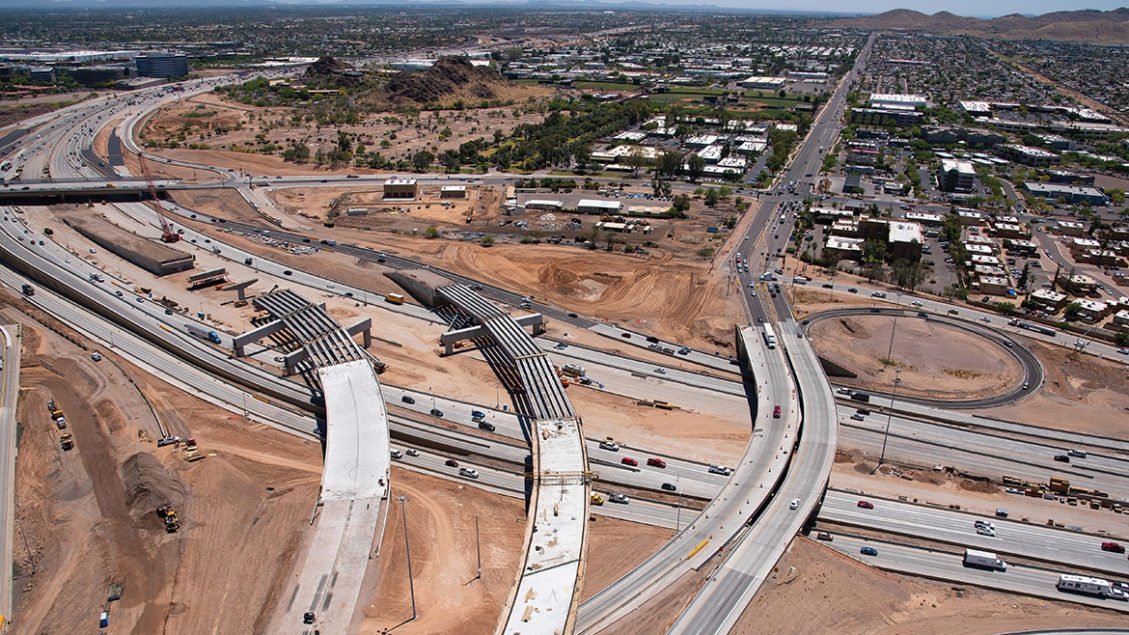
These are just a few of the many problems the Arizona Department of Transportation (ADOT) has long sought to solve with a major renovation of Interstate 10’s Broadway Curve corridor. By building or rebuilding 21 bridges, adding lanes and introducing drivers to the concept of collector-distributor roads, ADOT’s largest freeway reconstruction project to date aims to untangle convoluted interchanges and simplify navigation along one of Arizona’s busiest corridors.
But the effort hasn’t come without its own puzzles, including a commitment not to close any major lanes of traffic on weekdays, a complex sequencing of construction with ever-changing traffic alignments, and an ongoing commitment to stakeholders, businesses and the public to keep travelers, and the project—on track.


Crews placed the final beams for the project’s 21 bridge structures last month.
Photos courtesy of ADOT
Multifaceted collaboration
About eight months remain in the public-private partnership design and construction effort that began in July 2021. Of the total construction budget of $729.7 million, $616.6 million has been intended for developer Broadway Curve Constructors (BCC), a joint venture of Pulice. Construction, FNF Construction and Flatiron Contractors.
While not a traditional P3 in which builders also have a maintenance or operation contract for several years, the P3/DB model gave BCC more flexibility during the procurement process and also allowed ADOT to negotiate with the best value winner for incorporating ideas. that other teams brought to the table, says Steve Campbell, BCC project manager and senior vice president of Pulice.
The contract includes an early completion incentive of $50,000 per day, capped at $3 million, and a penalty of $70,000 for each day of delay, says ADOT spokeswoman Marcy McMacken.
The project was originally identified as a priority by the Maricopa Association of Governments and funded by a sales tax approved by voters in 2004. ADOT conducted in-depth studies between 2014 and 2017, and the environmental review was ended in early 2020.


ADOT created informative videos and animated displays to introduce travelers to the concept of collector-distributor roads.
Schematics courtesy of ADOT
* Click on the images for more details
The design fell to TYLin International, Stanley Consultants and Aztec Engineering, but the concept of collector-distributor (CD) roads had already been incorporated by ADOT when the project went out for proposals, says Josiah Roberts, director of main project of TYLin. .
One of the design team’s biggest tasks was tracking more than 1,500 potential utility conflicts with more than 30 different utilities and coordinating more than 70 sets of relocation plans, Roberts adds.
Currently, 300,000 vehicles pass through the catchment area on an average working day, and this is expected to increase by 25% over the next 15 years. Because US 60 and SR 143 terminate at I-10 within a short distance of each other, “there’s a lot of traffic that changes lanes and jockeys to get where they need to go.” , says McMacken. “The purpose of the CD roads is to separate the main traffic going through the Broadway Curve area from the traffic trying to get off US 60 or SR 143 or Broadway Road or 40th Street.”
Along with CD roads, crews will widen and improve an 11-mile stretch of I-10 from Ray Road on the south bank to just north of the Salt River, where I-17 splits. In some areas, an additional HOV lane and two general use lanes will be added (see map above). At its widest point, I-10 will contain 26 lanes.
The 21 major structural elements include two new pedestrian/bicycle bridges.
“There are over 5,000 businesses along this 11-mile corridor that are affected.”
—Nicole Moon, Public Engagement Manager, WSP
But intertwining the CD structures and roads along busy interchanges has been a Herculean sequencing task for BCC. “Our commitment to the job is to make sure we’re maintaining the same number of lanes in each direction at all times, except when we have a full freeway closure,” says Luke Peterson, BCC’s director of construction. “So from a phasing standpoint, we’ve probably made four or five major changes to the traffic alignments just to make sure we keep the same number of lanes.”
To improve and widen the existing roadway, “we need to be able to get to these older work areas while maintaining the same number of lanes” by splitting traffic on both sides of a construction zone, Peterson says. “The idea of splitting traffic to maintain freeway speeds is new to the Phoenix area.”
For the first major split orchestrated last fall, traffic split into two streams that go around new ramps being built in the middle. Another major split occurs in late summer on the Salt River Bridge, which is being widened as part of the project.
With a workforce exceeding 3,000 people, heat mitigation becomes critical during the summer months. Some crews, such as those building ramps and bridges, start work at 2 a.m. or 3 a.m. Classification crews begin their shift at 5 a.m. “Most shifts are between 1 p.m. and 2 p.m. before the sun is really at its peak,” he says. .
“People are working behind temporary concrete barriers or they have a shock absorber truck with them.”
—Steve Campbell, Project Manager, BCC
The procurement team can also schedule up to 25 weekend closures in the Broadway Curve area in each direction, in addition to a series of overnight lane restrictions, during which crews and subcontractors work throughout the evening.
With so much foot traffic, BCC places a strong emphasis on workplace safety. “One of the things we keep hammering into everyone’s head is: We can police ourselves, but we can’t police the traveling public,” says Campbell of Pulice. Although the posted speed limit is 55, the driver often speeds over it. “People are working behind temporary concrete barriers or they have a shock absorber truck with them. There’s no latitude to say, ‘I’m only going to be out there for 10 minutes.’ There’s a 30-foot clear zone that you have to ‘be behind’.


Crews take advantage of the shade under one of the two new pedestrian bridges (left). During a weekend closure to demonstrate old overpasses (right), ADOT created the award-winning Ready to Rubble awareness campaign.
Photos courtesy of ADOT
Award-winning disclosure
The project allowed ADOT to take its public involvement to the next level. “It was very important to us during the environmental review phase to invite the public to be a part of the project,” says Nicole Moon, public engagement manager for the project’s general engineering consultant WSP USA. “There are over 5,000 businesses along this 11-mile corridor that are affected. So we had a business forum in 2019 and a freight and logistics forum because we wanted to talk to those people who would be most affected by the construction of our project”.

To avoid both the high desert temperatures and the busiest traffic times, crews often work at night and early morning.
Photo courtesy of ADOT
A key insight from the disclosure revealed that many companies operate trucks for shipping or other purposes overnight, and giving them at least two weeks’ notice of night lane restrictions or weekend closures would alleviate greatly impacts their businesses, says Moon.
The BCC team included mobility management company Iteris in their original proposal as a value add, Campbell says. Iteris uses proprietary software to collect live cell phone data to track and analyze traffic during shutdowns. This helps optimize future closures and helps with traffic management in and around the project, adds TYLin’s Roberts.


Crews widen the Salt River Bridge, shown from above and below. During last year’s wet winter, heavy rains upstream required the release of dams, flooding the bridge pier foundation construction site for several months.
Photos courtesy of ADOT
The project also commissioned ADOT’s first project-specific mobile app, which has been downloaded over 20,000 times to provide users with up-to-date information. Also, for the first time, ADOT is conducting a paid advertising campaign through television ads, social media and billboards “to get project information to a much larger group of people rather than just those they meet in the hallway,” adds Moon.
Also on social media, ADOT’s McMacken has been producing regular behind-the-scenes tour videos. Moon says the videos are useful “because we want you to watch the video on social media and not watch the teams while driving the project. It’s been a very successful campaign for us.”
In April 2023, a major weekend shutdown occurred to demolish the old 48th Street and Broadway Road bridges. To increase public awareness of the closure, ADOT created the Ready to Rubble: the Ultimate Bridge Takedown event. Stakeholders and media were invited to the site and visuals were distributed to the public detailing the bridge removal process, McMacken says. The successful effort garnered innovation awards from the Transportation Research Board, the American Association of State and Transportation Officials, and the Women’s Transportation Seminar.
Later this summer, drivers will get their first taste of CD roads as traffic is backed up to allow work to continue in the medians. To prepare, ADOT launched a Find Your Lane campaign to help drivers adjust to the new transportation paradigm.
Peterson says he’s looking forward to the change, which will allow for the final steps in the long construction journey: “It will allow us to do the final diamond grinding and asphalt surfacing, put in the final stripes, do the aerial signage work and the final paint job really shines.”
