

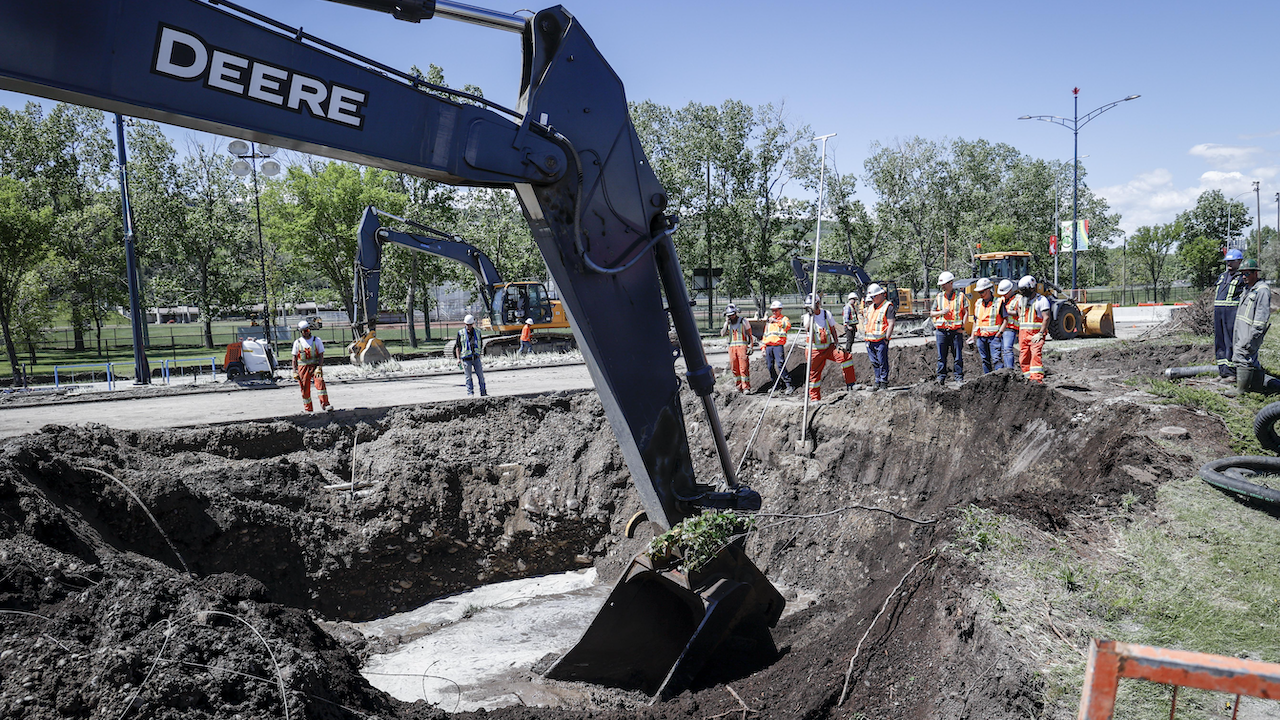
Work to repair a water main in Calgary on June 7. (Jeff McIntosh/CP)
I saw a moving tweet Sunday. It was remarkable for two reasons. The first was that something moving was a nice change of pace. But the second was that I was talking about a story that is currently very much in the news and also very relevant to my interests. The City of Calgary is being sent a section of replacement pipe by the Municipal Water Services Department of San Diego, California. It’s apparently just what Calgary needs to help it recover from the recent catastrophic water main failure that has deprived the city of 60 per cent of its drinking water supply, prompting the , this weekend, of the state of emergency.
I have some thoughts on all of this…
Let’s stay with the heartwarming subject for just a minute. Canadians have long had a complicated relationship with their neighbor to the south and complicated feelings towards their neighbor to the south. And certainly these days I am absolutely concerned about American political and social trends and stability. Problems in any of these departments automatically spell trouble for us. I think about this a lot and sometimes write about it too.
But let me get something straight: America is, at its best, the greatest country the world has ever seen, and despite its current problems, Canada couldn’t have asked for a better neighbor. The fact that San Diego is urgently shipping replacement parts to a Canadian city, and also took the time to literally paint a heart on it, is completely in line with the best of America. To any Americans who may be reading this: Thank you. We have had and are very lucky to have you by our side.
It felt good to say that. But now let’s take a closer look at why this worries me and why it fits with so much of what I write.
Why is the nearest necessary spare part in California?
Regular readers of mine will know that two topics I write about a lot are our lack of strategic and defensive thinking and, lately, a growing list of indicators that suggest to me that Canada is failing at many basic tasks, specifically that the government has lost basic core competencies and can no longer perform tasks that we would have normally expected of it before. How, for example, to keep the infrastructure in good condition. This is a story that touches on both.
Readers may know that I like to say that I worry about “our expectations are a problem.” Most Canadians alive today, and basically all of them in positions of authority, grew up in a time when Canada didn’t have to worry about the basic necessities of life. Usually, when I write about this, I’m referring to matters of defense and national security. But not always. The general lack of preparedness for emergency response is an important part of my thesis about expectations are a problem. We have not prepared and do not prepare for bad scenarios, because we have very little lived experience with them. We don’t really expect them to happen, on a gut level, even though we know intellectually that they can happen. So we treat them as intellectual projects and design purely intellectual paperwork plans to respond to them.
I will admit that this is not a uniquely Canadian failure. Few of us in the Western world, with a few possible exceptions in former communist bloc countries, have much lived experience with infrastructures that are consistently unreliable. And one of the things that means, as our friends in Calgary are discovering, is that many, if not most, of our governments have very little surge capacity to respond to catastrophic system failures.
This was amply demonstrated during the pandemic. When COVID-19 hit, we realized very quickly that we had almost no capacity to bring additional healthcare staff into an emergency role without completely disrupting routine healthcare delivery, which is what we ended up doing. We had almost no spare physical infrastructure in the system, no spare equipment (such as ventilators, which is why there was such a rush to acquire them at huge cost), and not even the personal protective equipment we thought we had stockpiled after our experience with SARS. We had it! Then we let it rot.
We have long since squeezed any slack out of the system in the name of financial efficiency. I like financial efficiency! But any system that routinely operates at or near 100 percent capacity lacks the capacity to respond to emergencies.
It’s not just health care. You’ll find this replicated at scale in most US governments, so Calgary is calling on any private sector workers who can help out their municipal engineers and send spare parts from California.
Let me tell you a little story. A few years ago, at the major intersection closest to my house, one of the traffic lights was knocked down at the intersection by a crash. Fortunately, no one was hurt by this, but the post was completely removed. I was pleasantly surprised at how quickly it was replaced. Everything was back up and running by the end of the day. I talked to some of the engineers who had done it. I can’t remember if they were city employees or contractors, but I do remember being told that light standards are something the city needs to replace so often that they keep them as a veritable inventory of spares on hand. One of the guys joked to me that they were one of the few things the city had on hand. Most parts are ordered as needed.
We’ve all heard the concept of just-in-time economics. This describes how manufacturers don’t really keep an inventory of consumables (whatever they are for a specific business) around, but instead rely on deliveries every day or every few days at most to keep their operations going. If anything delays or disrupts these deliveries, anything at all, operations will cease almost immediately. Again, this is in the name of efficiency.
And again, I like efficiency. I’m not here to argue against efficiency. But I think we should all take a minute and reflect on the fact that Calgary, one of our largest and wealthiest cities, does not have enough engineers or critical spare parts in its inventory to deal with this problem quickly on its own . He has to call the private sector and send parts from the United States.
I’m glad he’s doing both of those things. I am hopeful that Calgary, a beautiful city that is home to many people I love, will get back on its feet as soon as possible.
But we should really think about whether or not this is how we want to run a society. Everyone loves efficiency, but we also need redundancy. Keeping critical spare parts and some excess skilled labor capacity on the payroll can seem like inefficiency, most of the time. But when you need it, it looks like something else: a lifesaver. Sometimes literally.
