

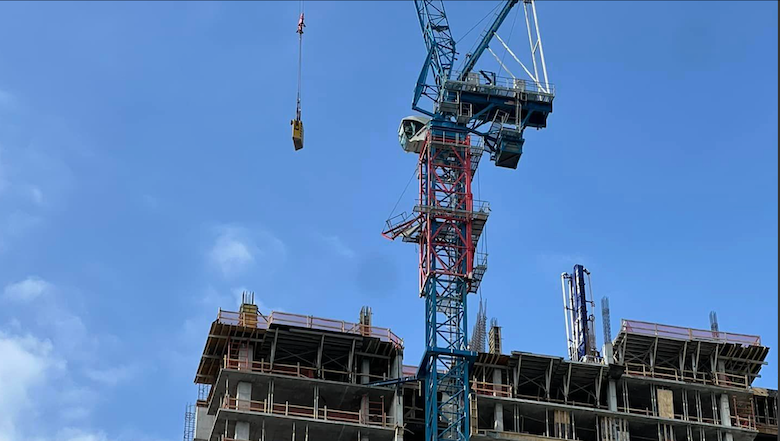
cReports of what may have happened in a fatal Florida tower crane accident in April suggest that a cable supporting the climbing unit’s work platform failed, detached or snapped .
A post-accident photo of the climbing unit and a video description from the rigging crew chief point to the role of the rig cable, suggests William Neeley, who trains crane operators for Crane Tech LLC. a national crane service company based in Tampa, Fla.
A police report obtained by ENR stating that one cable on the work platform was “loose and frayed” while another was still intact and connected further adds to investigators’ interest in the cable.
The accident caused a heavy crane mast section of the tower crane on the platform, which was ready for insertion during a climbing operation, to crash into a bridge road adjacent to the tower apartments in Fort Lauderdale, Florida. When the mast section fell from the rig, a rigger, Jorge De La Torre, 27, fell about 300 feet to his death.
The pole section crushed a hatchback passing on the road below, although its driver escaped relatively unscathed. Other cars were also hit by debris and one person received a laceration to the head.
In the days following the accident, Neeley suspected the climbing unit’s work platform was involved after seeing a photograph posted online by Fort Lauderdale Fire & Rescue that was used in news reports.
To comply with the state of Florida’s public records law, Fort Lauderdale police on July 18 released several videos of the pole section crashing into cars, as well as officers’ body camera footage locals who rushed to the job site and interviewed crew members.
the video shows the upper parts of the building, the blue mast of the tower crane, the red climbing unit and the working platform protruding from it. The outer edge of the platform should be tied to the climbing unit by cables at the corners of the edge, but in this case the outer edge seemed to be tied to the climbing unit by only one cable .
It is not yet known whether the tilting of the platform and the apparently missing support cable were the triggering causes or part of a chain of events, and whether the cable had been cut, failed or inadvertently pulled from an anchor , Neeley said.
A worker, who identified himself as Francisco Manuel Tobias and said yes crew chief at Phoenix Rigging & Erecting, twice responded to police that he was collecting names and contact information, offering vivid descriptions to officers.
After learning about Tobias’ video description, Neeley said it matched his theory made in April.

Francisco Manuel Tobias, left, describing to a police officer what he believes happened on April 4.
Image: Courtesy of Fort Lauderdale Police
“We were just fixing something … and the crew was just going to jump over to the other side,” Tobias told an officer, apparently meaning the mast section would be inserted.
Then, “we just heard a loud noise and the tower just fell,” he added, appearing to be referring to the mast section of the crane. The crane mast, attached at intervals to the frame of the building, was never in danger of collapsing.
Tobias indicated that the tower or section of the tower was “just standing there,” on the platform and “I was just waiting there, and I guess that broke,” he said, grabbing a wire on the back of the truck tool shed The crew chief said he was strapped in and was able to hold on, saving himself.
A police report also suggests that the work platform cable may be part of the failure sequence. Officer Jaclyn Smith, who entered the building shortly after the accident, observed that one cable from the climbing unit’s work platform was in place, while another was “loose and frayed ” and not connected. He also noted that “loose cables were attached” to the work platform end of the climbing unit where the loose, frayed cable appeared to have broken or become detached.
Federal safety officials are still investigating the crash.
The police report also contains details that may partially explain why the crew was deeply shaken: The force of the 30-plus-story fall that killed De La Torre caused serious injuries, and his remains were still at the site of work 30 or 40 paces from the tool shed. . Crew members likely saw the injuries.
A gofundme page has been created by De La Torre’s family, which includes two children.
 A Gofundme page was set up for surveyor Jorge De La Torre, who was a father of two and died in the crash.
What happens next from a legal perspective will likely involve the separate companies that are often involved when a tower crane is used on a project: the employer of the crane operator, the owner of the crane or unit of ‘climbing and the equipment contractor.
But, says Neeley, tThe task of assigning legal responsibility “becomes very sketchy because in the tower crane world, the operator sitting on top is not in charge” or under the control of the rigging crew.
