

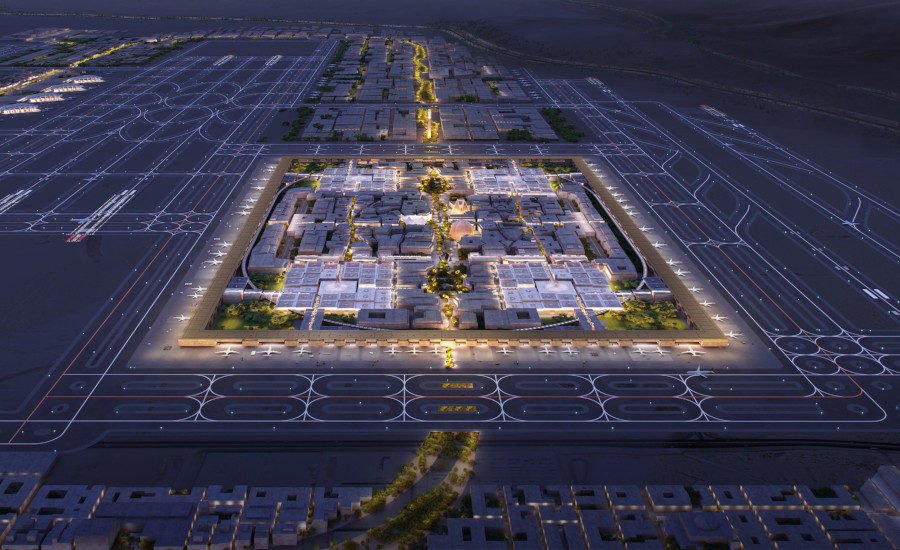

Four design firms, including US-based Jacobs, have signed strategic partnerships to develop Saudi Arabia’s planned mega-airport in Riyadh. King Salman International Airport Development Company (KSIADC) signed the agreements with Jacobs, Saudi Arabia-based Nera and UK-based firms Mace Group and Foster + Partners.
“We are delighted to welcome these industry leaders to work closely with the KSIA team,” Marco Mejia, acting CEO of KSIADC at the August 20 contract signing. “Their combined expertise will be critical to delivering a world-class airport that exceeds expectations and fuels regional economic prosperity.”
The expanded King Salman International Airport would cover 22 square miles and include six parallel runways. Saudi officials say the airport could handle 100 million passengers by 2030.
Foster + Partners and Jacobs will handle the infrastructure design of the estimated $7.2 billion project. Jacobs will provide concept master plan validation, detailed master plan design, runway design and other services. The two companies previously won a competition to design the conceptual master plan for the King Salman International Airport.
Mace Group is the delivery partner for the project and will focus on planning and construction schedules to enable the phased completion of one of the world’s largest airports. Nera will provide technical and operational solutions for aviation and air navigation.
Saudi Arabia’s Crown Prince Mohammed bin Salman announced the airport’s expansion plan by 2022 as part of the kingdom’s Saudi Vision 2030. The program aims to diversify Saudi Arabia away from its dependence on oil revenue. KSIADC is part of Saudi Arabia’s sovereign wealth fund, the Public Investment Fund (PIF).
The plan, unveiled in 2016, calls for making Saudi Arabia a regional logistics hub, in part by increasing air connectivity to 250 destinations and carrying 330 million passengers.
“This project supports the Kingdom of Saudi Arabia’s ambition to achieve the strategic goals of Vision 2030, showcasing the Kingdom to the world and diversifying the economy into new areas such as tourism,” said Keith Lawson, Vice President senior from Jacobs.
The design will prioritize low-carbon design and the use of renewable energy and technological innovation to provide more sustainable and efficient operations with the goal of achieving LEED Platinum certification, Jacobs says.
The project is one of two mega-airports under development in the Middle East. Earlier this year, Dubai announced a $35 billion plan to expand Al Maktoum International Airport over the next ten years. The new airport, also known as Dubai World Central, would replace the current Dubai International Airport, currently the world’s busiest for international traffic.
The project would expand the emirate’s second-largest airport to cover 27 square miles and include five parallel runways. The four terminals will house 400 gates that will allow the facility to handle up to 260 million passengers and more than 13 million tons of cargo per year.
