

✕

ENR August 30, 1962
Cover of ENR files)
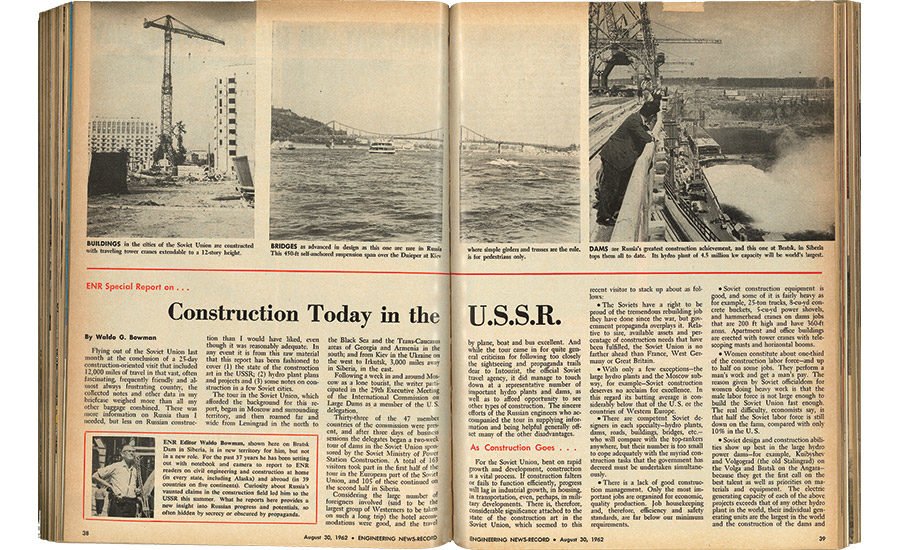
One of the most notable reporting trips by an ENR editor took place in 1962, when ENR Editor-in-Chief Waldo G. Bowman attended the 29th Executive Meeting of the International Commission on Large Dams , held in Moscow, as a member of the US delegation. .
After three days of commission sessions, delegates from 33 countries embarked on a two-week tour of the dams sponsored by the Soviet Ministry of Power Plant Construction. Bowman’s 18-page special report in the 30 August 1962 issue of ENR included a four-page assessment of Soviet construction practices, a 12-page article on dam projects, and a two-page article on work in progress in four major cities.
On the Dnieper River in Ukraine, the group visited the Kiev Hydroelectric Project, where a 950-foot-long spillway and a combined power plant structure were being built, along with a ship lock and complex of bomb storage. A notable feature was the project’s use of precast concrete units for 70% of the reinforced concrete placed above the foundations, many weighing up to 20 or 30 tons. The Soviets “adopted prefabrication because of a shortage of field construction workers and on the theory that the necessary labor could be more easily trained,” Bowman wrote.
Of the many dams on the Volga River, a notable one was the 2,543 MW Volgograd Power Station, the largest hydroelectric facility in the world, completed the previous year. Its water impoundment structures consisted of two miles of hydraulic fill embankment and one mile of concrete structures: a 2,100-foot-long powerhouse, a 2,400-foot-long spillway, and two lines of double chamber locks to lift vessels 85 feet. sand and internal sand erosion below the foundation slab, steel pile trims were installed along both the upstream and downstream edges of the foundation mat.
Half of the dam’s power output supplied industrial plants and shipyards, and much of the rest was sent 550 miles to Moscow on 500-kv AC transmission lines, significantly higher than the US maximum of 345 kv in that moment
competition
Bowman noted the Soviet capabilities in the numerous dams completed, underway or planned. He stated: “It is easy to recognize the competence of Soviet engineers in the field of low dams, large rivers and hydraulic power plants; also to understand the confidence they have in their abilities, as it derives from two decades of experience in this type of work”.
But I was puzzled by his similar reliance on high concrete or rock-fill dams, even though he had almost no experience with them. His group visited a canyon on the Inguri River in Georgia, where officials planned to build the world’s tallest dam, a 990-foot-tall concrete arch structure. At that time, only a short test tunnel had been excavated to examine the character of the foundation rock, a limestone. In addition, Soviet officials discussed the Nurek Dam in Tadzhik SSR, a proposed 980-foot-high earth and rock dam, the site of which was not on the tour. Inguri Dam was built episodically and was completed in 1979 at a lower height of 891 feet. Deficiencies in the construction process caused ongoing maintenance problems. The Nurek dam, also built in a halt and completed in 1980, has deficiencies in terms of seismic stability.
Impressed visitors
The group flew 3,000 miles to visit the Bratsk hydroelectric project in Siberia, which will become the largest hydroelectric plant in the world when it is completed in 1967, at 4,500 MW. A two-story steel construction trestle running the length of the 4,650-foot dam crest carried a road and rail line and was topped by six 22-ton hammerhead cranes with trolley hook arms 360 feet long. The project’s workforce peaked at 14,000 people, aided by 6,000 workers employed in factories that supplied supplies for the dam. Visitors were impressed with “techniques, materials, workmanship and equipment as good as could be found anywhere”.
Bowman’s overview found that the most distinctive feature of Soviet building practice was the extensive use of precast concrete. “Prefabrication is credited with making possible the rapid pace of the Soviet housing program, which reached 2.2 million non-agricultural units in 1960, about twice the U.S. total,” he wrote, while pointed out important limitations.
Another big difference was that women made up about a third of the construction workforce in the USSR, a stark contrast to the US, where in 1960 only 0.5% of craft construction workers were women . Soviet officials explained that there were not enough men available, as half of their workforce still worked on farms, compared to only 10% in the US at the time.
