

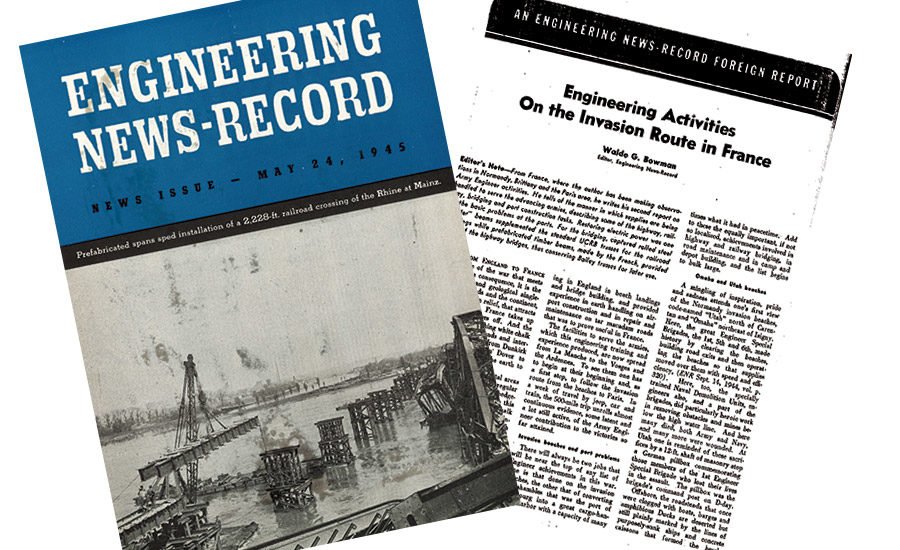
Excavators are first. This slogan crystallizes the role that engineering and construction played in World War II, where combatants were much more mobile than in previous conflicts. War plants were needed for the mass production of tanks, aircraft and weaponry. Shipyards and naval bases to support a two-ocean navy were vital. Before pilots could be trained, air bases had to be built. The phrase was also the title of a 1944 book that was a collection of reports by five ENR war correspondent editors, who traveled more than 100,000 miles around the world documenting the work of military engineers and units of American construction.
After the December 1941 attack on Pearl Harbor, Hawaii, the territory of Alaska was seen by the United States as vulnerable to Japanese attack. With no land connection, American military leaders quickly decided to build a road link between northern British Columbia and Fairbanks, Alaska. In March 1942, crews were cutting a primitive right-of-way. Spruce trees with shallow roots were knocked down by bulldozers. ENR editor Harold W. Richardson described crossing muskeg swamps by assembling corduroy mats from sticks and brush. Many streams and rivers were crossed by pontoon bridges until later temporary trestles could be lit. The permafrost in the Yukon was so unstable that it had to be covered with 4 feet of trees and brush before gravel was placed. Much of the machinery used was Civilian Conservation Corps equipment, with broken machines often dismantled to repair others. Working around the clock, 10,000 soldiers, a third of them black, living in tent camps were able to complete the 1,700-mile route in less than eight months.
After Japan captured two of the Aleutian Islands, Richardson reported on the hasty construction of airstrips on several other islands. To overcome the lack of local materials, the Corps of Engineers relied on a product recently developed by the US Army Corps of Engineers known as perforated planks. These steel sheets, ¼-in. thick, 16 inches. wide and 10 feet long, they were pierced with holes 3 inches in diameter and serrated with a series of grooves and hooks so that they could be interlocked to form a tight, smooth mat. On Adak Island, excavators scraped sand over a tidal marsh and drilled planks were laid. Four days after an amphibious landing, a 3,000-foot-long runway was operational.
Formation of the SeaBees
After Pearl Harbor, Japanese forces captured Guam and Wake Island, as well as the city of Cavite in the Philippines, making the construction of forward base facilities by civilian contractors untenable. “With every forward base a potential combat point, and every newly won beachhead a construction site, only naval personnel under military command could get the job done. So, for the first time in its long history, the Armada decided to “roll up” in the construction business. This is how the Navy Construction Battalions (Seabees) were founded. Its officers were almost all licensed engineers, with extensive experience in construction or public works, while the enlisted men brought craft skills.
Editor-in-Chief Waldo Bowman spent time at Camp Bradford in Virginia, where Seabees were assigned to 15 specialized classes, ranging from cabin building and firefighting to pontoons and dry docks, scrubbers of water and salt water evaporators, to welding and dynamiting. . He saw crews lifting and dismantling steel storage tanks and erecting Quonset huts. Editor Nathan A. Bowers toured the Pacific, reporting on Seabee activity at 29 bases. “On Guadalcanal, Tarawa and elsewhere, the construction battalions landed with the first waves of combat troops, began construction work while the fighting was in progress, and had misfired. [Japanese] airfields ready for service a few days after the attack on the bases began.” Eager to tackle other problems, they also repaired torpedoed ships, blasted ship channels, operated sawmills, and overhauled broken-down machinery of all kinds.
Making a virtue out of a necessity, the only surface material for airfoils available in the Pacific Islands was coral. Bowers described how the Seabees learned to judge the various qualities of coral, taking into account moisture conditions in order for it to compact and establish effectively. Well-constructed coral runways were found to require less maintenance and equipment than air strips composed of any other local material or even perforated planks.
The pontoons proved to be very versatile assets as American forces advanced across the Pacific. The thin steel plate was welded into 5ft x 7ft x 7ft box units that were floating. Joined together in various configurations they formed barges, drydocks, docks, bridges and even ferries or tugboats if equipped with outboard motors. Bowers described a wharf at Noumea, New Caledonia, consisting of pontoons chained together in cells eight wide and 62 long, which at 40 feet wide and 434 feet long allowed larger ships to be unloaded. These assemblies were valuable in places where piles and pilings were not available for the construction of traditional docks and piers. The pontoon dock at Noumea was built in four weeks by 24 Seabees working during 12 hours of daylight each day, as no lights were allowed at night.
Bowman also reported on construction work in Britain, which served as a staging area for 1.5 million US troops preparing for deployment to North Africa and France. American military engineers built dozens of airfields in Britain from which American bombers flew missions over Germany. They also built hundreds of barracks, an artillery base, oil depots, and an anti-tank field containing “three miles of padded railroad tracks on which the targets moved.”
With most of the ground fighting on the Eastern Front and much of Russia’s industrial base destroyed, the Allies pledged to supply large quantities of vehicles and weapons to their Soviet ally. The main route they devised was the Persian supply corridor. American engineers set to work in 1942 to improve the 800-mile limited railway running north from the small port of Bandar Shahpur on the Persian Gulf to Bandar Shah on the Caspian Sea, supplementing steam locomotives with diesel The rail line and accompanying highway traversed rugged desert terrain and mountain passes more than 7,000 feet above sea level. Crews erected a GM truck plant and a Douglas Aircraft assembly plant. Bowman spent two weeks there, reporting on how the workforce had to deal with sandstorms, floods, bottomless mud and malaria. Freight trains and long truck convoys carried equipment such as Studebaker US6 trucks and canned food north, making up 45% of all US Lend-Lease aid to the Soviet Union.
One piece of equipment that proved invaluable to the Allies and has since been widely used worldwide was the Bailey bridge. Invented by Donald Bailey, a British civil servant, in 1940, it first saw service in the North African campaign in 1942. A portable prefabricated truss bridge, each of its sections 10 feet long and 5 feet tall consisted of 17 parts. Each 570-pound cross-rectangular unit could be carried by four soldiers and required no special tools or heavy equipment to assemble. The modular units could be connected together to form lights over 200 feet and were strong enough to support tanks. They allowed units to advance across rivers or ravines in areas where crossings had been destroyed by retreating enemy forces.
First line engineering
After the successful invasion of Normandy in June 1944, made possible by the artificial “Mulberry” harbors, US Army engineer units set about rebuilding the port of Cherbourg, which had been destroyed and exploited by the retreating Germans. Millions of man-hours were spent clearing debris, building 5 miles of new docks, and paving hundreds of thousands of square meters of beach for use by landing craft and amphibious trucks. The rebuilt port had 25 times the cargo handling capacity of the pre-war port. Three other army engineer regiments rebuilt more devastated French ports.
As Allied forces advanced through France and Belgium in late 1944, the engineers’ primary task was to rehabilitate 7,000 miles of railroad to move supplies. Hundreds of railway bridges destroyed by the Germans were restored to service using three types of prefabricated bridges developed by the British: the UCRB, a parallel rope span, Pratt type; LST and HST, light steel and heavy steel trestles; and RSJ, laminated steel crossbars. A notable effort was the restoration of a 75-mile section of track that involved 6,000 workers repairing seven bridges, three rail yards and building new water tanks in 48 hours, allowing supplies to reach the Third Army of General George S. Patton.
A dramatic episode late in the war involved the railroad bridge over the Rhine at Remagen, Germany, a triple-span tied arch with spans of 278 feet, 513 feet, and 278 feet. As an American armored division approached, he learned of a German prisoner. that the Germans had planted explosives on the bridge and were minutes away from detonation. American artillery, grenade and rifle fire killed the Germans stationed on the bridge, but one of the planted charges exploded, seriously damaging a shoe in the armor upstream. Some tanks and troops crossed over, establishing the first beachhead east of the Rhine. Tens of men went to work repairing the bridge as quickly as possible, replacing deck beams, welding, cutting and hammering for ten days. German artillery less than a mile away continued to target the bridge, killing a number of soldiers and causing additional damage. On March 17, 1945, just ten hours before a critical splice was due to take place, the bridge collapsed, claiming the lives of a further 28 Allied soldiers. Bowman himself had spent that morning on the bridge, two hours before it collapsed, and published a detailed article with photos and sketches.
More than 700,000 American soldiers and sailors served in engineering units during World War II; 325,000 were Seabees and the rest with the Army.
