

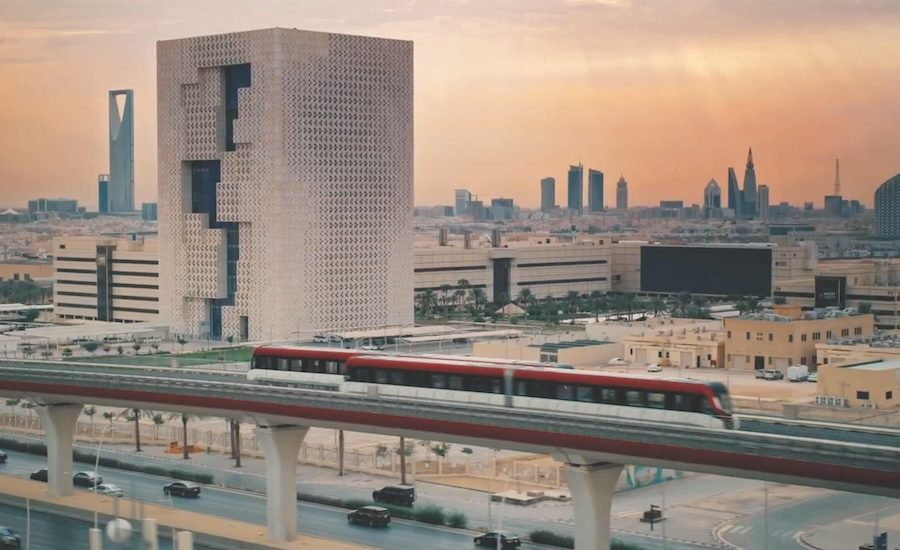

After a decade of construction, the six lines of a new 176-kilometer, 85-station Riyadh metro rail system have opened, with the final line being launched on January 5. Three consortia made up of 19 companies from 13 countries, including the US, France, Spain, Germany, Japan, South Korea, Canada and the UK built the $25 billion electrified system, providing the city with public transport for first time
The blue, yellow and purple lines opened on Dec. 1, followed by the red and green lines two weeks later and the orange line this month, according to a press release from the Royal Commission for the City of Riyadh. The system has a capacity for 3.6 million riders.
“It is the world’s largest subway project to be built in a single phase, and the first to conceive, design and build six fully integrated lines simultaneously,” Brendan Bechtel, Bechtel’s chairman and CEO, said in a blog post of the company Bechtel was a member of the BACS consortium that includes Almabani General Contractors and Consolidated Contractors Co., which built the Blue and Red lines. “All of this took place in the dense urban core of Riyadh, which had to remain open to traffic and fully functional for millions of residents,” Bechtel added.
The two lines entailed the construction of 25 km of viaduct and 19 km of level track, according to Michelle de Franca, director of the BACS project. Line 1 has approximately 17 km of bored tunnel and Line 2 has approximately 3 km of tunnels constructed using the Austrian New Tunnel Method and cut and cover. The biggest challenge was managing groundwater, as there were extensive underground aquifers, he says.
Bechtel noted on its blog that the design team produced more than 98,000 drawings and 100 mockups. “The doors in the system alone required more than 10,000 unique designs, with custom signage and specifications,” he said. “Operators received more than 120,000 drawings and as-built documentation from tens of thousands of laboratory tests, verifying compliance with nearly 700 material criteria.”
In addition, de Franca says that “we have more than 10,000 doors made of various materials such as steel, glass, wood, steel mesh and aluminum grids. These doors come in different types, including swing doors, sliding doors, revolving doors, roll-up doors, and louvered doors. Each door has 15 or more properties that set it apart from the others.
An international competition led to station designs by Zaha Hadid Architects, Snøhetta, Gerber Architekten and Omrania. Zaha Hadid’s design for the 42,000 square meter King Abdullah Financial District station features an iconic lattice design inspired by the sand dunes. The five levels of the atrium are supported without columns, using cantilever trusses and bracing to create an open and fluid interior space, notes de Franca. Crews placed more than 3,000 curved ultra-high-performance concrete panels on the exterior facade.
The city’s goal is to increase the share of public transport trips in the city from just over 2% to 18% by 2030.
