


The US civil construction world continues, to varying degrees, a broad shift from transactional to relational forms of procurement, with proponents citing examples of how integrated project delivery (IPD) and alliance saved projects
Although collaborative project delivery has been around for more than two decades, “we have muscle memory to overcome” in adopting it, said Mike Tracey, vice president of infrastructure markets and strategy at Kiewit. Speaking at a Transport Research Council session this month, he added that the delivery of collaborative projects “is completely different from what has been done for 100 years” but that “we are finally making progress”.
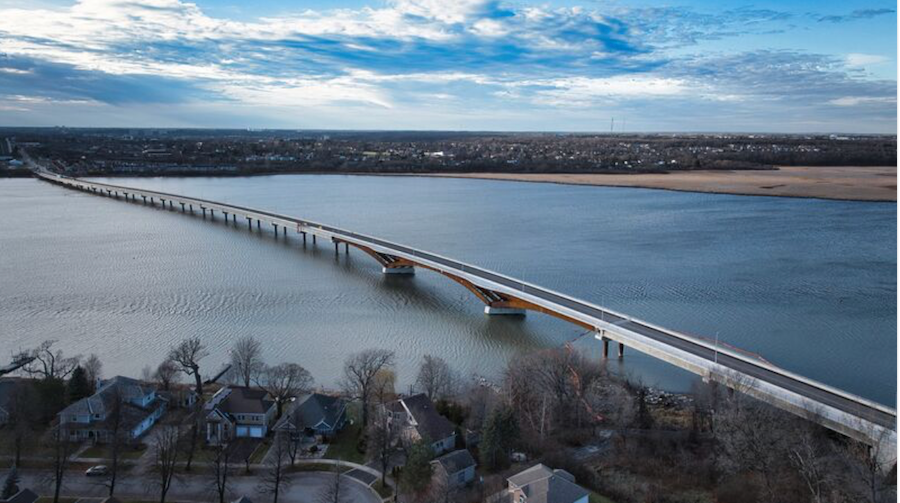
A $180 million, 4,000-foot precast girder bridge project in Kingston, Ont., would have been scrapped in 2018 when U.S. steel tariffs caused costs to skyrocket, he said. But the alliance method and a collective investment in the success of the Waaban Crossing project allowed the team to pivot to a concrete alternative, with the steel supplier voluntarily withdrawing from the profit pool and risk, he noted.
The alliance means “designing the job to the right level of risk and contingency, not just the 30% design” before going out to bid, he noted. “Leave your business cards, titles and egos at the door,” he said of the process. “It’s about committing to overcommunication.”
Mike Dubreuil, managing partner of PTAG, noted that IPD saved an $800 million phase of Canada’s Keystone pipeline project that was expected to finish a year later. “We talk to each other, criticize safely and share ideas,” he said. The project arrived two weeks late. He said that of the 324 industrial projects using IPD, largely in Australia and the North Sea, only one was deemed a failure.
The emergence of design, build and construction manager/general contractor multi-phase progressive project delivery methods has gone a long way to addressing the often contentious allocation and sharing of risks, particularly in large and complex projects, but past experiences and a currently busy market. have made contractors more cautious and selective about participating, WSP USA Senior Vice President Kenneth Beehler observed in another TRB session. “Because these companies have less appetite for fixed price and global price projects, you [want to find] ways to encourage them to participate and reduce risk. The opportunity to add certainty to prices makes them more conducive to collaboration.
But the success of the approaches depends heavily on the agencies and contractors involved. John Carlson, vice president and strategic director of transportation business at Sundt Construction, says mutual trust is the most important element of the processes and sometimes their biggest challenge.
“It affects speed and cost, but it also requires a change in culture and training,” he says.
In an academic study conducted by researchers from South Dakota State University, the University of Kansas, Colorado State University and Iowa State University, 42 state transportation departments responded to a survey, and 18 responded that , to some extent, had been evaluating the performance of alternative procurement. methods, said Christopher Harper, associate professor at Colorado State University. The Federal Highway Administration’s Procurement Alternatives Adequacy Evaluator (CASE) web tool is “starting to grow,” he added.
But he noted that only California responded that it was comparing design-bid-bid with alternative project delivery, and that only 22 percent of contractors participated in post-project evaluations.
