


After two decades, the Port of Long Beach (POLB) continues to move forward with its environmental efforts. At the Jan. 16 “2025 State of the Port” event, the port’s general manager, Mario Cordero, talked about how it is not only meeting environmental milestones, but also meeting operational and commercial goals and “setting our sights on successes even bigger in the coming years.” ”
Speaking to more than 900 industry partners, community members and civic leaders at the Long Beach Convention Center, Cordero spoke of POLB’s record 2024, with 9.6 million cargo containers moved without disruptions or delays, and said he is making progress in the transition. operations at zero emissions while marking air quality and spectacular environmental improvements.
The port’s green journey began in 2005 when the Port of Long Beach Commission adopted the Green Port Policy, a commitment to reduce the harmful impacts of port operations and safeguard the health of people and wildlife of the surrounding communities.
Cordero said the Green Port Policy has resulted in a cleaner port, industry-leading green building practices and, most importantly, air quality improvements as a result of reduced emissions. So far, he says diesel emissions have dropped 92%, nitrogen oxides 71%, sulfur oxides 98% and greenhouse gases 17% since 2005. He says the port will continue to fight for emissions-free operations.
“For those who in 2005 questioned our environmental determination, the data shows otherwise,” he said. “For those who said that a Green Port could not compete commercially, the facts prove otherwise. And today, for those who still doubt us, we’re proving you wrong every day.”
Cordero said the POLB continues to build on its green policy through flagship projects such as the installation of rail support at Pier B, to that construction began last year. The project will improve freight movement while improving air quality and vehicular traffic in Southern California.
In addition, Toyota Motor North America and FuelCell Energy partnered with the Port to open the first-of-its-kind “Tri-gen” system to generate renewable hydrogen, electricity and water to support Toyota’s operations in Long Beach.
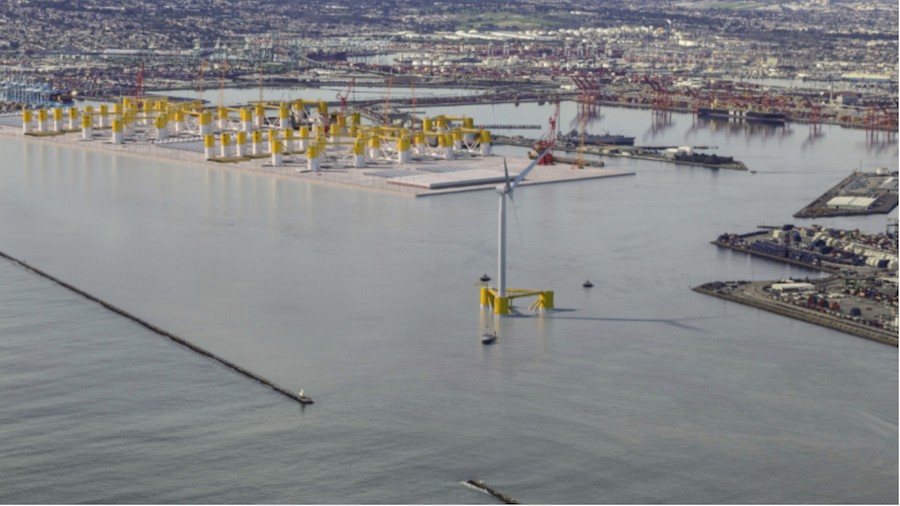
Cordero also discussed Pier Wind, a proposed 400-acre terminal to mount massive 1,100-foot-tall floating wind turbines that would be towed 20 to 30 miles off the coast of Central and Northern California. Currently under environmental review, the project is designed to help California meet its clean energy goals; according to a recent preliminary economic impact report, it could generate $8 billion in job income, $14.5 billion in economic output and $1.3 billion in state and local taxes by 2045. Construction of this project could to begin in 2026 and would be the largest facility at any US seaport specifically designed to accommodate the assembly of offshore wind turbines.
During the event, representatives from the California State Land Commission and the Ports of Long Beach and Humboldt ceremonially signed a memorandum of understanding, securing an agreement to collaborate on critical port infrastructure improvements needed to support offshore wind projects across the state.
The port handles $200 billion in trade annually and supports 2.6 million jobs nationwide, more than 575,000 in Southern California and more than 50,000 jobs, or 1 in 5, in Long Beach. The port is also one of the few ports in the United States that can handle today’s largest ships, serving 175 shipping lines with connections to 217 seaports around the world.
