

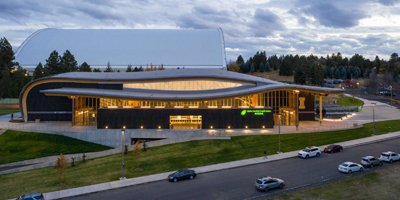
The Idaho Central Credit Union Arena at the University of Idaho (U of I) features a specially designed double-curved roof in a long-span format made of solid wood. The engineering team behind the project worked to develop, shape and optimize the curved roof, ensuring its feasibility for manufacturing and construction.
This painstaking process not only enhanced the architectural vision, but also addressed the various limitations and challenges associated with a double-curved structure spanning 5,760m.2 (62,000 square meters). The architect, Opsis Architecture, envisioned the roof shape to be inspired by the rolling, mountainous landscape of the Palouse region, which spans parts of northern Idaho, southeastern Washington state, and some areas of northeastern Oregon.
The use of wood in a double-curved roof and a structure composed of hybrid wood/steel trusses, spanning 150 feet (45.7 m), brought its own set of challenges. To overcome these challenges, the consultant’s engineering team, KPFF Consulting Engineers, and the structural engineer and construction engineer, StructureCraft, worked together with the architect to find a suitable solution. The solid wood featured in this project includes long span roof trusses, glulam columns, and cross and stud laminate floors.
In the arena, carefully designed, meticulously proportioned 3D wood/steel trusses extend across the roof to meet a distinctive wooden proscenium arch that gracefully demarcates the arena’s intimate space. Constructed of locally sourced lumber, this newly constructed structure has quickly transformed into a beloved exhibition space, showcasing the pride of the university and Idaho’s important forestry industry.
The project used primarily locally sourced Glulam, with curved Glulam members produced by two different manufacturers based in Idaho. This posed a significant challenge, as these manufacturers had not previously worked with the precise tolerances required for a project of this magnitude. However, according to StructureCraft, the structural 3D model produced by their team successfully generated all the geometry and shop drawings needed to produce the unique curved shapes of Glulam.
To achieve this, the engineer’s shop team leveraged their in-house computer numerical control (CNC) capabilities and used design optimization techniques to precisely cut the desired shapes from the levers actual curves received from Idaho manufacturers. In addition, the team meticulously performed a “fit test” of each major assembly inside the shop to ensure proper fit before sending the components to the build site.
To minimize work at height, the entire portal frame was meticulously pre-assembled on site in three components, each weighing more than 22,679 kg (50,000 lbs).
The kingpost trusses presented a significant challenge during installation due to their weight and the need for a crane inside the bowl. To overcome this obstacle, a parametric model of the trusses was developed using genetic algorithms. This allowed for structural optimization while adhering to various aesthetic goals. As a result, the trusses achieved improved structural efficiency, significantly reducing the weights of the prefabricated elements. This approach not only kept the project on budget, but also ensured its successful completion.
