

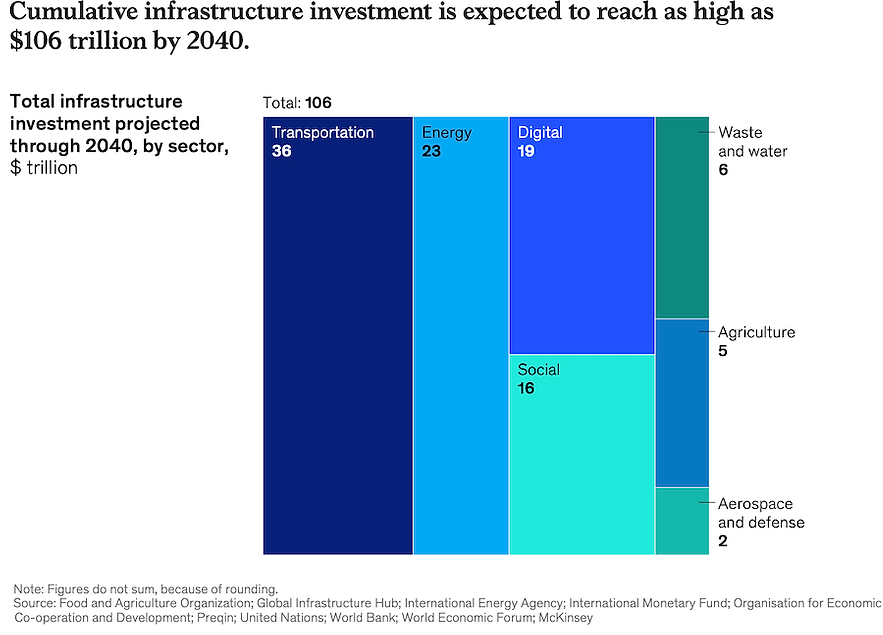

The growth of populations, data centers, IA, electrification, energy transition and urbanization is shaping an investment opportunity of infrastructure of $ 106 million estimated to 2040, which will involve more and more private investors, according to researchers from MCKINSEY and CO.
Highlights are the convergence and intersection of various sectors of infrastructure such as water, digital, energy and transport and supply of new business models in a new report published on September 9.
“The definition of infrastructure is changing,” said Alastair Green, a senior partner of McKinsey, at the infrastructure summit he hosted in Los Angeles from 9 to 11 September. He said that the definition of infrastructure now includes 100 more types, which is under seven large verticals: transport, water/wastewater, energy, digital, agricultural, social and aerospace/defense with a relatively new. 30%.
Energy transition is one of the main engines of the need for investment, and countries that seek to achieve various sustainability goals until 2030 and beyond. In the United Kingdom, there is an investment of 12 billion pounds in sustainable energy projects, but “ we need an investment of 40 million pounds, said that Fintan Slye, CEO of his Electrical Systems Operator in Britain, National Energy System. Steve Powell, President and CEO of South California Edison, echoed the more investment, which requires more investment, $ 75 million only for transmission and investment line projects in distribution systems.
“We are behind for almost any measure” to try to achieve sustainability goals, said Gene Gebolys, CEO of World Energy, a global biofuels company. But he expressed optimism that large corporations would not give up these goals. “They can reposition -but most care about their brand, personal values and mission,” he said.
Experts agreed that the license and permission process for infrastructure projects should be rationalized, and Powell said that a transmission project could take up to 20 years despite the real construction that only takes advantage of it.
Geopolitical uncertainty is another factor that involves challenges. The pandemic, the global war and the current North -American administration have contributed to “a reversal of foundations that we used to be, such as free trade,” said Christopher Frost, CEO of Macquarie Asset Management. For three decades so far, “the relatively benign interest environment, the international rule -based order and the belief that infrastructure is essential for economic growth provided a constructive environment for this class of assets,” he said.
Jonathan Elkind, a leading advisor to Westexec Advisors and ex -Deputy Secretary of North -American Energy of International Affairs, also said “the uncertainty about the legal structures that were previously thought to be out of the matter.” He warned that “poorly considered change can be dangerous and creepy for investment.”
However, investment in infrastructure is still a class of “low -risk, low return,” said Frost. Luba Nikulina, responsible for Investor IFM strategy, said that its recently published report states that the infrastructure is still a “interesting trajectory” with the expectations of investors in investment in investability augmented in a year.
The interest of the private sector is vital to meet the needs of infrastructure. “We are desperate for the diversification of funding,” said Jamie Torres-Pringer, President of the Construction and Development Unit of the Metropolitan Transport Authority in New York City. He said that the Agency is interested in possible public-private collaborations for projects such as the planned redevelopment of an old goods line in a traffic line that connects Brooklyn and Queens, adding “we have moved a lot to design creation and encouraging schedules” for contractors.
Shailen Bhatt, Senior Vice President and Operational Director of the United States, Latin America and Minerals and Metals Business of Atkinsrealis and former Head of the Federal Road Administration, suggested that private sector companies could even join public agencies on projects. “It takes politics out of the infrastructure and solves the contracting process” to implement new technologies, “he added.
Private partners such as the Dominion Energy Utility Company work with public entities in Virginia and South Carolina, said Carlos Brown, executive vice president of Dominion. “The developer must be open … what is the ultimate goal? What are non -negotiable?” Then do not be restricted by traditional models, he said.
“This is not the solution; this is the purpose” of the Infrastructure Project, said Nick Harris, CEO of the National Roads of the United Kingdom, which plans to start the construction of the 14.5 lowest tunnels pair of the lowest Thames. He said that a reflective purpose of a project to attend to the community through economic development, environment, inclusion or other positive goals can help a project to survive political cycles in constant transformation.
In Australia, while the focus shifts from the Megaproject of Transport to Energy Transition projects, “projects will have to mark many boxes,” said Adam Copp, Director General of Australia Infrastructure. Encounter the subject of the interconnections of the MCKINSE report between the infrastructure, he said that, regardless of the main emphasis of a project, he will have to address other issues such as housing, manufacturing, decarbonization and knowledge sharing.
Brown coincided: In the coming years, “a lot of dirt will fly … [and projects] It will be more inclusive than ever. “
