

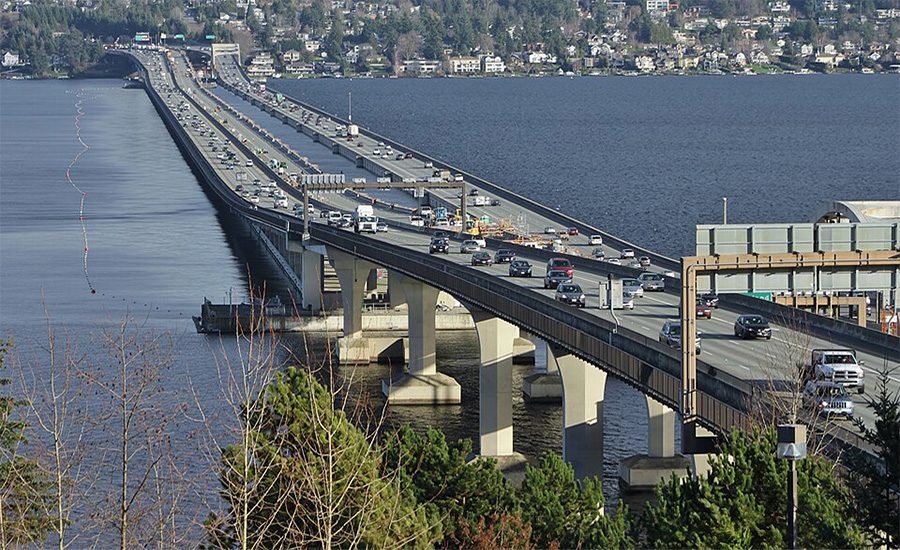

Washington transportation officials are sounding the alarm about the state’s growing maintenance backlog.
During the Oct. 14-15 meeting of the Washington State Transportation Commission, the Washington State Department of Transportation said it needs about $8 billion over the next decade to preserve its highway, bridge and ferry assets, a figure officials admit is far beyond current funding levels.
The agency’s estimate, first described in WSDOT’s 2021-2023 preservation budget request, reflects a 10-year backlog of deterioration of pavements, bridge decks and marine structures.
At the hearing, WSDOT Chief of Asset Management Troy Suing warned that “we are in the early stages of a critical failure due to lack of funding … we are underfunded. We are forced to be reactive when we look at our assets right now.”
This urgency has revived the debate among lawmakers who just months ago approved a new two-year transportation budget.
RELATED
Harsh realities of infrastructure maintenance: It won’t be new for long
State Sen. Marko Liias (D-Edmonds), chairman of the Senate Transportation Committee, said the state can finish projects and preserve infrastructure “only if our budget includes new revenue.”
State Rep. Jake Fey (D-Tacoma), who chairs the House Transportation Committee, added that lawmakers are “taking the necessary steps to pay [investments] and protect them in the long term.”
WSDOT’s 2025-27 Capital Preservation and Improvement Program, released last October, lists preservation and safety as “critical unfunded priorities.”
The agency’s 2024 Gray Book shows highway maintenance performance falling to 2.03 out of 4, the lowest in more than a decade, and estimates an operating deficit of $442 million over 10 years just to maintain current service.
State Sen. Curtis King (R-Yakima), ranking member of the Senate Transportation Committee, said both parties recognize stress points in the system. “Washington faces serious transportation problems, from unsafe roads to a failing ferry system,” he said.
The voltage is visible on the ground. WSDOT this month began six weekends of lane closures on Seattle’s I-5 Ship Channel Bridge to replace worn expansion joints, and crews reopened the White River Bridge at SR 410 on Oct. 16 after emergency repairs ended weeks ahead of schedule.
RELATED
Northwest transit agencies seek connectivity between modes and partners
“We made a commitment to reopen this bridge as soon as possible,” Gov. Bob Ferguson said in announcing the early completion. “People just want government to work. Together we can move fast and solve big problems.”
The state’s Joint Legislative Audit and Review Committee has pressed WSDOT to clarify preservation forecasting methods after a 2023 audit cited inconsistent assumptions about the bridge’s life.
Lawmakers are expected to revise the transportation allocations when the 2026 session opens in January, and WSDOT plans to update its 10-year statement of needs before the end of the year to reflect 2024 condition data and inflation adjustments.
Washington’s challenge reflects a national trend as state DOTs grapple with rising maintenance costs following increased federal infrastructure spending. For WSDOT, the calculation is immediate. As Suing said:
“When we don’t preserve the system, it affects everybody … there’s no short-term fix when it comes to bridges.”
