

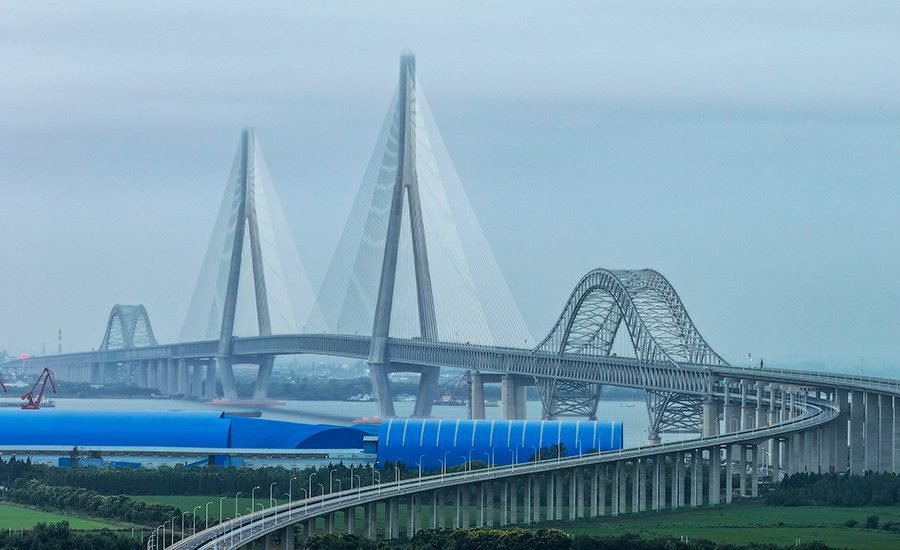

The recently opened Chantai Yangtze River Bridge in China, with a length of 1,208 m, guarantees it the title of the longest cable-stayed bridge in the world, came with its share of engineering challenges.
“It has set three world records: the largest cable-stayed bridge, the largest highway and railway dual-purpose steel truss arch bridge, and the largest continuous span steel truss bridge.” contractor China Railway Group Ltd. he said in a statement.
Explaining the size of the 10.3 km long bridge over the wide Yangtze River, Chinese media compare it to building a bridge over the Mississippi River. The bridge, that open to the public on September 11 it reduces the travel time between the cities of Changzhou and Taizhou from one hour to 20 minutes.
Record-breaking bridges over the Yangtze have been an important part of China’s infrastructure construction in recent decades. Six of the ten longest cable-stayed bridges in the world are over the Yangtze and were built in the last 20 years.
Unusual asymmetric design
The lower deck of the bridge includes a regular railway line, a metro line and a regular road in one structure.
The bridge designers chose not to follow a standard design of having the rail alignment along the center of the bridge between the road lanes. Since the railroad ties weigh up to three times as much as the roadway, having it off-center caused some problems. Uneven loading of the support cables was identified as a problem. A team led by China Railway Group Chief Scientist Qin Shunquan had to adjust cable tensions on the rail side of the bridge in order to keep the deck level.
But this solution to the cables in turn changed the structure itself, misaligning its centerline. That problem was solved by calibrating the shape of each prefabricated bridge segment during production, allowing the deck to straighten naturally once assembled, official sources said.
“We split the problem into two parts and solved them separately. That’s how we overcame the challenge of building the world’s first large-span asymmetric bridge.” Qin Shunquan, Chief Scientist of China Railway Group, he told state broadcaster CCTV.
The decision not to place the rail alignment in the middle of the bridge with each direction of traffic on either side was motivated by other concerns, Qin says. “This setup creates big inconveniences,” because when the lanes are split emergency vehicles can’t easily turn around to get to an accident, he explained.
The mighty Yangtze
Strong water currents in the Yangtze River also posed a challenge. “The foundation of the bridge has been strengthened to be able to withstand the river currents,” said Li Zhen, head of the on-site project at the Jiangsu Department of Transportation.
two 350 m high, Diamond-shaped steel and reinforced concrete towers support the cables. The project team used what it calls the world’s first smart tower crane for precise placements. With a lifting capacity of more than 10,000 metric tons, the deck crane is equipped with millimeter precision in the placement of ultra-heavy segments.
There were other smart machines on site as well. “During the operations, the team employed the latest intelligent robots for the first time. These robots could navigate complex underwater terrain and clean sand from the corners of the caisson,” Li Zhen said.
The teams installed 80 permanent sensors to track structural changes at the micrometer level during multimodal traffic. The bridge is designed to withstand natural disasters such as earthquakes and typhoons, ensuring its safety and reliability under extreme conditions, official sources said.
It also incorporates intelligent monitoring systems to provide real-time data, enabling proactive maintenance and ensuring long-term safety.
“By introducing large-scale automated production equipment groups, 3D laser scanning inspection systems, intelligent manufacturing processes and micro-innovations, we successfully overcame the high-standard quality control challenges of large bridges.” said Ma Zenggang, project manager of China Railway Baoji Bridge Group, another member of the project team.
