

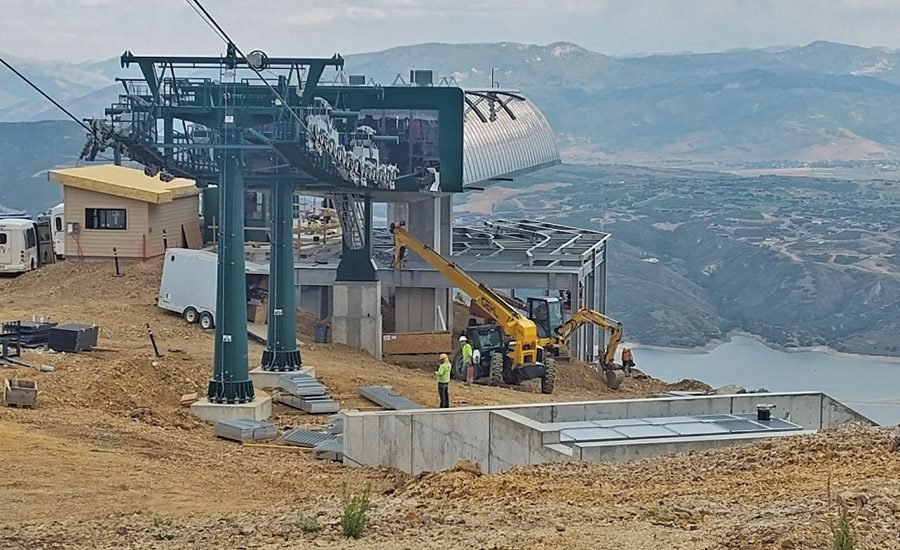
As soon as the last skier left Utah’s Deer Valley Resort at the end of the season, construction crews moved in to begin work on what resort officials are calling the largest current expansion of a ski resort in North America. Under a plan marketed by the resort as Expanded Excellence, work that began in 2024 got underway this summer as Deer Valley executes plans that will double its skiable area to 5,726 from the current 2,026 over the next two years.
Deer Valley’s parent company, Colorado-based Alterra, has said the project is the largest they have undertaken in a season.
The expansion is taking place to the east of the existing complex in an area known locally as the Mayflower property, named for the silver mine that once operated there. The expansion has been part of the resort’s long-term vision, says Garrett Lang, Deer Valley’s senior director of mountain operations. That vision only became a reality when Alterra purchased the complex in 2017. Alterra signed an agreement with New York-based Extell Development to develop and operate new facilities at the complex. Extell has the long-term leases on the land and is developing the facility on the mountain with Deer Valley. Daily operations of various facilities will be split between Deer Valley and Extell.
As part of Alterra, Deer Valley joins nearly a dozen other North American resorts owned by the company, which offers access to all of its properties through its IKON Pass.

A heavy-lift, tandem-rotor helicopter moves a lift tower into place for one of seven new ski lifts being installed on the mountain. Crews also used the helicopters to place concrete in difficult locations.
Photo courtesy Deer Valley Resort
Lots of time to come and more to come
With many entities involved in the expansion and sharing costs for different parts of the work, it is difficult to determine a publicly available budget number for Deer Valley East Village. Estimates in 2020 put the price at around $2 billion. In June of this year, Extell secured a $600 million loan for the construction of a new Four Seasons Resort and Residences in the East Village. In September of this year, Alterra announced $400 million in capital investments, most of which would go toward the Deer Valley project.
The Deer Valley East Village expansion includes a partnership with the Military Installation Development Authority, an entity established by the state of Utah that works with the U.S. military, private businesses and local governments to facilitate the development of military property in the state and to promote economic growth. The MIDA had significant amounts of property on the east side of Deer Valley. In partnership with MIDA, Extell developed the new Grand Hyatt Deer Valley hotel, which offers discounted rates to members of the military. MIDA also issued just over $600 million in bonds to facilitate infrastructure development in the Deer Valley East Village project.

New lodges will soon be erected near the base station of the East Village Gondola. The system has gondola cabins with heated seats for 10 passengers and can move up to 3,000 people per hour at 1,400 feet per minute.
Photo courtesy Deer Valley Resort
Digging and standing
The hills have been alive with the sound of digging, scraping and blasting to create foundations for new buildings and piping for the extensive snowmaking system, while aerial helicopters buzzed as they delivered concrete and placed towers for the seven new lifts being installed.
Lang estimates that on an average day between 200 and 230 workers have been on site, with peak days reaching 270.
The installation of the snow system and seven of the project’s 10 new lifts was the main focus of the works in the summer. Water for the snowmaking system is drawn from the nearby Jordanelle Reservoir, located across from the site on the east side of US Interstate 40.
“Probably 95 percent of the land is in Wasatch County, and then the rest is in Summit County. We’ve been fighting redlines and potential stop-work orders all summer. We’ve had to keep going as the permits come in and it’s been working.”
—Matt Tuttle, Senior Superintendent of Vertical Construction, Deer Valley
Crews have installed 80 miles of pipe for the system, which includes four pump houses and several reservoirs. The system can move up to 15,000 gallons of water per minute along with 32,000 cubic feet of compressed air to the 1,250 snowmaking guns that travel across the 81 new ski slopes.
Lang says dealing with ground conditions and the ever-evolving permitting process were the biggest challenges for the project this summer.
“We had to fly more than I would say was planned,” he says. “There are inevitably delays in the permitting process, and we just have to work with schedule changes. Despite the challenges, the project has not experienced any major delays.”
Coordinating so many different projects during a short construction season and all at once has also been tricky, Lang said. “The biggest part of doing it this season is the logistics … making sure that something the lift installer does doesn’t prevent the snowmaking installer from continuing. [and so forth] so there’s no domino effect that slows down the progress of the hostel or whatever,” he says.
Matt Tuttle, senior superintendent of vertical construction with Deer Valley, says an added layer of complexity has been that the project area is in two counties, each with its own approval and permitting process.

Crews from Salt Lake City-based Big-D Signature prepare to pour concrete for a lift tower base.
Photo courtesy Deer Valley Resort
“Probably 95 percent of the land is in Wasatch County, and then the rest is in Summit County. We’ve been fighting redlines and potential stop-work orders all summer. We’ve had to keep going as if the permits were coming in, and it’s been working,” he says.
Vernal, Utah-based welding company DC Welding installed the snowmaking piping. The elevator system is supplied by Austria-based Doppelmayr, which has its North American headquarters in Salt Lake City.
Salt Lake City-based Big-D Signature was responsible for pouring the concrete bases for the elevators. “We’ve been working on the elevators since 2024,” says Cody Dusenberry, project manager for Big-D Signature. “We’ve been able to get dump trucks on the mountain and mixers, but sometimes the location of the tower means we have to use helicopters for dumping. It’s more expensive, but it buys us time.”
Shawn Marquardt is Doppelmayr USA’s senior director of sales, and says the company partnered with Alterra to design the lift system and perform the work of placing lift towers and installing the lift equipment.
“We have manufactured most of the towers, electrical controls, operator houses and fixed grip chairlift machinery at our Salt Lake City facility,” says Marquardt. Other equipment, such as gondola cabins and chairs, came from facilities in Canada and Switzerland.
“I’m happy to say that there were no outstanding or excessive concerns with materials or delivery,” says Marquardt. “We have a thoughtful production strategy with locations around the world to ensure the equipment will be delivered on time.”
Two of the six-seater chairlifts with a “bubble” enclosure and the 10-passenger gondola, both with heated seats, are firsts for a Utah resort, he adds.
“The aesthetics and finishes were specified to fit Deer Valley’s unique heritage,” says Marquardt, referring to the use of Deer Valley’s signature green and gold color schemes.

Working with a helicopter, the team from Austrian ski lift manufacturer Doppelmayr prepares to secure the top of another of the seven new ski lifts erected this summer.
Photo courtesy Deer Valley Resort
Park Peak Lodge takes shape
One of the most important elevators for the project is the East Village Gondola, which departs from a plaza that will host housing in later phases. The lift reaches a mid-mountain point at 8,170 feet where skiers can exit or continue to Park Peak Lodge at 9,100 feet.
At just over 80,000 square feet, Park Peak Lodge, designed by Salt Lake City-based GSBS Architects and built by Big-D Signature, is under construction now and won’t open until next year. Includes basement storage space for 144 of the gondola cabins.
According to Tang Yang, GSBS lead architect for the Park Peak Lodge, the design aimed to incorporate familiar Deer Valley design elements with updated touches that emphasize the expansive views from the summit.
“What makes the lodge distinctive is how it overlays this familiar mountain comfort with new layers of drama. The architecture intentionally frames view corridors, maximizes openness, and uses contemporary engineering and construction techniques to elevate the guest experience beyond the traditional lodge,” says Tang.
“As the core and connector between Silver Lake and the new East Village, the lodge required a unique solution that balanced function and identity. The expansive views and sensitivity to the natural mountain ranges give the project its distinctive quality,” he adds.
Dusenberry notes that the short construction season prompted the contractor to use precast concrete panels for the foundation, and the team was able to pour footings for the structural steel last year. The steel was delivered and erected over the summer, and crews are now racing to prepare for winter.
“Access to the site was a challenge. Getting the cranes up there and the six-wheel trucks delivering materials was difficult. There’s more planning than usual in this, and we have to coordinate with a lot of crews,” says Dusenberry.
“With the structural steel for the lodge, we want to work during the ski season. We want to put the roof up before December,” he says.
