

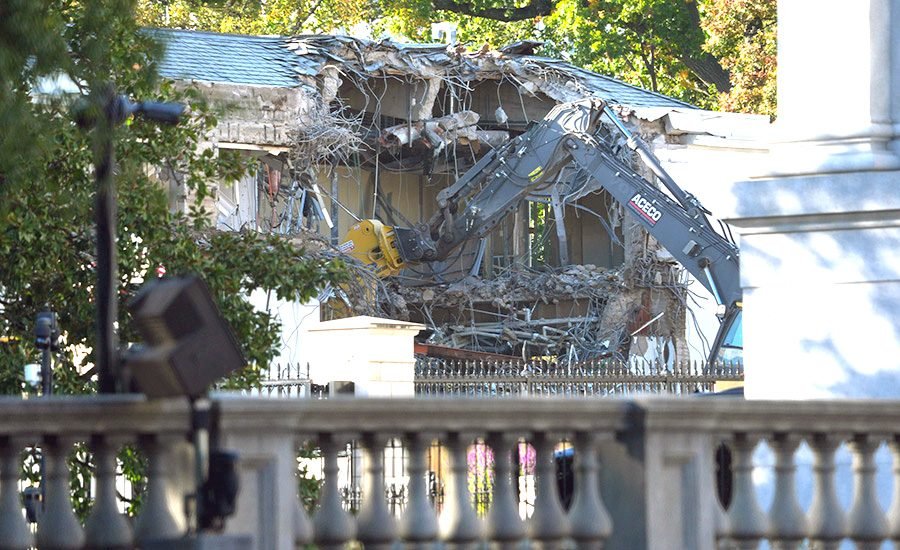
Demolition crews began work on Oct. 20 in the East Wing of the White House to clear space for a privately financed 90,000-square-foot ballroom valued at approximately $200 million at the behest of the president.
The project, announced July 31 by the White House, will be built by Clark Construction Group with AECOM as the engineer and McCrery Architects as the designer.
Officials said it will create a larger venue for state and ceremonial events, funded entirely by former President Donald Trump and “patriotic donors.”
The addition marks the most substantial change to the Executive Residence since the Truman Reconstruction of 1948-52. Renderings show a limestone-clad structure with tall arched windows, ballistic-resistant glass and interiors described by the White House as “ornately designed.”
Press secretary Karoline Leavitt told reporters when she announced the plans that the new hall will hold about 650 guests, with a capacity that could reach 900.
RELATED
White House picks Clark and AECOM for $200 million state ballroom
The design calls for the addition to remain structurally distinct from the residence while echoing its neoclassical form. The press office said the ballroom “will be substantially separate from the main building … but its theme and architectural heritage will be almost identical.”

Diagram showing the White House complex with the planned ballroom addition (sketched at right) extending east from the existing East Wing beyond the Jacqueline Kennedy Garden.
Image courtesy of Wikipedia
The current East Wing, completed in 1942 to house the First Lady’s office and support staff, presents significant engineering challenges. Any addition must maintain structural independence while protecting the historic building’s load paths, vibration limits and facade integrity.
Engineers hope the base’s isolation and redundant mechanical systems will ensure uninterrupted White House operations.
“The proposed ballroom will be the first major change [the White House’s] outward appearance in the last 83 years,” the Society of Architectural Historians said in an Oct. 16 statement calling for a careful review.
Regulatory documents show that as of Sept. 4, no submissions had been made to the National Capital Planning Commission (NCPC), which reviews major federal projects in the capital region.
Commission Chairman Will Scharf, who also serves as White House staff secretary, said during a public meeting that “what we’re dealing with is essentially construction, vertical construction,” explaining why demolition and site preparation work began before the NCPC review. Interpretation leaves design oversight unresolved, even as groundwork progresses.
Quiet build, great questions
Architectural organizations have pushed for transparency. In a letter to the White House Preservation Committee, the American Institute of Architects said, “The ballroom project may have secured private financing, [but] the White House is not a private building … Any modifications must strictly adhere to established federal processes for public buildings.”
The AIA stressed that new construction on historic federal properties should comply with the Secretary of the Interior’s rehabilitation standards, which require that “new additions … not destroy historic materials” and “be compatible with historic features, size, scale, and proportion.”
Site work began in September with the removal of trees and the leveling of the south lawn. Bulldozers were later seen dismantling sections of the East Wing facade. In keeping with the project’s privately funded model, no design documents, subcontractor lists, or federal contract documents appear in public databases.
Unlike Truman’s reconstruction, which was based on congressional appropriation and formal oversight by the Commission of Fine Arts and NCPC, this expansion proceeds under the notion of executive authority over the residence.
“Under current federal law, alterations to the Executive Residence are under presidential authority, subject to consultative review by federal planning agencies,” according to the White House National Archives description of the government and the National Capital Planning Commission’s enabling statute.
Congress retains indirect influence through appropriations for operations and security, but has no direct approval role when private funds are used. Federal agencies such as the NCPC, the CFA and the White House Conservation Committee have advisory roles and cannot block a president’s decision without new legislation.
Clark, based in McLean, Va., is ranked No. 19 on the ENR 2025 Top 400 Contractors list. Dallas-based AECOM is #1 on ENR 2025’s Top 500 Design Firms.
