

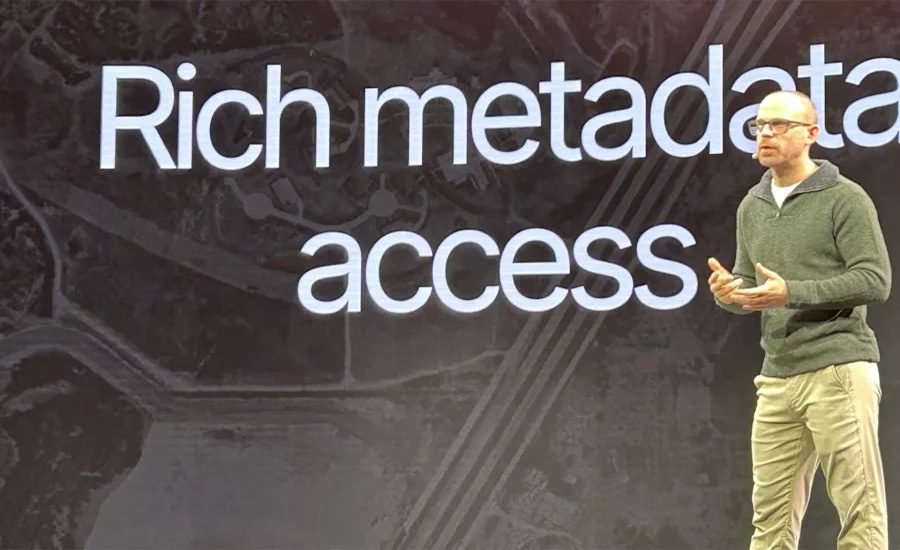

Bentley Systems has unveiled new AI-enabled capabilities in its design and construction management products, including Synchro and OpenSite, as well as an Infrastructure AI co-innovation initiative, created to enable design firms and asset owners to collaborate on new AI workflows.
“AI is poised to transform infrastructure,” said Bentley CEO Nicholas Cumins at its Year in Infrastructure conference and awards event, held Oct. 14-16 in Amsterdam. “Our vision is for AI to empower infrastructure engineers, not replace them. Based on the infrastructure context, AI can improve engineering productivity and transform workflows across project and asset lifecycles.”
AI civil site design
OpenSite+ for civil site design is a set of enhancements to the OpenSite civil design platform that use AI-assisted workflows, such as querying data, generating design scripts, and automating miles of road or pipe.
Its AI capabilities are available now through an early adopter program, Bentley said. OpenSite+ and other AI-enabled applications use Bentley Copilot, a context-aware AI assistant that guides users through workflows, displays relevant documents, and can modify 3D models.
OpenUtilities Substation+, also announced, is a new application that brings AI and digital twin capabilities to electrical substation design. It allows multiple users to work simultaneously on the same 3D model while using the same AI capabilities in OpenSite+.
“We’ve been building a new generation of infrastructure applications built on digital twins, powered by AI and fully connected to the Bentley Infrastructure Cloud,” said Francois Valois, senior vice president of the firm’s open applications group. “They show what’s possible when AI is built for real infrastructure workflows and tailored to the needs of engineers.”
Improvements in project management
Synchro+ offers a number of enhancements to the Bentley Synchro digital construction project delivery platform, shifting Synchro to a data-centric workflow using Bentley Copilot AI assistants. Marion Bouilli, Bentley Senior Product Manager for Synchro+, demonstrated early access user feedback and simplified workflows developed through user workshops.
Synchro+ integrates Cesium, Bentley’s 3D digital tile acquisition, for geospatial context. Use Bentley CoPilot LLM to leverage AI to explore construction sequencing and scheduling and illuminate insights from both data sets. Bouilli said Synchro+ will be available in December.
OpenRoads Designer and OpenRail Designer will also receive new AI capabilities for model-based road and rail design. An AI agent that automates drawing annotation will be generally available in November, Bentley said. Bentley Copilot will be integrated into both products in early 2026. New AI-powered search capabilities were announced for the construction project management platform Projectwise, which will also debut early next year.
Much of the AI agent’s advancement was made possible by Bentley Cloud Connect, a connected data layer that allows project data to be tracked for insights on everything from design to construction sequencing, Cumins said.
Cesi adds Splats for viewing
Patrick Cozzi, Bentley’s platform director and former CEO of Cesium, which was acquired by Bentley in 2024, said Gaussian “splats” can now be used to recreate a scene from an extended point cloud and blur to create a photorealistic scene that can be squished directly into Cesium’s high-fidelity, low-data-weight 3D visualization platform.
Cozzie said his group is working with Esri, the Khronos group and others in an open standard for Gaussian splats, an increasingly popular way of doing this share point cloud data for quick visualization.
Cumins acknowledged that AI in design and construction is still evolving, asking users to help define new workflows and ways to share information with the new capabilities. “We welcome the creative ways our users are already combining our apps with AI, and we believe this is just the beginning,” he said.
Cumins announced the Infrastructure AI Co-Innovation Initiative to collaborate with engineering firms and asset owners on AI-enhanced workflows, open to Bentley users. It’s designed to examine how Bentley’s APIs can evolve to better support AI use cases and explore new business models that reflect the evolving balance between AI- and human-driven work, he said.
“Our users aren’t waiting, they’re engaging with AI,” he said.
