

---Stacked-Planes.webp?t=1763407999)
The 43-day shutdown of the federal government, the longest in the United States’ 249-year history, ended Nov. 12 after Congress passed a revised interim funding package and President Donald Trump signed it into law.
The impasse ended after five members of the Senate minority brokered a deal with Republicans to pass a revised version of the House continuing resolution (CR) legislative package first passed on September 30. The Senate version, approved Nov. 9, amended the CR to add appropriations for the entire fiscal year 2026 for the Department of Veterans Affairs construction program and two military areas. the full year rather than a short-term extension.
The House approved the revisions on Nov. 12 before sending them to the White House for President Trump’s signature. The law reopens the government, but nearly all federal agencies involved in infrastructure continue to operate under the CR until Jan. 30, 2026, setting strict parameters on how the agencies operate.
“Contractors should expect additional delays”
The reopening restores federal paychecks and restarts suspended programs, but the cap sharply limits what agencies can do. Under sections 101 through 115, agencies must operate at 2025 funding levels, cannot initiate new programs, and are directed to spend only what is necessary to maintain essential operations.
Those rules now add to a significant backlog within the U.S. Department of Transportation, the Environmental Protection Agency, the U.S. Army Corps of Engineers, the Federal Aviation Administration and other infrastructure agencies — backlogs that will take weeks, not days, to unwind.
“Reopening of the government [was] long overdue, but business will not immediately resume as normal,” said Jake Scott, a Washington, D.C.-based partner at Smith Currie Oles, whose practice advises and litigates on behalf of federal contractors across the country.
“The government will need some time to excavate and contractors should expect additional delays even after reopening,” Scott added.
DOT faces the biggest queue. ENR reports throughout this year reflect that before the shutdown began, the department had announced thousands of discretionary grants that had not yet been finalized through signed agreements.
About 23 percent of FY 2022 awardees still did not have agreements executed by early 2025, and the DOT had cleared only about a third of a nearly $10 billion backlog when the shutdown occurred. The 43-day hiatus means that each of these steps (negotiation, compliance review, documentation and obligation) has been built further into the calendar.
Now, under the continuing resolution, DOT must complete this work using only the prior year’s authority and cannot accelerate staffing or hiring to match the workload.
EPA and the Corps of Engineers face similar challenges. EPA must resume reviews of clean water and drinking water state revolving fund requests, along with a number of water infrastructure approvals, under fiscal 2025 caps that cannot be adjusted until Congress approves full-year appropriations.
These reviews were slowed or stopped during the shutdown and must be resumed with state partners in a phased manner. The Corps’ Regulatory Program must operate with a backlog of Section 404 permits, water resource authorizations, and jurisdictional determinations.
Those actions stopped at the beginning of October must now be rebuilt project by project. Districts cannot expand their operating posture because Section 110 directs agencies to spend “as limited as possible” during the shutdown.
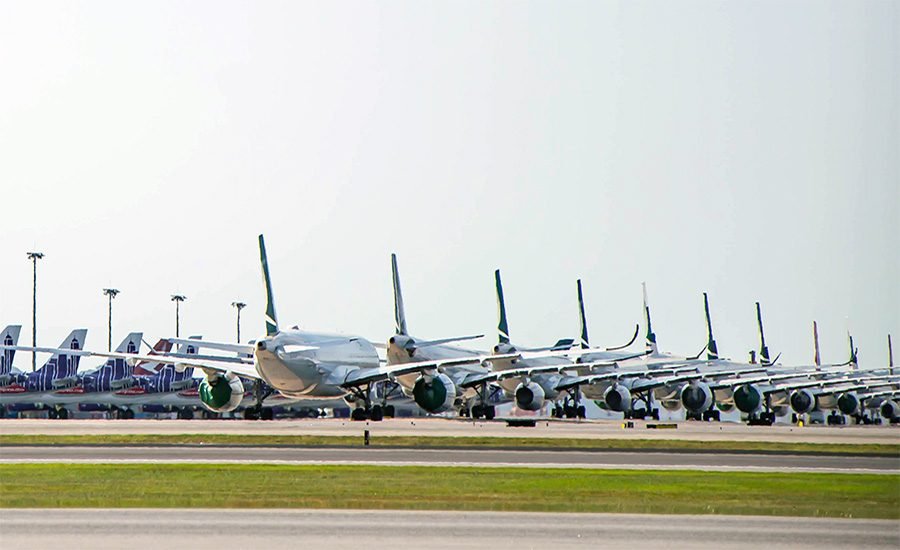
Aviation and transit programs also remain limited. Delays began mounting at the nation’s largest airports as the shutdown entered its fourth week, forcing Transportation Sec. Sean Duffy will introduce mandatory reductions in airspace capacity for public safety. The staggered flight reductions, along with food assistance funding, were important catalysts that prompted actions to reopen.
The FAA is resuming airport improvement program reviews for major terminal and airfield projects at a time when several sponsors need environmental determinations to proceed with procurement. The Federal Transit Administration must advance capital investment grant agreements without additional flexibility to expand administrative capacity.
The effects of the shutdown are seen in industry data
The effects are beginning to show in market data. Associated Builders and Contractors reported that its gauge of construction backlog fell to 8.4 months in October, the lowest reading since May and the third straight monthly decline.
Smaller businesses saw the steepest decline. Those with less than $30 million in annual income were only 7.29 months late, more than a month less than at the end of the summer. ABC Chief Economist Anirban Basu said the data reflected more competitive bidding conditions as companies tried to maintain their workload amid delayed federal actions, higher financing costs and high material prices.
Contractors directly tied to federally supported projects felt the immediate and practical effects of the shutdown’s impact. Delayed grant agreements and environmental reviews delayed mobilizations, leaving crews and equipment idle. Companies may consider rebalancing their backlogs to avoid gaps between federal and private work in the future.
Project teams preparing initial work packages should anticipate longer turnaround times for federal reviews that have since resumed, albeit more slowly than before the shutdown. The other challenge for contractors is how persistent inflation adds to the challenge as procurement windows move further into the winter or spring risk exposing material packages to cost volatility.
Public owners face similarly compressed schedules. State transportation departments must obligate formula funds from the Jobs and Infrastructure Investment Act of 2021 by statutory deadlines, even as federal review pipelines slowed for more than six weeks.
The IIJA surface transportation title expires on September 30, 2026, and DOT cannot extend spending authority or adjust contract capacity under the CR to help states make up for lost time. Transit agencies negotiating multi-year projects must finalize capital investment grant agreements within limited administrative bandwidth.
Airport sponsors must align capital program schedules with the FAA’s restricted review capacity. Water owners, especially utilities planning major upgrades in response to regulatory or growth pressures, need to sequence projects around EPA approvals that will improve gradually, not immediately.
Civil works linked to the body face additional time challenges.
Coastal, navigation and flood risk reduction projects that were awaiting permit decisions or feasibility analyzes before the shutdown must re-enter the queue on a district-by-district basis. Construction packages expected to move forward in early winter may change in the spring, increasing exposure to weather-related delays and potential cost escalation.
Binding and blessings
The specific operating rules of the CR section shape all these results. Section 109 restricts grant spending to only what is required during the CR period, limiting agencies’ ability to accelerate obligations even when backlogs require it.
Section 111 maintains mandatory programs, but does not expand authority for discretionary infrastructure accounts. Section 118 directs reimbursement to states that administered federal programs during the transition, helping to stabilize budgets after running out of funds to maintain essential services. Section 116 retroactive payment restores federal payroll operations and allows agencies to reallocate personnel to core program functions, but not beyond the limits of the limitation.
Despite the limitations, the reopening gives agencies a baseline to work from in late January. Federal teams can sort through backlogs, issue backlog guidance and reset obligation schedules, albeit at slower-than-normal rates.
ENR’s report, after the reopening deal was approved, noted that “weeks of delayed federal action” should be expected as agencies regain momentum. This view remains accurate based on continued resolution.
For the industry, the end of the shutdown does not mean a return to normal operations. Public contractors, designers and owners who anticipate extended federal deadlines, and to sequence work accordingly, will be better positioned as agencies work to regain full operational momentum over the winter.
