

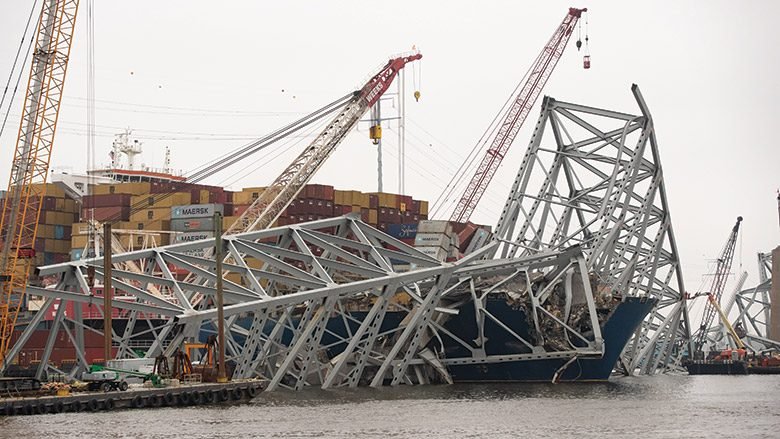

Rising material costs and design considerations for a sturdier structure have added time and expense to the reconstruction of Baltimore’s Francis Scott Key Bridge, according to the Maryland Transportation Authority. Originally estimated at $1.7 billion and opening in October 2028, the restoration of the two-mile-long Patapsco River crossing is now expected to cost between $4.3 and $5.2 million, with completion now slated for 2030.
The update comes as the National Transportation Safety Board released the findings of its 22-month investigation into the March 26, 2024, collapse of the main beam of the original 1.7-mile steel bridge after a collision with a support pylon by the neo-Panamax container ship M/V Dali following two successive power outages. NTSB Chair Jennifer Homendy called the incident, which killed six construction workers, a “tragedy that should never have happened.”
In a statement, MDTA explained that preliminary reconstruction cost and timeline estimates, made less than two weeks after the incident, were needed to apply for federal emergency relief funding for immediate cleanup and recovery.
“Typically, on a project of this size, a cost estimate would not be provided until much later in the design process,” added MDTA Executive Director Bruce Gartner.
Among the unknowns at the time, MDTA adds, was the size and cost of a dock protection system to safeguard a bridge that the agency says needs to be taller and wider than its predecessor to accommodate ever-larger ships accessing Baltimore Harbor. The design, developed by Kiewit Infrastructure Co. under the $73 million first phase of a progressive design-build contract, calls for a 1,665-foot-long main span supported by two 600-foot-tall main light pylons, with the height of the bridge deck above the main deep-draft shipping channel at least 230 feet.
A generally more expensive construction environment also contributed to the revised reconstruction estimate, MDTA says, citing a 72 percent increase in the Federal Highway Administration’s National Highway Construction Cost Index over the past five years. In addition to causing an uncertain construction and bonding market across the country, MDTA notes that “the cost of raw materials and labor continues to constantly fluctuate” as contractors price persistent inflation into their bids.
MDTA anticipates that negotiations with Kiewit on the final design and construction cost of the project are within the expected price range. Some aspects of the reconstruction, including pile testing and demolition of the remaining original spans, are already underway.
Although Congress passed then-President Joe Biden’s promise of full federal funding for a replacement, subsequent friction between Maryland leaders and the Trump administration over the state’s disadvantaged business hiring practices has injected uncertainty into how much of that promise will ultimately be fulfilled.
In a statement, Gov. Wes Moore (D) said the state “will continue to work with the Trump administration to find ways to cut costs and rebuild faster.” He added that the higher cost of rebuilding was the result of “federal design and resiliency standards, not discretionary state choices.”
Along with promising to make “substantial financial commitments and contributions to support the reconstruction of the Key Bridge, the state says proceeds from pending litigation against Dali’s owner and operator, Singapore-based Grace Ocean and Synergy Marine, respectively, will be used to pay for damages from the incident, including reconstruction. Both companies have asked to limit their maritime liability law to less than $4 million.
Trace the probable cause of the collapse
The NTSB’s exhaustive investigation of the chain of events leading up to the collapse of the spandrel bridge ultimately led to the maze of wiring that made up the nine-year-old Dalí’s control and power systems. Investigators determined that the probable cause was a loose connection of the signal cable to a terminal block, the result of where the cable tag band had been placed, which resulted in the loss of propulsion and steering. Although the crew members quickly restored the systems, the diesel generators soon failed again due to insufficient fuel pressure from a wash pump that did not have the ability to restart after the initial failure.
NTSB investigators noted that Dali crew members’ maintenance practices in the months leading up to the incident included reliance on visual inspection and other techniques that had limited scope when the systems were energized. The agency found that more efficient fault identification technology, such as infrared thermography, could have proven more effective if it had been made available to the crew. The wiring and pump problems were included in the federal government’s $102 million 2024 settlement with Grace Ocean and Synergy Marine to recover response and cleanup costs associated with the collapse.
According to the NTSB’s timeline, the second blackout sent the Dalí drifting past two 28-foot-wide dolphins, eventually striking one of the Key Bridge’s main support pylons with a force nearly five times the structure’s lateral capacity, investigators say. The absence of adequate countermeasures to reduce the vulnerability of the key bridge to ship impacts, which were not required when the structure was designed and built, was a contributing factor to the structure’s collapse and loss of life, the Board concluded.
The NTSB investigation also found that the eight-person crew from Brawner Builders Inc., which was making concrete repairs on the main span, was apparently unaware of the impending danger. As the engineless Dalí headed toward the bridge, the Baltimore-based pilot radioed the situation to his dispatcher and requested immediate closure of the crossing. MDTA police were then notified to shut down traffic at both ends, but word did not reach the crew inspector, who had provided his cell phone number to MDTA police in accordance with contract requirements.
Investigators estimate that if the crew had been notified at the same time as MDTA police, they would have had approximately 90 seconds to drive to safety. Only the crew inspector and one other worker survived the collapse. The Board noted that by calling MDTA police before notifying the U.S. Coast Guard, a departure from MDTA protocol for bridge threats, the dispatcher and officers were able to stop traffic quickly, potentially preventing further loss of life.
The 17 NTSB safety recommendations resulting from the investigation include a call for al American Association of State Authorities and Transportation Officialsthe US Coast Guard and the US Army Corps of Engineers and the FHWA to help guide bridge owners in exploring ways to reduce the risk of bridge collapse through errant vessel detection technology, design measures, and the incorporation of motorist warning systems capable of activating when a threat is identified and immediately stopping bridge traffic. The Board also recommended that the American National Standards Institute update its A10.47 standard for highway work zones to include an effective and immediate means of emergency communications to alert workers working on bridges over navigable waters.
In addition, the NTSB reiterated its March 2025 urgent recommendations for vulnerability assessments to be performed using AASHTO’s Method II calculation on nearly 70 bridges spanning key navigation channels. According to agency staff, assessments have been completed on 35 bridges, with 22 exceeding the acceptable risk threshold. The owners of these structures, including the Betsy Ross and Walt Whitman Bridges in Pennsylvania and New Jersey, the Huey P. Long Bridge in Louisiana, and the two spans of the MDTA-owned Chesapeake Bay Bridge, are currently working on hazard reduction calculations. Vulnerability assessments of the remaining bridges cited by the agency are still ongoing.
The NTSB will release its final report on the Dali and Key bridge collapse in the coming weeks.
