

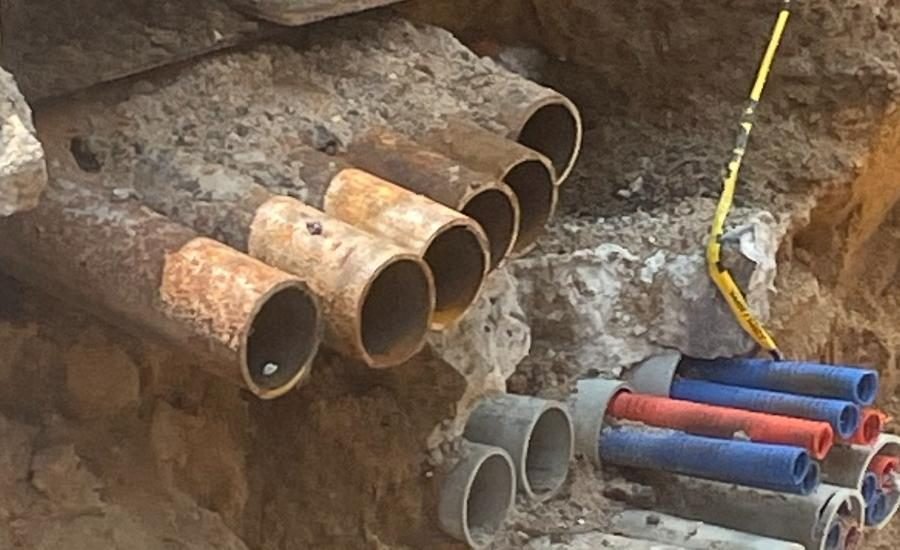

Mayor Adams’ office announced last week that New York City would spend $10 million on a digital map that would unify all the tubes, pipes and other infrastructure beneath the streets. When it launches in 2028, the “3D Underground” program should allow public agencies and their partners to better respond to emergencies or prepare for construction by seeing what hazards might be lurking six to nine feet below the surface.
“We’ve been putting things in the ground since, literally, Aaron Burr,” said Debra Laefer, a professor of civil and urban engineering at New York University. Information on where the additions are located has been isolated in different public and private bodies. “My understanding is that a lot of companies know where their assets are, but they don’t know what else is in the trenches with them.”
Not only are there several centuries of tubes, pipes and cables under the pavement, but the city grants approximately 100,000 requests for permits to cut streets or sidewalks for utility maintenance each year. Instead of having utility representatives mark each site, 3D Underground would allow project planners to work more independently. Emergency response teams could also take advantage of the resource. Firefighters, for example, could see where gas lines enter the building in 3D Underground and avoid parking their trucks above the safety hazard.
Users of the new platform will be able to view integrated maps for a single city location at a time. The data itself will not be stored in a perpetual map of the entire city; security and business concerns ruled out the idea of a merged database early on, said Laefer, who led the pilot projects and workshops that led to 3D Underground. A combined system would also have become the responsibility of maintaining the city.
Instead, each company or agency with underground assets will create and store its own maps. A filter provided by 3D Underground will integrate the inputs into a usable interface in a couple of hours if not minutes. Before the project was underway, mapping software options were so wide-ranging, linking two sources into a compatible visual could take weeks, Laefer said.
There could be opportunities to hire teams, live or not, that have yet to be mapped.
“The city has not yet finalized its procurement plans, although it may issue a request for information to better understand options for deploying ground scanning technologies,” a city spokesman said.
Radar, electromagnetic induction and other technologies can only pick up so much — concrete and pavement might interfere, or plastic might go unnoticed, Laefer said.
Some work is likely to require reverse engineering where infrastructure is located based on historical records or above-ground remains.
Assembly of one aspect of 3D Underground, city-wide soil modeling, will be led by George Deodatis, professor of earth and environmental engineering at Columbia University. The resulting data layer could become an OpenData resource, Laefer said, such as catchment and hydrant city maps.
The $10 million for 3D Underground came from the US Urban and Housing Community Development Block Grant for disaster recovery after Hurricane Ida. Much of the work Laefer and his team did before the program was funded by a $1.2 million National Science Foundation grant called the Civic Innovation Challenge, which aimed to bring researchers and public agencies together to solve civic problems.
