

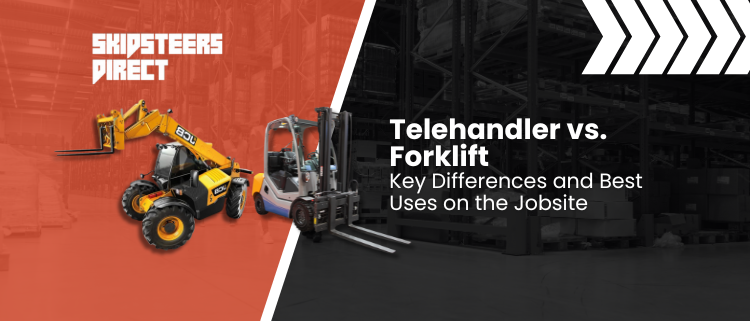
At first glance, a telehandler and a forklift may seem to do the same job: lift and move heavy loads. But when you get to the job site, the difference between a forklift and a telehandler becomes apparent. One is built for stability and maneuverability in tight interior spaces; the other is designed for range, versatility and rough terrain handling.
So how do you choose the right one for your next project? In this guide, we break down their capabilities, explain where each machine excels, and help you decide based on your workplace needs.
Whether you’re in construction, farming, or industrial material handling, understanding these machines can save you a lot of time, money, and frustration.

What is a forklift?
A forklift is a compact, motorized industrial truck designed to lift, transport and stack materials over short distances. You’ll find them everywhere, from warehouses and manufacturing plants to supply yards and shipping docks. Forklifts use a vertical mast with forks to lift loads, usually on pallets, straight up and down.
Its strength lies in maneuverability and controlespecially in narrow interior spaces with smooth floors. Forklifts are known for their low center of gravity and tight turning radius, making them ideal for environments where precision and space saving are crucial.
But forklifts are not made for everything. Their lift height is limited, they don’t work well on uneven terrain, and they don’t have the reach of a boom.

What is a telesonic manipulator?
A telescopic manipulatorshort for telescopic handler, it is a versatile lifting machine that combines the characteristics of a forklift and a crane. Unlike a standard forklift, a telehandler uses a telescoping boom instead of a vertical pole. This allows it lift loads not just up, but over obstaclesa critical advantage on construction sites, farms and rough terrain.
This machine can be equipped with various accessories such as forks, buckets, lift arms and work platforms, transforming it from a basic material mover to a multipurpose work tool. Due to its all-terrain tires, greater ground clearance and boom reach, it is ideal for outdoor and uneven terrain where forklifts cannot operate safely.
To learn more about how telesonic manipulators work, their main use cases and which brands are leading the market, check out our guide: What is a telesonic manipulator? Uses, brands and models explained.

Telehandler vs Forklift: Key Differences
When deciding between a forklift or a telehandler, it helps to break down exactly how these machines differ in real-world use. Although both are designed to lift and move materials, their structure, capabilities and ideal environments are very different.
Here’s a look at the key differences between a telesonic handler and a forklift:
| characteristic | Forklift | Telescopic manipulator |
|---|---|---|
| Lifting mechanism | Vertical mast | Telescopic arm (extends up and forward) |
| it arrives | Limited vertical access | High reach + forward extension |
| land | Best on flat and smooth surfaces (indoor/outdoor) | Built for rough terrain and irregular jobsites |
| maneuverability | Compact and tight turning radius | Larger footprint, less maneuverable in tight spaces |
| Attachments | Mostly forks, some tweezers/specialized tools | Wide variety: forks, buckets, work platforms, fires |
| Visibility and security | Excellent for work at low height | Requires attention to load balance and boom angle |
| Typical use | Warehouses, yards, shipping docks | Construction, agriculture, placement of materials at height |
The difference between using the telesonic manipulator and using the forklift comes down to one question: Do you need more range and versatility, or more precision and compact handling?
When to use a forklift vs
Understanding the difference between the capabilities of forklifts and telehandlers is only half the battle, knowing when to use each machine is what really drives efficiency and safety in the workplace.
Use a forklift when:
- You are working indoors or on smooth, flat ground.
- you need load, unload and stack pallets. More information in our guide on how to move pallets with a forklift.
- Your site has tight spaces that require a small turning radius.
- The elevator height is less than 20 feet.
- You are focused on speed and efficiency for repetitive tasks.
Use a Telesonic Manipulator when:
- You are operating on a construction site, farm or uneven terrain.
- Obstacles must be overcome or materials placed at height.
- You want flexibility with accessories like buckets or platforms.
- You are handling irregular loads or materials that are not palletized.
- You need a machine for various tasks in a wide area.
This side-by-side breakdown of the telehandler and forklift shows that while there is some overlap, the use cases are quite different. If you’re moving pallets in a warehouse, a forklift is hard to beat. But if you’re placing materials on scaffolding, navigating rough terrain, or switching between attachments, a telematics manipulator is the tool for the job.
Attachments and Personalization
Both forklifts and telehandlers support attachments, but telehandlers offer much more flexibility. While forklifts mostly use pallet forks and some specialized tools, telehandler attachments can include buckets, forks, winches, and even man baskets, turning a machine into a lift, loader, or platform as needed.
If you want to expand what your telehandler can do, check out our complete selection of telescopic handler accessories for construction, agriculture and material handling work.
Choose the right tool for the job
The difference between a forklift and a telehandler isn’t just technical, it’s practical. Every machine is built for a purpose. If you need accurate and fast material handling in a warehouse or yard, a forklift is the clear choice. But if your job requires reach, versatility and performance over rough terrain, a telehandler will give you an advantage.
Choosing between a telehandler or a forklift depends on where you work, what you move, and the flexibility you need. And if you’re still not sure, our team is here to help.
Questions about specifications, attachments or availability? Contact us today, we’ll help you find the right equipment for your workplace and budget.
Frequently asked questions
Is a telescopic handler a forklift?
Not exactly. Although a telehandler can perform similar lifting tasks, it is more versatile and built for different conditions. A telehandler offers greater reach and terrain capability, while a forklift is ideal for tight, soft interior work spaces.
What is the difference between a forklift and a telehandler?
A forklift uses a vertical mast to lift loads upwards and is primarily designed for indoor or flat surface use. A telehandler uses a telescoping boom to lift loads up and out, making it better suited for rough terrain and elevated locations.
Can a telehandler use forklift attachments?
Yes, many telehandlers are compatible with pallet forks and other forklift-style attachments. But telehandlers go further by supporting buckets, flakes and work platforms, giving them much more flexibility on the job site.
Which is safer to operate, telehandler or forklift?
Both machines are safe when used properly, but telescopic handlers require extra care due to their extended reach and boom movement. Operators must be trained to manage load balance and boom angles. Forklifts have a lower center of gravity and are often easier for beginners to operate safely. chell our Beginner’s Guide to Forklift Operation to start with the basics.
Which one is better for construction work?
In most construction scenarios, a telehandler is the best choice for its reach, lift height and off-road capabilities. However, for indoor material handling or unloading deliveries, a forklift may still be the most efficient option.
