

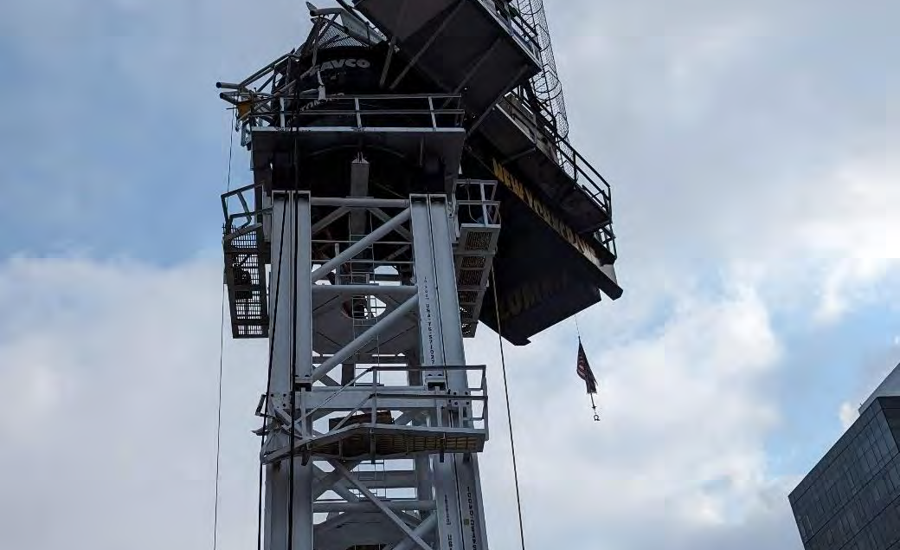
A disconnected hydraulic hose likely sprayed flammable oil onto a hot surface and ignited a fire that compromised the luffing system of a tower crane on a busy street in New York City, which crashed its boom 500 feet into the ground, according to a long-awaited investigation into a crane fire in 2023 and partial collapse on the west side of manhattan.
The collapse of a 45-story mixed-use tower rising at 550 10th Ave. it injured several workers and damaged a neighboring building, but did not cause any fatal injuries.
968-page report from the New York City Department of Buildings on July 26, 2023 incident—written in concert, the New York Department of Investigation and engineering consultants Gilsanz Murray Steficek (GMS)—is generating new fire safety requirements for diesel-powered tower cranes operating throughout the city. City leaders say the findings underscore the need for stricter protocols on equipment inspections, firefighting and operator supervision.
Building Commissioner Jimmy Oddo called the accident a “nightmare scenario” for the industry and noted that the city “has already implemented new changes to prevent this from happening again.”
A chain of failures
According to the report, crews were using a Favelle Favco diesel-powered tower crane owned by New York Crane & Equipment Corp. and operated by Cross Country Construction for concrete placement when a hydraulic hose near the engine compartment became detached from its corner. The failure is believed to have released hydraulic oil which ignited on contact with a hot surface on the crane deck. Temperatures in the compartment are estimated to have reached 900°C when the fire spread.
 The crane collapse and fire occurred after this failed hydraulic hose, with spiral delamination, became detached from its crimp connection.
 Photo courtesy of the New York City Department of Buildings
The operator tried to put out the flames with an on-board fire extinguisher but was forced to climb down the tower to escape the fire. The fire critically damaged the rope supporting the crane’s 165-foot boom, which then failed, sending the boom down 10th Avenue and striking the facade of the adjacent building at 555 10th Avenue. Workers at the site suffered minor injuries.
The report says casualties were “probably” avoided because the project’s general contractor, Monadnock Construction, quickly close the surrounding streets.
“In this way, the industry can learn and promote among employees the importance of prompt action from this example,” the report states.
Monadnock said in a statement provided to ENR that it does “A 50-year track record in the safe management of complex construction sites and appreciates the decisive and life-saving action of our team on the day of the incident is the only reference to our company in this report. and notes that these efforts should set the standard for the construction industry.”
New York Crane & Equipment Corp. could not be reached. to make comments and Cross Country Construction did not provide comment prior to publication.
Regulatory response and violations
Following the collapse, the city issued four violations to general contractor Monadnock Construction and crane operator Cross Country Construction for failing to safeguard the site, maintain cleanup standards and implement appropriate safety measures.
A Monadnock spokesman said one of the three due date violations cited by his company was dismissed, one was immediately cured, and a third is being challenged in court. The spokesperson did not elaborate on the nature of those violations at the time of publication.
Citing the investigation’s findings, DOB has made the manufacturer’s previous voluntary fire safety recommendations mandatory for all diesel tower cranes in New York City. All units operating in the five boroughs must now include fire detection and suppression systems in the engine compartment area, along with improved inspection procedures.
The agency has also strengthened oversight of lift managers, who oversee crane movements, jumps and load handling, by adding new registration requirements and experience thresholds. Additional reforms enacted from 2023 include a new class of license for operators of smaller lifting devices such as articulated trucks, mini cranes and telehandlers. Any equipment rated for 2,000 pounds or more must now be operated by a DOB licensed professional with at least 3,000 hours of experience.
Parallelism to previous accidents
The researchers also reviewed global incidents involving similar Favelle Favco models and found that the circumstances closely mirrored tower crane fires and collapses in Sydney in 2012 and Melbourne in 2016. Following these events, the manufacturer issued a technical bulletin recommending optional, but not mandatory, improvements such as leak inspection protocols, engine extinguishing systems, additional extinguishing systems and of extinguishing fires. near the crane cabin.
None of those voluntary recommendations had been implemented at the Midtown crane at the time of the fire, according to the report.
Impact on the industry
DOI Commissioner Jocelyn Strauber said the incident highlights the importance of “robust security protocols,” noting that investigative work has already accelerated improvements across the industry.
The city is reviewing additional recommendations from technical consultants, including Crane Tech Solutions, TJ Russo Consultants and Edgett Williams Consulting Group, with the goal of further modernizing New York’s crane regulations. DOB officials say they will continue to work with the City and industry stakeholders to improve standards.
“This research provides critical lessons to help prevent future incidents and informs new fire safety requirements for tower cranes across the city.” Jeff Roth, dthe deputy mayor for operations said in the statement.
