

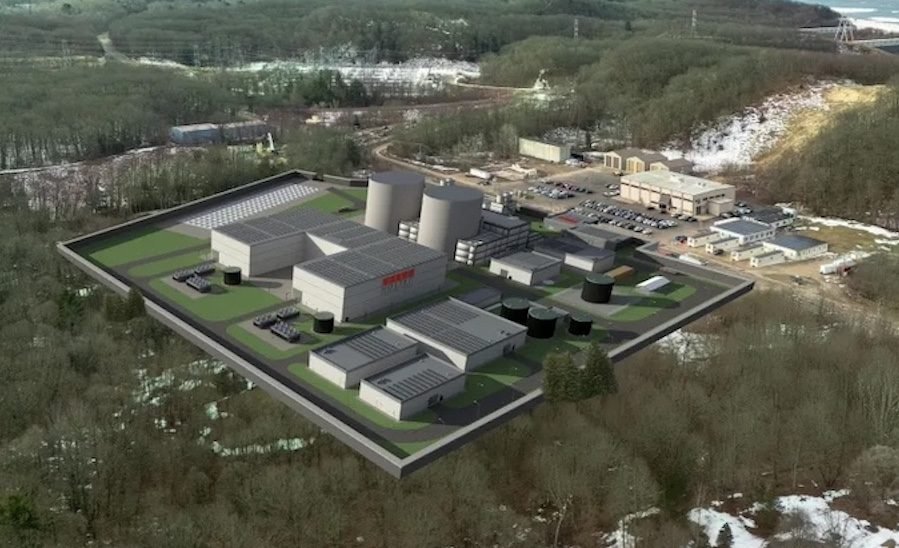

Small modular nuclear reactors using light water cooling technology to be developed for U.S. commercial use by power supplier Tennessee Valley Authority in its multistate region and private developer Holtec International in Michigan will each win up to $400 million in federal cost-sharing funds to advance related projects and supply chains, the U.S. Department of Energy announced this month.
Energy Secretary Chris Wright said the project’s investments in third-generation nuclear power technology will help advance the Trump administration’s goals outlined earlier this year to boost this energy source domestically, particularly to ensure US energy security and gain global dominance in artificial intelligence. “Advanced light-water SMRs will give our nation the consistent, reliable power we need … support data centers and AI growth, and bolster a stronger, more secure power grid,” he said.
The funding actually comes from a Biden-era request released in October 2024 with funding from the 2021 federal infrastructure act that includes another $100 million to be awarded later this year to support further deployments and address barriers in design, licensing, supply chain and site preparation, the DOE said. But the Trump administration revised the application last spring to remove required financial investments for the benefit of the community by the winners.
The DOE funding will help TVA build the first two-unit GE Vernova Hitachi BWRX-300 SMR of an estimated 600 MW at its Clinch River site in Tennessee in the early 2030s and plan future deployments with partners Indiana Michigan Power and BWX Technologies. TVA’s development team also includes contractors Bechtel and Aecon, Duke Energy, Oak Ridge Associated Universities and the Electric Power Research Institute.
TVA’s construction permit application to the US Nuclear Regulatory Commission for the BWRX-300 at Clinch River, filed in May, is still under review by the agency. “This award confirms TVA’s continued leadership in shaping the nation’s nuclear energy future,” said Don Moul, president and CEO of TVA, the independent federal corporate agency that supplies power to 10 million people in most of Tennessee, northern Alabama, northeastern Mississippi, southwestern Kentucky and smaller areas of neighboring states.
“Unlike previous nuclear construction projects in the US, contractors will work with [GE Vernova Hitachi Nuclear Energy] and TVA as a highly integrated project team to plan, design and potentially acquire, construct and commission Clinch River Unit 1. Bechtel said in January. “The integrated project delivery model is the preferred method that will make our project a true team effort,” said Bob Deacy, TVA senior vice president and Clinch River project leader. “We will actively work together to achieve a target budget and schedule, creating a significant advantage to drive nuclear innovation, share risks and reduce costs.”
TVA has also signed public-private partnerships with other SMR developers in recent months, including Kairos Power and NuScale, as well as nuclear fusion developer Type One Energy. TVA said it currently has about 11 GW of requested load for AI and data centers in its area, including Google, Meta and xAI.
TVA’s technology collaboration partner, Ontario Power Generation, has begun construction of four GE Vernova BWRX-300 units, with the first coming online in 2030 at its Darlington power station. The province approved construction plans and awarded a contract in May to a partnership between Aecon and Kiewit Nuclear Canada for construction planning and execution and project management. Aecon said its share of the contract is worth about $930 million.
GE Vernova Hitachi Nuclear Energy and design firm Samsung C&T also announced in October a strategic alliance to advance the deployment of BWRX-300 SMRs in markets outside of North America.
Go modular in Michigan
Holtec’s funding will help the company’s plans to deploy its two-unit SMR-300 reactors at the site of the 800 MW Palisades nuclear power plant it owns and also aims to restart in January in Covert, Michigan, adding an additional 600 MW. The developer also signed an expanded alliance agreement with Hyundai Engineering & Construction to build a 10GW SMR-300 fleet in North America through the 2030s, starting with the Palisades project. The contractors will manage the reactor’s construction, deployment, operation, supply chain and power sales. The cost of the project has been estimated at $2.1 billion to $2.7 billion per reactor.
“Aiming for first power by 2030, our Mission 2030 initiative will position the Palisades SMR project as the reference plant for all future SMR-300 deployments, nationally and globally,” said Holtec.
The company’s founder, president and CEO Krishna Singh told attendees at an American Nuclear Society conference last month that the company’s SMR-300 reactor was “born the day after” the 2011 meltdown at the Fukushima nuclear power plant in Japan, but it did not win DOE funding at the time because of the agency’s disagreement over its design. Holtec self-funded the project, Singh noted, and will submit its design next year to the U.S. Nuclear Regulatory Commission for a limited work permit.
According to a statement from Holtec, “DOE’s support is an essential enabler of the Palisades SMR-300 project, moving it from development to deployment based on previous government support” under the agency’s Advanced Reactor Demonstration Program that dates to 2020.
Holtec also has a $1.52 billion conditional loan from the DOE for the Palisades restart, though the move faces new litigation from anti-nuclear groups that have sued the developer and the commission in federal court.
Other top applicants for the $900 million in federal SMR funding included utility Arizona Public Service and developer Constellation, according to media reports. The latter also closed a $1 billion DOE loan last month to restart the undamaged 835 MW reactor unit at Pennsylvania’s Three Mile Island nuclear power plant.
