

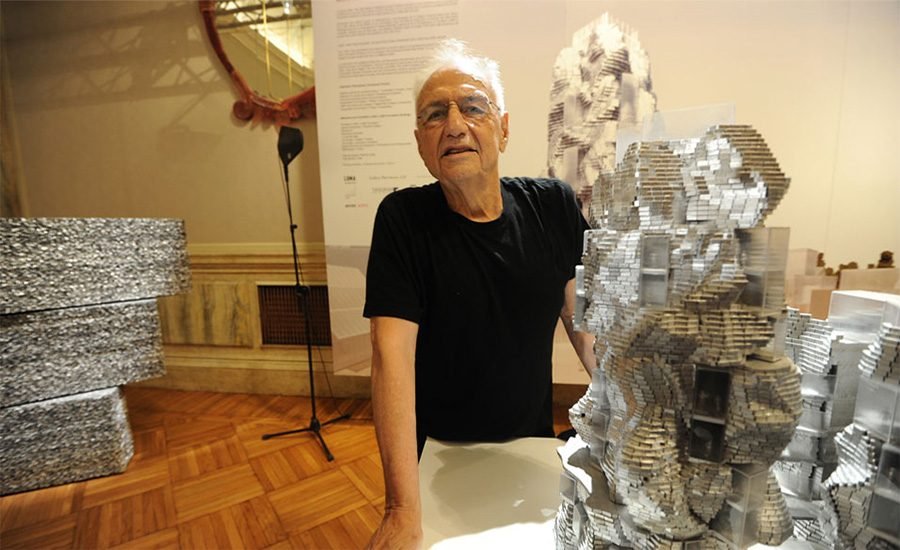
Frank Gehry, the architect whose buildings forced contractors, engineers and manufacturers to reinvent how complex structures are delivered, died Dec. 5 at his home in Santa Monica, California, after a brief respiratory illness, according to the Associated Press and Reuters. He was 96 years old.
Although he is known internationally for sculptural works such as the Guggenheim Museum in Bilbao and the Walt Disney Concert Hall, Gehry leaves a quieter but equally consequential legacy in construction.
His ambitious designs accelerated the shift from drawing-based workflows to model-based delivery, helping to spur digital fabrication, 4D sequencing, and the first forms of integrated project delivery years before these methods became industry standards.
First digital vision
Gehry began exploring aerospace modeling tools in the early 1990s as he struggled to reconcile the curvature of his physical study models with the limits of conventional architectural documentation. In a 1999 interview with former ENR Buildings Editor at Large Nadine M. Post, conducted the morning after receiving the American Institute of Architects Gold Medal, Gehry said that digital modeling could restore the architect’s traditional role as “master builder,” though he joked that he didn’t know how to “turn the damn computer on.”
He understood that the construction side of the profession needed better tools, and he was willing to restructure his practice to develop them.
Central to this change was his decision to adopt CATIA, the aerospace CAD platform developed by Dassault Systèmes, and to recruit collaborators such as the late Jim Glymph to translate analog models into manipulable digital surfaces.
Gehry insisted that the digital model, not the 2D drawings, serve as the authoritative record of geometry, design intent, and fabrication. This position became a defining characteristic of his approach to the realization of the project.
Gehry believed that a better definition of what was to be built, using 3D models, could return the architect to the role of the master builder of antiquity, such as Filippo Brunelleschi, who designed and built imposing cathedrals and pushed construction technology forward through the development of technologies such as double-shell designs and the use of lifting machines during the Italian Renaissance.
RELATED
The film of a work that defies description is worth a million words
Musical Experience Project: The Prototype
The methods Gehry advocated emerged publicly during work on Seattle’s Experience Music Project (EMP), completed in 2000. Case studies published by the American Institute of Steel Construction and the International Institute of Building Enclosure Consultants describe the project as the first building in the United States to rely on CATIA-based 3D modeling from design through fabrication. The steel, cladding and formwork were modeled directly from the model.
Hoffman Construction, the project’s contractor, said EMP “helped pioneer” the use of modeling and coordination tools. Shop drawing procedures were largely replaced by a federated digital environment that clarified tolerances, sequencing and the many intersections of the building’s non-orthogonal surfaces.
The project became a testing ground not only for Gehry’s team, but also for manufacturers who had to develop new digital detailing capabilities to continue working.
EMP noted that projects of substantial geometric complexity would require deeper digital integration between architects, engineers and contractors. What started as an experiment quickly turned into a repeatable delivery framework.
Walt Disney Concert Hall: Rewritten Construction
If EMP established the feasibility of model-based delivery, the Walt Disney Concert Hall in Los Angeles, completed in 2003, demonstrated its necessity. Mortenson Construction, tasked with finishing the long-delayed project, said the geometry was so difficult that conventional sequencing, estimating and communication tools were inadequate.

The Walt Disney Concert Hall in Los Angeles, one of Frank Gehry’s most technically demanding projects, drove the early adoption of 3D and 4D modeling as contractors worked to translate its curved stainless steel forms into buildable ensembles.
Image by Bruno Coelho/Adobe
To control risk and cost, Mortenson adopted 3D and 4D modeling to test logistics, assembly planning, access routes and overall schedule impacts. These workflows are now commonplace, but at the time they represented a huge leap forward in contractor digital capability.
A Stanford University research paper on 4D modeling at Disney Concert Hall describes efforts to map construction sequencing directly onto CATIA-derived surfaces.
Structural detailing company Dowco said in a project summary that fabricators relied on the architectural model to generate data-rich digital assemblies for curved steel, stone and finished surfaces. Several subcontractors reportedly withdrew early in the procurement process, unable to meet the project’s technical requirements.
The concert hall became one of the most important digital projects in the industry. Mortenson later cited the experience as instrumental in building its virtual design and construction program: ENR work covered a wide range as the company adopted model-based workflows on major sports and cultural projects.
RELATED
The obsession with innovation makes Mortenson the Heartland heavyweight
Gehry Technologies and Digital Project
Gehry formalized his approach by creating Gehry Technologies, the consulting and software arm of his practice. Its Digital Design platform, built on top of CATIA, offered an integrated environment for modeling, crash detection, constructability reviews, fabrication-level geometry and quantitative analysis.

The Beijing National Stadium, known as the Bird’s Nest, used Gehry Technologies’ Digital Projects platform during the coordination and modeling phases, helping teams manage the stadium’s complex lattice structure and manufacturing demands.
Image by coward_lion/Adobe
Gehry Technologies documented the use of Project Digital in large megaprojects beyond architect commissions, including coordinating the redevelopment of the World Trade Center site, the National Stadium in Beijing, the renewal of Lincoln Center in New York City and the first systems integration in the Burj Khalifa.
In each case, the company acted not only as a software provider, but as a project delivery consultant, using centralized digital models to connect design teams, contractors and manufacturers.
Gehry Technologies became especially known for transforming designs into structurally sound buildings, and sometimes saving a good chunk of the project cost in the process. One of the best-known projects he advised on was Herzog de Meuron’s 2008 Olympic Stadium, now known as the Beijing National Stadium in China, but commonly known as the “Bird’s Nest” stadium because it’s actually two independent structures 50 feet apart: a red concrete bowl and a complex steel exoskeleton surrounding it.
Trimble acquired Gehry Technologies in 2014 and has incorporated many of its project management dashboards and project delivery tools into its Trimble Connect platform.
A case study published by AECbytes highlights how Gehry Partners’ internal processes functioned as a complete BIM system before the term was widely used. The architectural model acted as the main data center, simultaneously supporting design development, engineering analysis and manufacturing planning, foreshadowing many aspects of today’s digital workflows.
RELATED
Cleveland gets a case of Gehry’s Totally Unreserved
Impact on the industry
Over several decades, Gehry’s processes helped accelerate the construction industry’s adoption of digital tools and collaborative delivery systems. Structural engineers have learned to work from curved digital surfaces rather than flattened projections.

Seattle’s Museum of Pop Culture, originally built as the Experience Music Project, was one of Frank Gehry’s first digitally modeled structures, requiring contractors to fabricate steel and cladding directly from CATIA-driven 3D geometry.
Image by Zenstratus/Adobe
Cladding and steel fabricators have expanded their CNC cutting and complex shop geometry capabilities, while contractors have embraced digital sequencing, clash detection and model-controlled change management. What were once difficult technical hurdles for Gehry projects decades ago are now key assets for companies working on digital project delivery.
Mortenson has repeatedly pointed to the Disney Concert Hall as a turning point in its digital evolution. Hoffman Construction has cited the Experience Music project as a catalyst for its modeling investments.
Fabricators involved in Bilbao, the Experience Music Project and Disney Hall said in project briefs that those assignments required a technical fluidity that later gave the companies an advantage in other geometrically complex work.
Academic studios at MIT, Stanford, and Kent State have used Gehry’s projects as benchmarks for digital surface rendering, building automation, and collaborative design research. These articles cite their buildings as environments that reconfigured communication, risk allocation, and authority among project teams.
ENR has covered Gehry’s work for more than three decades, given his impact on the construction industry. The editor of ENR Post, who interviewed him at key moments throughout his career, recalled in 2024 how unusually candid he could be when discussing the challenges of construction.
He said Gehry appreciated reports that captured the “agony and ingenuity” required to deliver his complex buildings, a nod to the contractors, engineers and fabricators who helped translate his designs into buildable structures. Post also recalled writing in ENR’s 2000 Musical Experience Project story that Gehry “knew how to electrify a technophobic construction crew,” a dynamic he said defined his relationship with builders confronting their digital designs.
Gehry’s buildings will remain world benchmarks, but his most profound influence on the construction industry lies in the delivery systems he championed. Long before BIM and virtual design and construction became mainstream, he demonstrated that model-centric construction could manage complexity, reduce risk and open up new manufacturing opportunities.
In doing so, it changed not only what the world builds, but how it builds it.
