

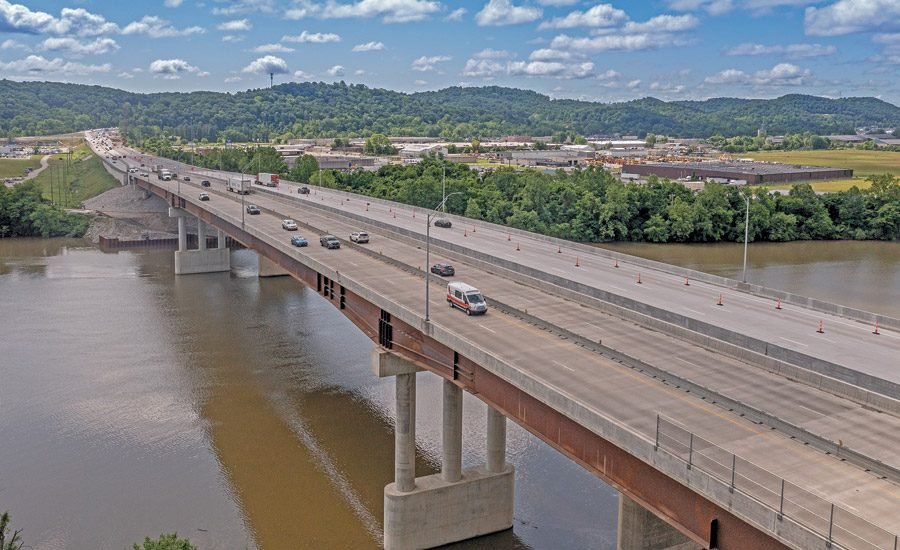
I-64 and Kanawha River Bridge Improvement
Nitro, W.Va.
Finalist Project of the Year and Best Road/Bridge
Presented by HDR
Owner: West Virginia Department of Transportation
Main design company: HDR
Construction Manager: Brayman Construction & Trumbull Joint Venture
With the Kanawha River Bridge to be completed in August 2024, the team built three-span double plate girder bridges, each with a 562-foot main span, creating the longest steel girder crossing bridge across the river in the US. Each bridge is 65 feet wide and has three lanes of traffic with a fourth for ramped traffic.
The project replaced the existing Donald M. Legg Memorial Bridge, which carried Interstate-64 across the Kanawha River in Putnam County, W.Va., for more than 60 years. During this time, the surrounding highway became a bottleneck in the regional transportation system, due to a narrowing of the lane and the inability to widen the truss bridge.
Although other bridge designs were considered, the team chose to go with steel plate girder girders because it was the right solution for both construction and long-term maintenance of the bridge, says Jason Fuller, vice president and senior project manager at HDR.

Photo courtesy of HDR
“In a design and construction environment, the [steel plate girder] it was the economic solution,” he says. “It was also the best solution for the useful life of the project and the least complex. In the future, it will greatly facilitate the maintenance of the owner. It’s a more typical structure and gives the owner a better long-term product.”
To create a record-breaking structure with a lifespan of 100 years, the team overcame significant challenges, including crossing a navigable canal; maintain traffic on both roadway and rail; mitigation of a hazardous materials site; rock blasting on a slope near traffic; coordinating agencies, interest groups and the public; and scope changes during construction.
After choosing the type of structure, the team prioritized long-term articles. The boxed design made it easy to manufacture, ship and build, while accommodating navigational clearances. Standard K-frames connected the diagonal members to bellows plates, which made shipping and lifting easier.

Photo courtesy of HDR
The project’s non-traditional erection methods required sequencing analysis to verify the adequacy of the beams. The team identified site constraints and assembly steps early, including temporary navigation clearance windows, eliminating false work on the river; the load imposed by the rope grip on the taillights and its impact on the size of the beam plate; and railroad and state route impacts on falsework and span lengths.
Although the bridge uses standard straight steel I-beams with square supports and standard cross frames, they are being stepped up. The girder method of the American Association of State Highway and Transportation Officials Bridge Design Specifications for Live Load Distribution in Slab Girder Bridges was only applicable up to 240 feet, although it was used for spans longer than 300 feet. The main span of I-64 nearly doubles the permitted length: 562 feet, with a width ratio close to 10.
Unique structural analyzes and non-traditional construction methods were essential in delivering the unique crossing, which posed unusual construction and marine design problems. Although reusing the existing docks minimized permanent channel changes, the river’s heavy barge traffic precluded connecting them with temporary false works. Collaboration with the US Coast Guard and other agencies established limits for temporary navigation channels and allowed for permanent navigation wrap. Standard K-frames connect the diagonal members to the gusset plates, which also made shipping and lifting easier.

Photo courtesy of HDR
During construction, an unknown utility line along one side of the project footprint was determined to be part of a hazardous waste drainage mitigation system. Since the line could not be relocated, the team incorporated an additional “jump span” into the design, helping to keep the project on schedule.
To maintain two lanes of traffic in each direction during construction, the crew reduced the lane width to 11 feet and used shoulders as needed. The team also kept a railroad and state highway under the western rear axles open during construction. Rock blasting on a slope adjacent to the freeway required extensive coordination with emergency services, local political representatives, and police and fire departments.
Throughout the project, the team reused and recycled materials whenever possible. The reuse of the bridge piers helped avoid the causeway, railroad, river banks, and approach slopes while maintaining the navigational envelope and eliminating permanent river impacts. The team also recycled road and deck concrete as fill material on the bridge approaches. The existing drainage system has been reused to the maximum, verifying its hydraulic capacity and eliminating corrugated metal pipe to reduce future maintenance.
The team also reused all soil on site and used EPA green remediation practices to reduce demands on the environment during cleanup actions. The approach avoided collateral environmental damage and built on environmentally conscious practices already in place, such as water conservation, water quality improvement, increased energy efficiency, toxic and waste management and minimization, and emissions reduction. The land management plan, in particular, addressed the impacts of dioxins on managed lands over the life of the project.
Hazardous materials were a constant concern. On the western approach to the bridge, the team made significant rock cuts into the hillside to allow for its realignment to the north. To the east, a hazmat site surrounded both sides of the approach. To minimize impacts in these areas, the team’s design reduced the depth of the river structure as much as possible, while providing the best geometric profile for connecting to the approaches. The horizontal alignment provided the most efficient solution and was converted to long walls to account for the height increases. This approach kept the filler tip in place. A 30-inch bottom drainage system at the tip minimized impacts to the existing hazardous waste site. These solutions kept the project in the right of way and eliminated encroachments on adjacent dangerous areas.
Within the project boundaries, the Kanawha River bed was contaminated, preventing bed material from being disturbed or removed. The team implemented a clean rock roadway with a geotextile liner between the river bed and fill material. The strategy limited the fines for lifting through the rock, prevented the rock from settling, and facilitated its removal upon completion of construction.
Completed on budget and ahead of schedule, the one-stop interstate choke point now accommodates one of West Virginia’s busiest sections of freeway and provides capacity for continued volume growth.
