

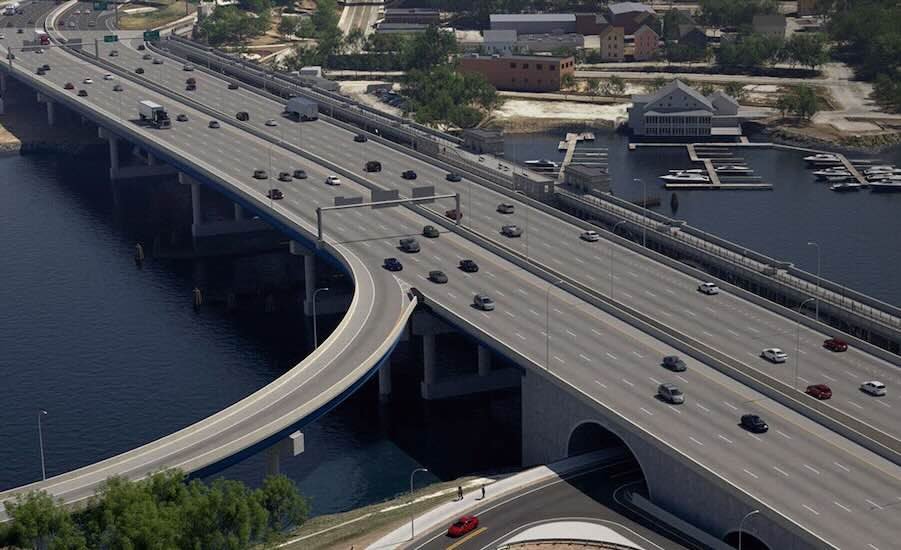

Walsh Construction Co. has completed demolition of the westbound span of the Washington Bridge in Providence, RI, clearing the way for construction of a replacement structure to begin next year.
The milestone comes nearly two years after the discovery of a deteriorating 2-foot post-tensioned anchor rod forced the emergency shutdown of the 56-year-old, 1,671-foot-long Seekonk River crossing on I-195. Subsequent investigations found that deterioration of the bridge’s cantilever beams and brackets was more widespread than originally believed, prompting the Rhode Island Department of Transportation to initiate a $427.9 million design-build replacement effort led by Walsh and design partner WSP USA.
A statement from Gov. Dan McKee (D) noted that the 18-month removal of the bridge’s deck and superstructure had been accomplished with numerous environmental precautions, including the strategic placement of support barges and turbidity curtains, which will remain in place until post-demolition inspections are complete. RIDOT also installed sensors to monitor noise, dust and vibration levels during the process, the release added.
While no start date has been announced for the 25-month construction phase of the replacement span, RIDOT says the project team has been conducting design, soil sampling, geographic surveys, permit applications and ordering materials for the past several months. Since the closure of the westbound section, the temporarily reconfigured 25-year-old eastbound section has been handling two-way traffic until a replacement is built. RIDOT has said the new bridge will be open to traffic in November 2028.
“The deterioration of conditions … was clear,” the report said.
Rotating controversy
Controversy has surrounded RIDOT and the Washington Bridge almost since the bridge closed in December 2023.
A 2024 Forensic Engineering Audit by Wiss, Janney, Elstner Associates Inc. (WJE), determined that the deteriorated tie-rod fractures had been the result of advanced corrosion coupled with decades of poor inspections and poor maintenance work. The report also noted “a lack of toughness in the original high-strength rod materials,” which, while based on the standards applicable at the time of construction, “present a greater risk than those meeting modern standards.”
The WJE report added that the “clear” deterioration of the bridge did not prompt an adequate response. “Program managers, bridge inspectors and designers should have been aware and could have been aware” of the developing problems, according to the report.
“Given industry experience with poorly grouted post-tensioning systems on other bridges,” the auditors concluded, “more attention should have been paid to signs of continued beam cracking along the tendons, exposure of post-tensioning anchors and advanced deterioration of cantilever beam ends.” Although a major 1996-98 rehab included tendon resurfacing, the report noted, “it is not clear that all of the gaps were treated or that the treatment was 100 percent effective.”
To prevent similar types of events from occurring in the future, the WJE audit recommended that RIDOT conduct a review of structures that could be considered complex to identify critical elements and “consider establishing specific Agency Defined Elements (ADEs) to ensure that elements are properly inspected/addressed with each applicable inspection.”
Another recommendation calls for RIDOT to review its processes for prioritizing and tracking work recommendations provided in inspection reports.
In August 2024, RIDOT filed a breach of contract and negligence complaint against 13 engineers and contractors who had inspected or performed work on the Washington Bridge over the past decade. The trial is scheduled for late 2027.
Meanwhile, RIDOT officials have repeatedly defended the agency’s project management approaches to state lawmakers while citing pending litigation to avoid questions about issues that contributed to the Washington Bridge closure or whether it was carrying out WJE’s recommendations. Criticism intensified when it was learned that the state attorney general had delayed the public release of the WJE report for more than a year on the advice of the state’s legal team until parts of it were leaked on social media last September.
