

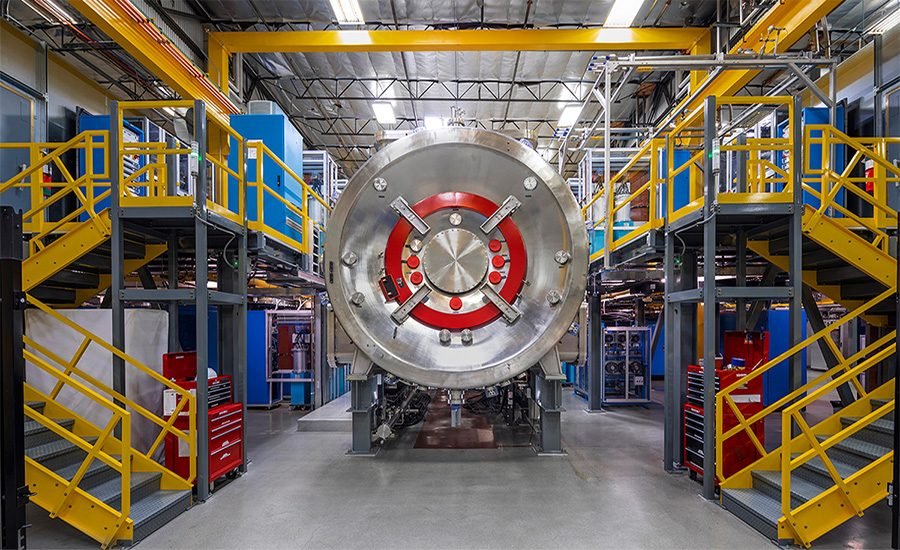

President Donald Trump’s publicly traded social media company, Trump Media & Technology Group, announced on Dec. 18 a planned $6 billion merger with nuclear fusion energy developer TAE Technologies, putting the speculative energy technology at the center of a high-profile corporate transaction.
Federal securities filings show the deal does not require the combined company to build, install or permit a fusion power plant. A Form 8-K filed with the US Securities and Exchange Commission outlines what the company has contractually agreed to and what it has not.
RELATED
Nuclear fusion is pushed to reach the commercial power plant stage
Under the deal, Trump Media remains the publicly traded parent company and formed a wholly owned unit to execute the transaction, with Foothill Ranch. California-based TAE which survives as a wholly owned subsidiary of this company. While its filings and investor materials refer to ambitions to develop a “utility-scale” fusion power plant, the merger agreement itself does not require the combined company to engage in construction activity.
Any discussion of development schedules appears only in forward-looking disclosures. In its filing, Trump Media cautioned that those statements include expectations about “development and construction timelines, the cost competitiveness of fusion-generated electricity; [and] the timing of the commercialization of TAE’s fusion technology, “all of which remain subject to significant uncertainty. The filing also warned of risks including regulatory hurdles, financing challenges and “delays in the development and manufacture of fusion power plants and related technology.”
Trump Media stressed that the Form 8-K should not be treated as final, saying it is “not a substitute for the registration statement, proxy statement/prospectus and consent solicitation statement,” which it said will contain additional information about the transaction and related risks “if and when they become available.”
TAE Technologies is a privately held company and has raised over $1 billion in private equity since its founding in 1998 from investors including Google, Chevron Technology Ventures, Goldman Sachs and Sumitomo Corp. of America.
Trump Media’s ownership structure adds a governance dimension to the transaction.
According to company disclosures, Trump owns about 59% of its outstanding shares, about 114.8 million shares, which are held through the Donald J. Trump Revocable Trust and managed by his son, Donald Trump Jr., as trustee. Based on this stake, the jump in stock price translated into a roughly $500 million increase in the value of the role of the president’s stake.
Ethics experts said the transaction highlights the potential conflicts inherent in a sitting president holding a controlling stake in a publicly traded company expanding into a heavily regulated industry. Richard Painter, former chief ethics counsel at the White House under President George W. Bush, told the Washington Post that the merger presents “a huge conflict of interest” because commercialization of the merger would depend on regulatory decisions and could require government support.
For the engineering and construction markets, the filings indicate nothing more than a long-term bet on merger development rather than a defined project opportunity. The fusion power has not yet been commercialized, and any future installation would require separate site selection, permitting and capital commitments that are not addressed in the transaction documents.
Trump Media said it plans to file a Form S-4 registration statement with the commission, which is expected to provide additional details about the merger’s background, financial assumptions and risk factors. Until these materials are presented, the disclosed agreements do not commit the company to building energy infrastructure.
