

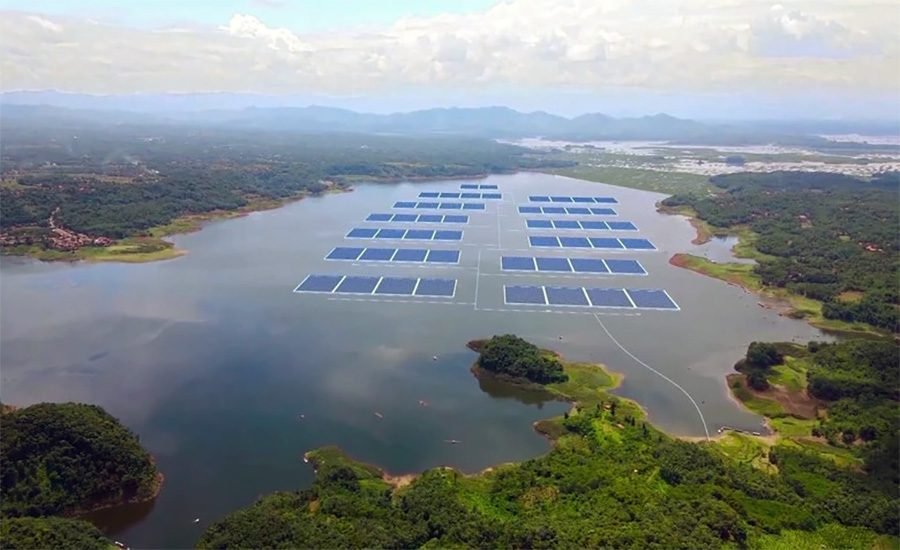

Abu Dhabi-based renewable energy developer Masdar has signed a power purchase agreement to build a 200MW floating solar project at Malaysia’s Chereh Dam, a development that would create Southeast Asia’s largest floating solar facility upon completion.
The project is Masdar’s first investment in Malaysia and will be developed by a consortium led by the company with local partners Citaglobal and Tiza Global. The power outlet will be secured through a long-term agreement with Tenaga Nasional Berhad, Malaysia’s state-owned power company, according to a company announcement in late December.
RELATED
Companies push competitive designs for floating offshore wind platforms
Once completed, the Chereh Dam project in Pahang state will have a DC capacity of over 300 MWp, equivalent to 200 MWac. The floating array will occupy approximately 950 acres of the reservoir’s surface and is expected to generate enough electricity to supply the equivalent of more than 100,000 homes. The total investment of the project is estimated at 208 million dollars.
“This landmark project, our largest floating solar development globally and our inaugural project in Malaysia,” Masdar CEO Mohamed Jameel Al Ramahi said in a statement. He said the company plans to leverage its experience in delivering utility-scale renewable projects around the world.
The Chereh Dam plant was awarded through Malaysia’s Large Scale Solar Cycle 5+ competitive bidding program, under which projects are ranked by price, with Masdar securing the lowest-cost bid in the floating solar category.
Masdar attributed the winning bid to its global supply chain partnerships and previous experience developing large floating solar facilities, including the 145MW Cirata Floating Solar Plant in West Java, Indonesia, which was commissioned in 2023 on a hydroelectric reservoir.
Operational precedents reduce utility-scale floating solar risk
This experience places the Malaysian project within a growing body of operational floating solar developments that have advanced the technology beyond pilot-scale deployment.
Cirata established the first major reservoir-based benchmark in Southeast Asia, demonstrating network integration, mooring systems and long-term operations at scale. In China, multiple floating solar plants exceeding 300 MWp have been built on reservoirs and former coal mining subsidence areas, providing additional performance and durability data at capacities comparable to Chereh.
Smaller but operationally influential projects have also helped define today’s engineering standards. Singapore’s 60 MWp Tengeh Reservoir floating solar plant, built on a potable water reservoir, has informed best practices for mooring design, water quality protection and maintenance access under strict regulatory constraints.
In Japan, the 13.7 MWp Yamakura Dam Floating Solar Facility, in operation since 2018, has served as a benchmark for corrosion management and storm-resistant mooring in typhoon-prone environments. Collectively, these projects have helped reduce the risks associated with engineering, permitting and financing for the largest floating solar developments currently underway in Southeast Asia.
RELATED
Saudi Arabia selects contractors for $1 million in solar energy projects
Masdar said the Chereh project is the inaugural development of a wider 10GW renewable energy roadmap agreement signed in 2023 with the Malaysian Investment Development Authority. The company is also progressing a feasibility study for a standalone floating solar facility at the Murum Reservoir in Sarawak, in partnership with Sarawak Energy and Gentari, which could further expand Malaysia’s renewable generation capacity.
The development of the Chereh Dam project will be financed through a non-recourse project finance structure with the participation of international lenders, Masdar said, indicating market confidence in the project’s fundamentals.
Masdar said it has executed an agreement with Pahang Water & Energy Resources, which establishes access to reservoirs and coordination with state authorities through construction and operations.
The company said the floating solar system will deploy technology tailored to the dam’s geometry and operating conditions to optimize long-term performance, endurance and efficiency.
Malaysia has aimed to increase renewable energy to 35% of its national power generation mix by 2030 under its National Energy Transition Roadmap, with floating solar expected to play a key role as land suitable for large land-mounted projects becomes more restricted.
