

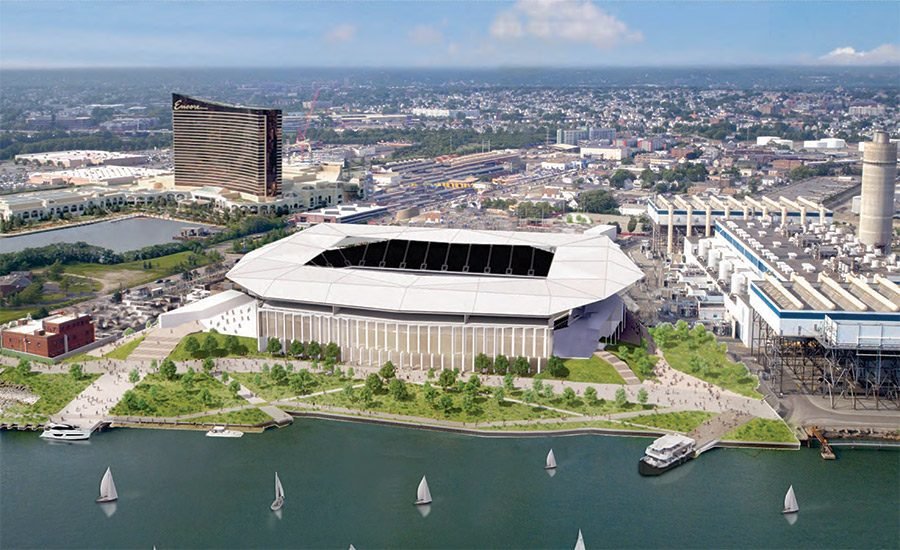

After years of negotiations with the city of Boston, the ownership group of the New England Revolution plans to build a $500 million soccer-specific stadium on a waterfront site on Boston’s northern border in Everett, Massachusetts.
The Kraft Group’s mitigation agreements for the 24,000-seat stadium announced Dec. 31 include a nearly $48 million, 15-year agreement with Boston. The agreement addresses concerns about potential traffic disruptions, noise and other daily impacts from crowds coming for games and other events at the stadium, according to media reports.
Permits for the stadium are expected to take 12 to 18 months, followed by three years to remove the defunct Mystic Generating Station before the stadium is built.
Separately, the city of Everett expects to receive an estimated $91.7 million in direct payments, infrastructure investments and other community sources, not including about $100 million for environmental cleanup of the Kraft Group site, according to media reports.
“Under the agreements, we will undertake significant environmental remediation and demolition of the long-vacant power plant, invest in major transit and transportation improvements, and provide substantial benefits to the community, including millions of dollars in infrastructure improvements,” the Kraft Group said in a statement. “The project will open up the waterfront with the creation of a new public park, strengthen pedestrian and bicycle connectivity and improve access to public transport.”
The Kraft Group says the deal marks “an important milestone in our effort to transform a long-abandoned industrial site along the Mystic River into a vibrant, publicly accessible maritime destination and the future home of the New England Revolution.”
Kraft’s deals also include a $200 million deal with the city of Boston and Everett to build a new headquarters at the MBTA Somerville Assembly Station. Of the $200 deal, $17.5 would go toward building a new headquarters at the Assembly Row station on the Orange Line, pending permits and approvals. The headway will also connect to the Massachusetts Department of Transportation’s $62.3 million Mystic River Bicycle Bridge Project, which connects the Mystic River to Somerville and Everett. The project is in the design phase and is scheduled to be completed in 2029,
Outgoing Everett Mayor DeMaria has voiced his support for the project, part of the transformative work planned for the city. In his final hours as mayor, DeMaria signed an agreement with Wynn Resorts that paved the way for the development of up to two new third-party hotels on properties owned by Wynn Resorts near the proposed stadium site.
The deal signed Jan. 5, part of a new casino district expansion, will bring “significant economic and transportation benefits to the City of Everett,” a city news release said. Incoming Mayor Robert Van Campen also voiced support for the deal in his first press conference.
In addition, it will generate revenue from property taxes, hotel rooms and meals, the city says. It does not include the games and is not related to the 2013 Host Community Agreement.
The two hotels are expected to have 800 new rooms in buildings developed on a 4.6-acre Wynn-owned site across from the Encore Boston Harbor casino, according to media reports. After review by the Everett Planning Board, construction could begin in the spring with the hotels opening in 2028, the city said.
Wynn’s new deal with DeMaria includes $15 million for transportation improvements, including expanded and dedicated bus lines and $25 million for a commuter rail stop.
To highlight: In other soccer-related news, Massachusetts Attorney General Justin Polk wrote in an eight-page letter sent Dec. 10 to the Massachusetts Bay Transportation Authority that agency officials violated state bidding laws in their work to upgrade the Foxboro commuter rail station ahead of the 2026 World Cup.
Despite the violation, Polk’s office has no plans to take legal action against the project.
“The Office of the Attorney General acknowledges the MBTA’s argument that the public interest would be best served by allowing the change order to stand and work on the project to continue,” the letter states.
Any appeal should be directed to the Superior Court of the State.
