

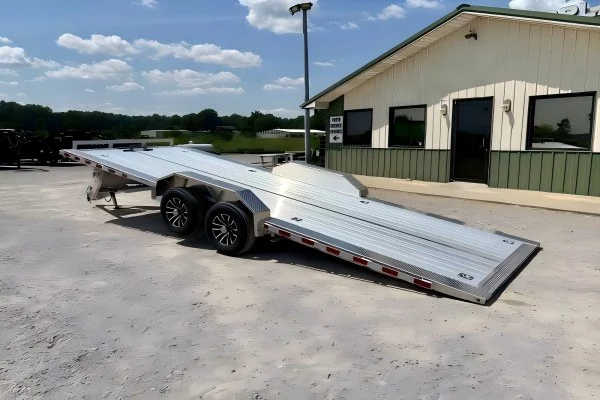
Aluminum tilting trailer guide for easier loading and long-term towing value
An aluminum tilt trailer is often the first serious upgrade people consider after struggling with heavy ramps, awkward loading angles, and trailers that slowly rust over time. If you regularly transport vehicles, compact machinery or wheeled equipment, the loading process is just as important as towing capacity. Aluminum tilt trailers are designed to reduce effort, improve safety and lower long-term costs of ownership. Instead of struggling with removable ramps, the trailer deck tilts, creating a smooth, controlled loading angle that works with gravity instead.

This type of trailer is especially popular with buyers who value efficiency and durability. Aluminum construction reduces weight, improves corrosion resistance and makes the trailer more stable. When these benefits are combined with a tilting deck design, the result is a trailer that feels easier to live with day in and day out, not just on paper.
What is an aluminum tilt trailer and why does it exist
An aluminum tilt trailer is a flatbed trailer constructed primarily of aluminum alloys rather than steel, with a deck that pivots at the axle point. This pivoting cover replaces traditional loading ramps. When weight is applied near the rear of the trailer, the deck gently tilts down until it touches the ground. Once the load is advanced and the weight distribution is balanced, the deck returns to a flat position and locks securely.
The reason this design exists is simple. Ramps are uncomfortable, heavy and often unsafe when used incorrectly. A tilt trailer eliminates this entire process. There are no lifts, no guessing angles, and no repositioning ramps. For people who carry equipment alone or in tight spaces, this design dramatically simplifies daily work.
Why aluminum construction changes the towing experience
Aluminum changes the behavior of a trailer both on the road and during its useful life. One of the most immediate differences is the weight. Aluminum tilt trailers are significantly lighter than steel equivalents. This reduced weight improves acceleration, braking performance and overall towing confidence, especially when approaching the limits of a towing vehicle.
Another important advantage is corrosion resistance. Aluminum does not rust in the same way as steel. For owners who operate in rainy climates, snowy regions or coastal areas where salt exposure is common, aluminum trailers maintain their structural integrity much longer. This results in fewer repairs, better appearance and stronger resale value over time.
How the tilting platform makes loading faster and safer
The tipping platform is the defining characteristic of this type of trailer. By eliminating ramps, the loading process becomes faster and more predictable. Vehicles and equipment roll smoothly on the deck at a shallow angle, reducing stress on tires, suspension and undercarriage components. This is especially important for vehicles with low ground clearance, such as sports cars or machines with low-mounted accessories.
Security is improved because there are fewer unstable components involved. Ramps can slide, flex or move under load. A tilting platform stays in line with the trailer frame at all times, providing a consistent and controlled loading surface. Over time, this reduces accidents, equipment damage and operator fatigue.
Common uses for aluminum tilt trailers
Aluminum tilt trailers are widely used for vehicle transportation, especially for performance cars, classic cars and lowered vehicles. The gentle loading angle helps prevent scraping of bumpers, exhaust components or front splitters. Many professional haulers prefer tilt trailers for this reason alone.
They are also common in the landscaping, construction and equipment rental industries. Compact loaders, trenchers, scissor lifts and mowers can be loaded quickly without additional installations. When jobs change frequently throughout the day, the simplicity of a tilting platform saves time and effort.
Key components affecting performance and reliability
The frame and deck of an aluminum tilt trailer are typically made from extruded aluminum sections designed to handle repeated load cycles. Quality trailers are designed to distribute stress evenly between pivot points to prevent long-term fatigue. The deck surface often provides natural traction without the need for additional coatings.
Axle selection also plays an important role. Many aluminum tilt trailers use torsion axles, which provide a smoother tow and lower deck height than traditional leaf spring systems. Tilting mechanisms are generally gravity-based or hydraulic. Gravity tilt systems are lighter and simpler, while hydraulic systems offer more control for uneven loads or frequent professional use.
Understand weight ratings and payload capacity
When evaluating an aluminum tilt trailer, GVWR should be one of the first specifications checked. The GVWR represents the maximum combined weight of the trailer and its load. Because the aluminum construction reduces the weight of the empty trailer, more capacity is available for the actual load without increasing the requirements of the towing vehicle.
It’s important to choose a trailer rated for the heaviest expected load, not just for your average use. Well-rated trailers tow more predictably, brake more effectively and meet the legal requirements of different regions.
Towing stability and on-road performance
On the road, aluminum tilt trailers generally feel more responsive and stable. The reduced weight improves balance and minimizes sway, especially at highway speeds. Many owners report that their tow vehicle feels less stressed, especially during long trips or frequent stops.
Fuel efficiency may also improve slightly due to lower rolling resistance and reduced mass. While this advantage may seem minor per trip, it becomes significant for business users or frequent flyers over time.
Long-term maintenance and durability expectations
One of the biggest advantages of aluminum tilt trailers is low maintenance. No need to deal with rust removal or frequent repainting. Basic maintenance includes checking fasteners, lubricating pivot points, inspecting brakes, and servicing tires.
Because aluminum resists corrosion, these trailers often remain structurally sound and visually appealing even after years of exposure to harsh environments. This durability directly contributes to increased resale value.
Cost considerations and overall property value
Aluminum tilt trailers tend to cost more upfront than steel alternatives. However, the difference is often recouped through lower maintenance costs, longer service life, improved fuel efficiency and stronger resale demand. Buyers who plan to use their trailer regularly or keep it long-term often find that aluminum is the more economical choice.
How to choose the right aluminum tilt trailer
Selecting the right trailer starts with the size of the deck. The cover must comfortably fit the larger load while allowing for proper weight distribution. Axis configuration is another key decision. Tandem axles offer better stability and greater capacity, while single axles are suitable for lighter applications.
Brake systems, tire ratings and lighting should never be overlooked. Power brakes and quality tires significantly improve safety and compliance, especially when towing on public roads.
Frequently asked questions about aluminum tilt trailers
Aluminum tilt trailers are strong enough for heavy equipment
yes Modern aluminum alloys are designed for structural strength. When properly graded, aluminum tilt trailers safely handle heavy equipment while maintaining a lower overall weight.
Aluminum tilt trailers work well in winter conditions
yes Aluminum naturally resists corrosion, making these trailers suitable for roads with snow, ice and salt without additional protective coatings.
Hydraulic tilting is better than gravity tilting
Hydraulic tilting offers more control, especially for uneven loads, while gravity tilting systems are lighter and simpler. The best option depends on the frequency and what you are carrying.
Aluminum tipper trailers can be repaired if damaged
yes Aluminum trailers can be repaired by qualified technicians. Although aluminum welding requires experience, repairs are common and well understood in the industry.
Aluminum tilt trailers are worth the higher purchase price
For frequent users, the long-term benefits often outweigh the initial cost. Easier loading, less maintenance and higher resale value make aluminum tilt trailers a strong long-term investment.
