

It was a field trip like no other. Before construction began on the $240 million Wisconsin Museum of Nature and Culture, the project team, including construction manager Mortenson Construction, Ennead Architects and exhibit designer Thinc Design, packed into cars for a seven-day, 28-stop road trip across Wisconsin. Their mission: to immerse themselves in the state’s most culturally and ecologically distinct places and gather inspiration that would ultimately shape the museum’s design and construction. Along the way, the trip also forged something equally important: trust and camaraderie among team members, including several who had never set foot in the state before.
Construction on the five-story, 200,000-square-foot museum began in the summer of 2024. It will replace the current museum, known as the Milwaukee Public Museum (MPM), which opened in 1882 and contains more than 4 million natural specimens and cultural artifacts. MPM will be open throughout 2026; the Wisconsin Museum of Nature and Culture is scheduled to open in the first half of 2027.

Workers are installing floor lighting in the five-story museum.
Photo courtesy of the Wisconsin Museum of Nature and Culture
Bringing the architects, construction management team and exhibit designers together for a road trip in the midst of the COVID-19 pandemic created a strong foundation for team building and a level of planning necessary for a very complex project.
“It was a great way to bond,” says Dr. Ellen Censky, the museum’s president and CEO. “We’ve had a lot of tough conversations. And we’ve worked through it because we all have confidence in each other.”
The trip also introduced the team “to the amazing scenery and people of Wisconsin. It inspired the team,” he says.

Construction of the new museum began in the summer of 2024, and is expected to be completed by 2027.
Photo courtesy of the Wisconsin Museum of Nature and Culture
“From a construction management perspective, the road trip really helped us establish a solid understanding of the vision for the project,” says Kurt Theune, vice president and general manager of Mortenson. “For any construction project, we’re problem solvers. But it really helped us set the boundaries for where we needed to problem-solve and problem-solve or come up with alternatives, knowing that there were things that were absolutely non-transmissible.”
Bringing the architect, construction manager and exhibition designer together early on and at the same time was “the right thing to do. We all grew in our understanding, and that’s very critical to building a cultural landmark for the city,” he adds.
“We’ve had a lot of tough conversations and we’ve worked hard because we all have confidence in each other.”
—Dr. Ellen Censky, President and CEO, Nature and Culture Museum of Milwaukee
One of the places they stopped was at Mill Bluff State Park in central Wisconsin, known for its dramatic, steep-sided sandstone bluffs and unique geological history.
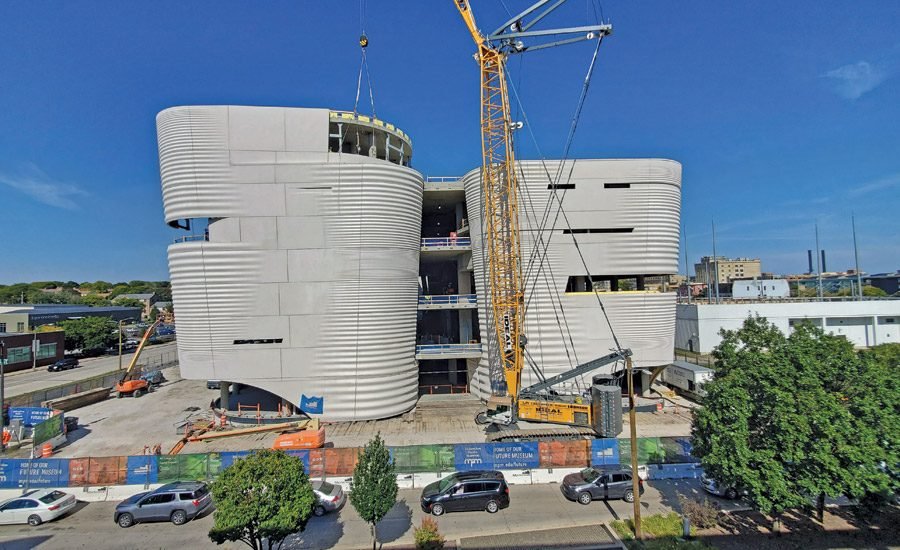
These rock formations inspired the museum’s exterior design, which consists of large sculptural concrete panels that mimic the cliffs. The plans also call for three entrances to the building that symbolize the three rivers that join Milwaukee. Each will end in a central area planned as a gathering space in the structure being built at North 6th Street and West McKinley Avenue in downtown Milwaukee’s Haymarket neighborhood.
“The word Milwaukee in Potawatomi means meeting place on the water,” Censky says. “And this is a gathering place. So this is all symbolic. And the site we chose was very specific. We wanted to be close to the neighborhoods we serve and not sit on the lakefront.”
The interior of the museum will feature five permanent galleries titled: Travels in Time, Travel to Wisconsin, Milwaukee Revealed, Living in a Dynamic World and Rainforest. There will also be a planetarium, a butterfly nursery, a roof garden, a cafe and an outdoor plaza.

Workers install 70,000 plastic voids to reduce the weight of the building.
Photo courtesy of the Wisconsin Museum of Nature and Culture
“Ellen [Censky] gave us this incredible challenge when we started the project, which was to tell the story of nature and culture and how they intersect not just in Wisconsin, but in Milwaukee,” says Jarrett Pelletier, principal of New York City-based Ennead Architects. “So we’re trying to tell a story that connects all of those threads. . . . We took a lot of cues from what we learned [on the road trip]and that really generated forms and materials and how we tell stories through architecture.”
The exterior features 670 precast concrete panels manufactured by Stonecast Products in Germantown, Wis. They vary in size, with some up to 35 to 40 feet long. The heaviest weigh up to 56,000 pounds, or 28 tons.
“In the beginning there were a lot more panels and it was a lot more expensive than we could afford,” says Censky. “The team came together and figured out how they could reduce the panels without reducing the look of the building.”
To maintain the structure’s appearance while keeping costs under control, Theune says the team focused on the building’s corner, curved panels, which were shaped like upside-down cones in sections.

The construction and design team envisioned the building as a tilted cylinder shape, which reduced cost and increased efficiency.
Photo courtesy of the Wisconsin Museum of Nature and Culture
“Initially, the lower radius was larger and the upper radius smaller, creating a unique formwork for each segment,” says Theune. “Each level required a different shape, which complicated the construction. Working with local contractors, we reimagined the geometry into what we called a tilted cylinder, essentially an extruded cylinder, a cylinder that has been stretched along its axis. This change meant that the same shape could be used all the way to each corner, making all 12 corners of the building identical.”
“They [Mortenson] they were very good to wear [Stonecast Products] to talk to us about our design at a time when we could still make design changes,” says Pelletier. “Through that, they helped us make sure that these shapes can be repeated even though the building has a very organic shape.”
“These temporary shapes disappear once the concrete cures, but the process was a game changer.”
—Kurt Theune, vice president and general manager, Mortenson
The team also optimized other aspects of the prefab process, including the pattern and texture of the forms, allowing for repeatable and reusable forms.
“We were able to cut hours and weeks and several people and out of the process to create these forms,” says Theune. “And that’s where the expense came down. It’s very important when you’re talking about 600-plus panels. Getting it down to 20 shapes that we can rinse, repeat and reuse was crucial.”
Theune says that from a construction innovation standpoint, some of the most interesting work in the building isn’t what you’ll see in the exhibit, but the means and methods that were used to create the building’s unique geometry.
No two floor plates are the same. There is a curved light well in the center that changes as it rises and creeps up the walls into the planetarium spaces.

An 82-foot-tall skylight and an organic, sculptural design are some of the museum’s attractive architectural features.
Photo courtesy of the Wisconsin Museum of Nature and Culture
“Concrete can be demanding, so our craftsmen had to innovate with their formwork and materials,” he says.
The crews used CNC machines, essentially automated tools that are guided by computer programs, to cut, cut, drill or shape materials with extreme precision rather than using field-cut plywood to ensure that everything lined up perfectly and looked as intended.
“These temporary shapes disappear once the concrete cures, but the process changed the game,” says Theune.
With panels weighing up to 28 tonnes, the team needed to reduce the load on columns, beams and foundations. They built the structure using 70,000 plastic vacuum forms, called BubbleDeck, which reduced the weight of each floor and allowed less steel in the building.
Theune says the BubbleDeck removed approximately 1,440 cubic meters of concrete from the concrete decks. A cubic yard of concrete weighs, on average, 4,000 pounds, which equates to approximately 5,760,000 pounds of removed concrete weight. Some weight was added for the weight of the bubble cages and balls, but the system lightened the structure by about 5 million pounds.

A tower crane was installed for the five-story building in October 2024.
Photo courtesy of the Wisconsin Museum of Nature and Culture
“Reducing the weight and carbon footprint of the project was a huge win and achievement,” says Theune. “It allowed us to shape the individual, unique floors of the building in the most efficient way and made more sense for the exhibition spaces within the museum.”
Like the cliffs it imitates, the building does not rise in a straight, vertical line. It grows in footprint as it rises and is curved and sloping.
The 150 craftsmen currently on site represent only a fraction of the 700 who will be working on the project at full capacity.
“These are some of the best in the city and the state, and they’re applying all their skill and intelligence, essentially creating a work of art,” Theune says. “It’s inspiring to see even new apprentices, many from Milwaukee County, explain the Three Rivers concept and the reasoning behind the building. That combination of innovation, craftsmanship and pride is what makes a project like this truly remarkable.”
Censky says the project’s unique design and construction methods are inspiring. “I’ve been bringing donors through [on tours] and I had a donor say, “I didn’t realize how transformative this is going to be.” I thought you just picked things up and moved them around. I think I need to get more involved.’ When people come in and see it, they’re blown away.”
