

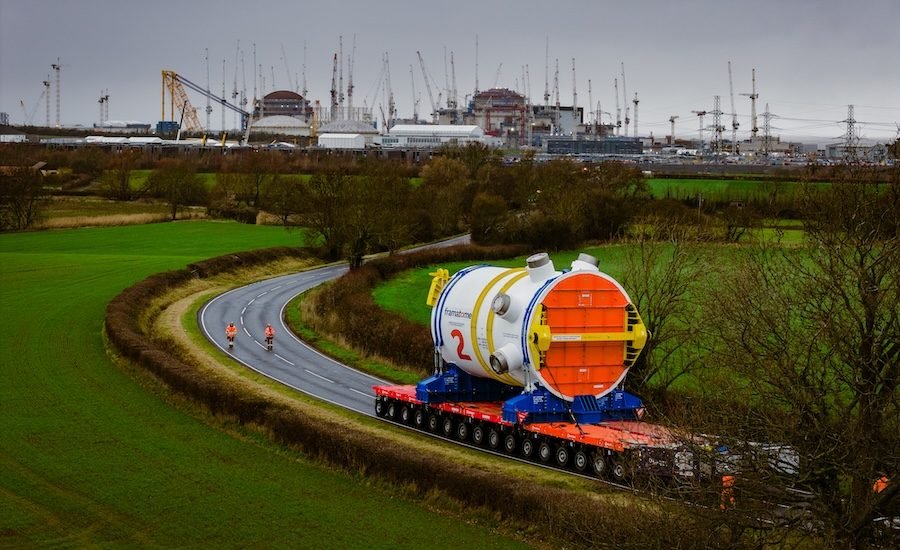

Nnuclear power construction projects in England and France, years behind schedule and billions over budget, hit milestones in recent weeks. In January, a project in Somerset, UK, took delivery of its second reactor. In December, the other project, in Normandy, France, became fully operational for the first time.
Rather than being examples of a bad trend, says a prominent British nuclear power advocate, these projects are outliers and nuclear power developers and contractors are building new power stations faster than in the 1970s and 1980s.
“We’re actually faster now,” writes Tim Gregory, a nuclear chemist and author of “Going Nuclear: How Atomic Energy Will Change the World” (Pegasus Books, 2025).
The The state-controlled French utility Electricité de France (EdF) is developing both the English and French projects as European pressurized water power stations.
The completion of the UK project, Hinkley Point C, will likely take anywhere from seven to 12 years to complete, Gregory writes.
The first reactor arrived in 2023 and is already installed and welded into place, EdF reported. The work continues faster in this later phase of work because of the experience with the first reactor, the company wrote.
In February 2024, following recent news of further delays and cost overruns at the 3,260 MW power plant, EdF completion forecast between 2029 and 2031, with costs rising to a range of $39 billion to $43 billion. The previous completion target set at May 2022 was June 2027.
At the Normandy project, EdF announced that it had reached maximum power in a pre-operational test of its EPR reactor, called Flamanville-3.
The expansion followed approval by France’s nuclear safety and radiation protection authority to exceed the 80% power threshold, EdF said. The plant was scheduled to be connected to the grid on December 30, EdF told NucNet.
Gregory notes in his book that the project will end in a cost many times what was first estimated in 2004.
Nuclear power’s role as a carbon-free energy source is likely to grow, he writes, but cost and schedule issues have plagued many recent projects.
Hinkley Point C and Flamanville-3 “are outliers,” argues Gregory, and “we’re actually faster now than we were in the 70s and 80s.”
Citing a 2024 International Atomic Energy Agency report, Gregory writes that Europe in those decades built nuclear power plants in an average time of 7 years and 2 months. France built numerous nuclear plants somewhat faster because it had chosen a standardized pressurized water reactor design and built it over and over again.
Slower construction times after Chernobyl, a localized problem
But since the 1986 Chernobyl nuclear disaster in Ukraine, Europe’s average construction time has reached 13 years, as the continent “forgot how to build fast,” Gregory writes.
But China, he says, has built 51 nuclear reactors since 1990, with an average construction time of less than six years. South Korea has also built 27 nuclear reactors since the 1970s. While that country’s three newest reactors took more than eight years to build, South Korea has built 27 nuclear reactors since the 1970s in a “decade-by-decade” construction time of less than six years, Gregory says.
Reducing construction time will lead to savings, Gregory says. “The delays in nuclear plants are bureaucratic and managerial,” he writes, and “it is not beyond our wits to make them cheaper by building them faster.”
While nuclear reactors are being built on time and on budget in some parts of the world, Gregory says, “We need the motivation to do it again in Europe and the US.”
