

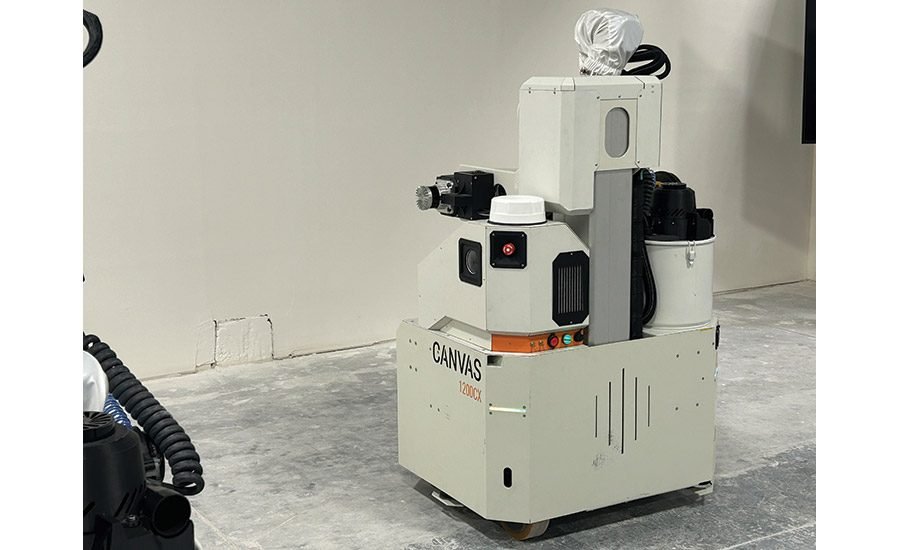

JLG Industries, a global manufacturer of mobile aerial work platforms and telematics manipulators, announced Jan. 5 that it has acquired Canvas, a San Francisco-based construction robotics technology company known for robotic solutions for drywall installation and finishing. Terms were not disclosed. The acquisition includes Canvas’ core technology that powers the 1200CX drywall robotic platform.
“Robotics and automation will play an increasingly important role in the future of construction, especially as the industry looks for practical ways to deliver greater efficiency, improve productivity and improve consistency on jobsites,” says Shashank Bhatia, Chief Technology Officer, Access Segment Based in McConnellsburg, PA JLG, a division of Oshkosh Corp. “This acquisition strengthens our technology roadmap and accelerates our ability to deliver solutions that create real, measurable value for customers in the field.”
CEO Albert and the Canvas team will become employees of JLG, but will remain based in San Francisco. Canvas’ technology combines robotic precision with the skills and experience of trained tradespeople who operate its robotic drywall platform. The system streamlines interior finishing workflows by automating fit and finish tasks, reducing rework and delivering consistent quality while minimizing physical demand.
Bhatia says Canvas’ technology will be used to advance the company’s robotic capabilities and autonomy, including pairing with JLG elevator access equipment to support a range of interior construction applications. These new processes will be designed to help skilled workers take on repetitive and physically demanding tasks to allow crews to focus on higher-value work.
“We actually started communicating with them in 2017, the year Canvas was founded,” explains Bhatia. “Their technology was always good, but we weren’t aligned at the time. Their go-to-market strategy was to be a general contractor. In 2021, I talked to [Canvas CEO Kevin Albert] again and that’s when they were working on the 1200CX product that could do a level 5 finish,” he says. “In 2024 we saw a vision of it and I really liked it. My mind was thinking “how can I use this in our current products?” for us, [products like the 1200CX] it fits so well into our vertical product line.”
Bhatia says the combined company is looking to innovate tasks like installing and finishing drywall, still largely done by hand by individual workers, into activities that equipment can improve in the same way that a hydraulic excavator can replace hundreds of shovels in the hands of human workers.
“The future of the workplace will move from enabling work to executing work,” says Bhatia. “Helping the operator get the job done. You could definitely see a case where the best place for the operator is to be on the ground with a swarm of robots controlled by operators on the ground who are doing the work up high.”
