

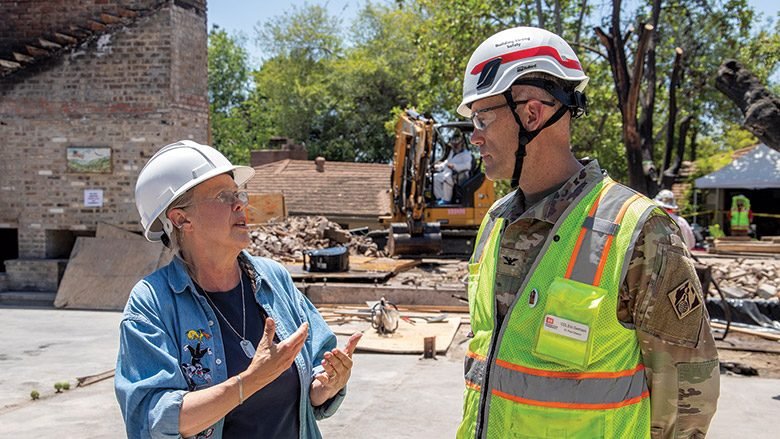

From an early age, Col. Eric R. Swenson was drawn to construction and earthmoving equipment, “so much so that as a child I lost my parents on a family bike ride after stopping to see the dredging operations of the Army Corps of Engineers in Ocean City, NJ,” says Swenson. His family also instilled public service as a core value, motivating Swenson to become an Eagle Scout and later study engineering at West Point, where he was commissioned as an engineer officer in 1998.
These values proved indispensable in helping communities clean up and recover from major wildfires, first in Lahaina on the Hawaiian island of Maui in 2023, and then the historic Los Angeles wildfires in January 2025.
Swenson brought many lessons learned from Maui to his role as commander of the reclamation field office in LA, responsible for coordinating thousands of corps workers and contractors to remove more than 3 million tons of debris from more than 9,500 properties.
“Disasters are fast and chaotic,” he says. “In the beginning, it’s the convergence of many agencies from all levels of government coming to help a community reeling from its worst nightmare. Building trust at all levels, and especially at the leadership levels of organizations, is critical to conflict resolution. Success in a disaster requires leaders to work together for the sake of the mission.”
LA County Public Works partnered with the Corps in coordinated recovery efforts. Swenson “played a key leadership role by serving as a central point of coordination, ensuring seamless collaboration between federal and county teams, solving real-time operational challenges and maintaining a shared focus on restoring affected neighborhoods safely and efficiently. He was the face of our operations and represents the best of what it means to serve our country,” says Public Works Director Mark Prest last year.
Critically, Swenson also sought to build trust among disaster survivors. “We saturated the affected areas with knowledgeable and personable teammates and met survivors where they were, emotionally and physically,” whether at places of worship, grocery stores, post offices, community centers or elsewhere, he says. “Building trust with the community gave survivors the confidence to sign up for the government’s waste program.” Since the vast majority of survivors signed up early, it allowed prime contractor ECC to mobilize quickly. The Corps’ pre-negotiated forward contracting initiative also helped begin debris removal within a week of fire containment.
Survivor Robert Staehle, a retired engineer at NASA’s Jet Propulsion Laboratory, says his experience with the Corps’ cleanup teams was “excellent,” adding “the planning was fantastic. All the right equipment showed up when it needed to be done, and all the right people with the right skills. They completely listened to what we wanted to save.”
Originally expected to take a year, the cleanup was completed in just eight months.
Swenson “showed purpose-driven leadership,” says Talin Espinoza, chief strategy officer at Royal Electric Co., which lost its home in the Altadena fire. “Combining urgency with clear communication and respect for those affected, he kept the mission moving efficiently while never losing sight of the human impact, allowing families like mine … hope that we could move forward and rebuild.”
He adds that the Corps demonstrated that “empathy and building can go hand in hand. A clear mission, disciplined execution and genuine respect for affected people set a powerful example for anyone serving communities in crisis.”
Swenson currently serves as deputy commander of the Corps’ North Atlantic Division. In July, he becomes commander of the New York district.
