

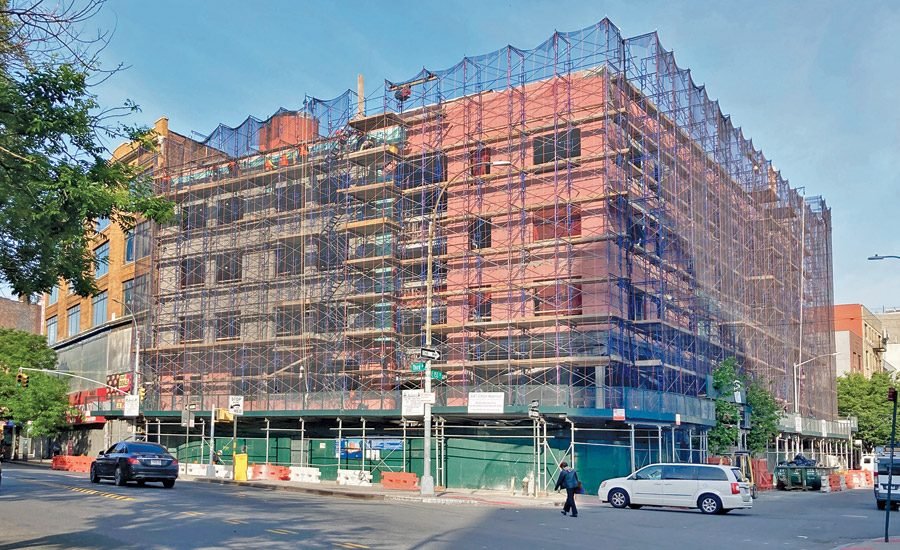
When the Earl Monroe New Renaissance Basketball School opens its doors in the Bronx this summer, there will be no doubt who the star of the building is. Located on the ground floor, just past the welcome desk, an 8,000-square-foot gym with a full basketball court and two smaller side courts will serve as both the physical and programmatic centerpiece of the five-story, 69,000-square-foot building.
The specialty high school, with a construction cost of $35 million, broke ground in September 2024. It will feature an academic curriculum focused on basketball and associated career paths, including media, sports psychology, law, nutrition, facilities management, venture capital business and others. The first school of its kind will accommodate up to 440 students in grades 9-12.
With the classrooms located on the floors above the gym, the design and construction team faced the structural challenge of stacking the upper floors over the long-haul gym space below. Kimberly Murphy, partner at project design architect ESKW/Architects, says the decision about where to place the gym kept the most public spaces on the ground floor, while the upper floors focus on students and staff.
“Putting the gym on the ground floor really allows it to be the star of the building in a lot of ways, and it allowed the classroom to have some privacy away from this very public space,” he says. “The gym can have donors and visitors and all kinds of people come in. … We invite the public to come in. We’re a community building. We want people to come and see the magic sauce of what goes on inside this school.”

The architect team of ESKW/Architects and IMC Architecture, construction manager JV Construction & Consulting, structural engineer CityScape Engineering and general contractor Brisa Builders worked together to create a large, column-free space in the gym area.
Rendering by ESKW/Architects
Long lasting solution
ESKW/Architects and executive architect IMC Architecture worked with structural engineer CityScape Engineering to address the building’s primary challenge: supporting the educational spaces above the gymnasium. The team developed an oversized truss structural system, including three sets of oversized trusses installed above the gymnasium to support columns and retaining walls for the three upper levels. The trusses are 12 feet high, and the longest spans over 92 feet.
“No building in New York City could lose 12 feet [of elevation].”
—Jonathan Imani, Director, IMC Architecture
Jonathan Imani, director of IMC Architecture, says the team knew from the start that incorporating the trusses into the design was the building’s main challenge. “No building in New York City could lose 12 feet [of elevation]” adds Jonathan Imani, director of IMC Architecture. “It was interesting how we worked this out.”
Finally, the design team was able to hide the system within the walls and ceilings of the third floor. One armature was integrated into a hallway, while another was placed along an exterior wall that overlooked a small rooftop space above the gymnasium. These armors required multiple penetrations for doors and windows.
Foundations include extended footings and grade beams. The design also includes two steep walls, two stair cores and an elevator core that serve as part of the side loading system.

The charter school for more than 400 students in grades 9-12 will expose students to professions including journalism, marketing, nutrition, physical rehabilitation, psychology, business, law, finance, entertainment, food service, personal representation, design and data analytics.
Photo by Peter Wilk/Wilk Marketing Communications
Construction challenges
Additional construction challenges arose with the design team’s structural solutions. The project is located at a busy intersection, creating logistical and staging challenges for the construction team. The team also had to consider transporting the large steel members to the site. The design team worked with construction manager JV Construction & Consulting and general contractor Brisa Builders to find feasible ways to cut, transport and install the steel members.
Finally, the trusses were manufactured by Breton Steel in Quebec, with the upper and lower chords of each truss cut into two sections. The longest span included a splice about 54 feet long and 36 inches deep. The heaviest piece was 30,244 pounds.
The team worked with the manufacturer early on in the project, which eventually paid off when tariffs were imposed on Canadian steel. “We won [the tariff deadline] of a couple of days,” says Jovana Villanueva, president of JV Construction & Consulting. “We planned it just in time.”
Villanueva says the team scheduled the erection of the armor on weekends to avoid disrupting individual and commercial weekday traffic. The rebars were installed with a Liebherr LTM 1250-5.1 crane and the streets were temporarily closed as needed. A robust steel assembly tower was also constructed to assist in the installation and joining of the steel members. The weight of the tower along with additional loads during installation required the design team to reinforce the foundations just below the tower location.
With the structure complete, crews installed the concrete floors. Instead of large pours, traditionally a faster but more expensive option, crews installed precast concrete planks.

Steel mounting towers were added to assist in the installation of the long span trusses.
Photo courtesy of CityScape Engineering
Honoring the Tradition
For the exterior facade, the designers chose a mix of masonry and concrete panels. The facade incorporates large, glazed areas of curtain wall, which the design team says “allow passers-by to visually engage with the activities taking place inside and remind students that they are part of a vibrant community.”
The building’s arched entrance is designed to reflect the look of a traditional early 20th century cottage design. The brick facade is meant to recall American school designs of the 1920s and 1930s. Different colors of exterior brickwork were specified to distinguish between the public and private spaces of the building. Public spaces on the lower levels, such as the gymnasium, library and lobby, will be a traditional red brick color. Lighter colored brick was installed at classroom levels on the upper floors. The exterior of the building also uses gray panels to indicate the location of the gymnasium and library/media center, as well as to break up the mass of the building.
Angular glass wraps around and above the main entrance, which leads into the lobby. Angled brick walls surround the glass system in the lobby, as well as a sloping brick system that slopes down to the glass. IMC identified a UK-based supplier, IG Masonry Support, who helped design the system and design and manufacture custom supports that support the custom brick feature. The company’s manufacturing facilities are located in Poland, England and Wales. In addition to the international sourcing of materials, the windows were manufactured in Germany and the Netherlands.
“Although drawing it on paper is not easy, building it is even more difficult.”
—Hadi Djohan, Director, CityScape Engineering
The gym has seven clerestory windows located 15 feet high on the building’s north facade. The placement of the window allows natural light in, but not direct sunlight that could affect players’ vision.
The building features a single-story wine cellar that will house the student dining hall and full-service kitchen, a lounge, a weight training room, as well as a ballroom with a floating floor system and a recording room that are part of the school’s music program. Acoustics were an important consideration in the design, as programming spaces such as classrooms and a recording studio were located above and below the gymnasium.
The second floor has a partial footprint as most of the gym occupies two levels. These levels house a lounge area with VIP gaming seating and a multi-functional library with a media center and conference room. This floor will also house the executive director’s office, which will overlook the gymnasium, and the staff lounge.
The third and fifth floors will primarily house 24 classrooms averaging 650 square feet each, plus offices, an art room and gender-neutral bathrooms. On the third floor, students can access an outdoor terrace.
While the first school of its kind could serve as a future model for the sports and education nexus, the design and construction team will also draw lessons from the project. Hadi Djohan, director of CityScape Engineering, says he hopes the use of long-span trusses can serve as an example of how the solution could be used in other projects that wouldn’t normally consider it.
“We had two other projects with a similar concept, but … they didn’t get built because the contractor was hesitant about the challenge,” he says. “I have to give credit to the contractor. While drawing it on paper isn’t easy, building it is even harder.”
