

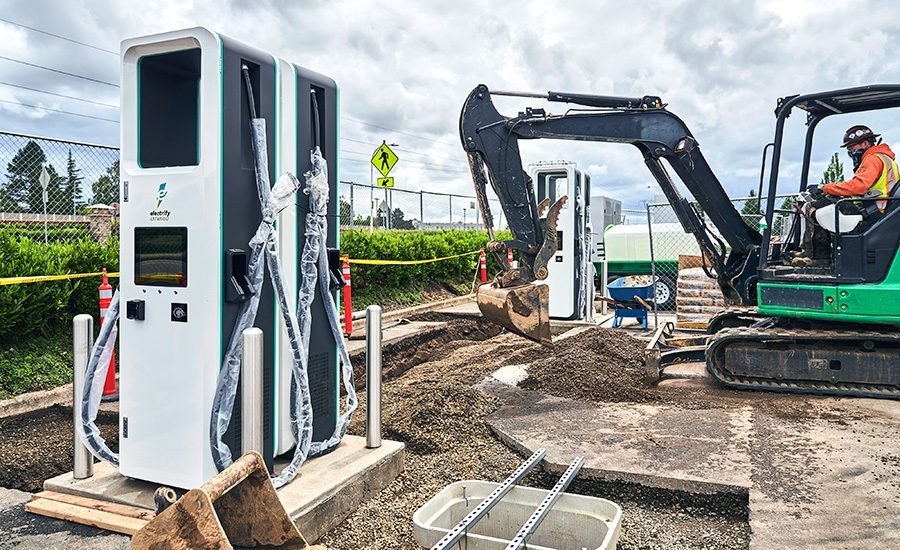
A federal court ruling has reopened access to hundreds of millions of dollars in electric vehicle charging funds, clearing the way for states to resume stalled National Electric Vehicle Infrastructure (NEVI) projects after the U.S. Department of Transportation froze approvals tied to the $5 billion program.
In her partial summary judgment issued on January 23, Judge Tana Lin of the United States District Court for the Western District of Washington ordered the USDOT and the Federal Highway Administration (FHWA) to suspend previously approved state EV infrastructure deployment plans or withhold NEVI formula funds tied to those plans.
Lin found that the FHWA lacked authority to rescind approvals of plans that had already passed federal review, a move the court called “capricious” and illegally blocked access to funds doled out by Congress.
Officials in Washington state, who led the multistate lawsuit, said the ruling restores certainty to a program designed to advance construction of the corridor’s freight across the country. State Attorney General Bob Ferguson said the federal government “cannot simply stop a program explicitly authorized and funded by Congress,” adding that the ruling ensures states can continue infrastructure investments already approved under federal law.
The decision follows a February 6, 2025 FHWA directive that rescinded previous NEVI guidelines and suspended approval of all state electric vehicle infrastructure deployment plans while the agency reviewed the program.
RELATED
Watchdog Says EV Infrastructure Funding Freeze Is Illegal
While the FHWA allowed repayment of existing obligations during the hiatus, states were prohibited from obligating new NEVI funds, effectively freezing procurement pipelines tied to approved plans.
Operationally, the ruling restores a key mechanism for the execution of the project. Once a state’s NEVI plan is approved, federal agencies cannot revoke that approval or block obligations without clear authorization from Congress. By preventing FHWA from suspending plan approvals, the order reopens access to unobligated NEVI funds for plaintiff jurisdictions.
What changes the sentence for the delivery of the project
The impact varies widely by state, depending on how much funding had already been committed and how far along projects were when the pause went into effect.
Data sidebar

A national map of designated alternative fuel corridors for electric vehicles shows where NEVI-funded charging projects are concentrated. Click the image to see which states have funding back in play and what happened next.
Map courtesy of the US Department of Transportation
In states with large unobligated balances, such as California, New York, Illinois and New Jersey, the decision clears the way for corridor charging projects that had stalled in the procurement or preconstruction stage. Other claimant states had already obligated most of their NEVI funds before the suspension.
For transportation agencies, the ruling restores bidding schedules and procurement sequencing that had remained in limbo. Several states halted applications or delayed awards while they awaited clarity on whether plan approvals would stand, particularly for corridor packages that require coordination with utilities and private freight operators.
In practical terms, the first projects likely to move are corridor packages that stalled after environmental clearance but before award, particularly those that combine site work, conduit installation, transformer pads and service preparation for high-capacity fast chargers.
In several claimant states, these projects had reached the point of issuing or evaluating requests for proposals when plan approvals were suspended, leaving contractors unable to price final scopes related to utility coordination and interconnection schedules.
Officials in Michigan, also among the plaintiffs, said the ruling allows the state to move forward with projects already planned under its federally approved rollout strategy. Michigan Attorney General Dana Nessel’s office said the decision ensures NEVI funds “will be available to support electric vehicle charging infrastructure projects that were halted without legal justification.”
Industry groups said the decision was not unexpected, but cautioned against assuming immediate impacts from construction.
RELATED
Senate lawmakers want FHWA to speed up EV charging program
“These funding breaks and withholdings are an issue we’ve been following closely since the beginning of the administration,” said Brian Turmail, vice president of public affairs and labor for the Associated General Contractors of America. “So far, in every case involving highway funding, they have been unsuccessful. The law is very clear about the limited reasons USDOT can withhold or terminate funds, so we were not surprised by the ruling.”
Turmail added that because USDOT renewed funding for the NEVI program last August, the court decision may not immediately change activity in all markets. Similarly, AGC Chief Economist Ken Simonson cautioned that the ruling may not translate into a measurable short-term impact for most construction companies, depending on how quickly states restart hiring and move projects forward.
The ruling directly affects the states and jurisdictions that brought the case, but its implications go beyond limiting how USDOT administers formula programs once funds are distributed and plans are approved. USDOT and FHWA did not respond to requests for comment on whether the agencies plan to appeal or how quickly plan approvals will resume.
For builders and designers, the key concern is time. With unobligated NEVI funds available again in major states, transportation agencies are expected to act quickly to resume stalled applications and move corridor freight projects toward construction as the next construction season approaches.
