

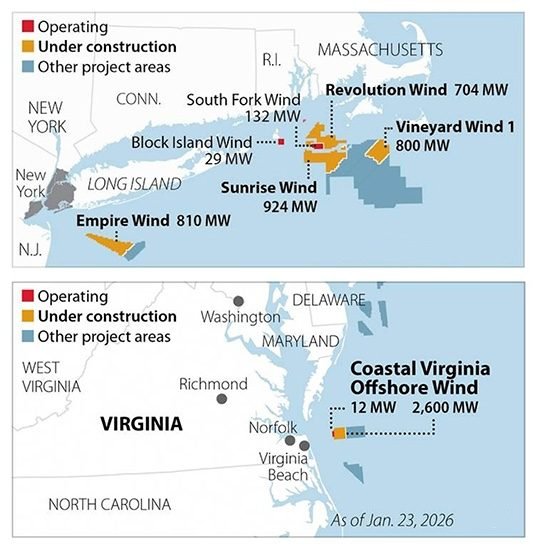

The last of five federal court hearings for large offshore wind projects under construction that challenged a Dec. 22 Trump administration stop-work order has played out like the others, with a Feb. 2 decision reversing a construction freeze on New York’s 924 MW Sunrise Wind project.
While the U.S. Department of the Interior asked the court for “deference” to its argument that the project, like the others, posed national security risks — information that project officials said was not shared with them — U.S. District Court Judge Royce Lamberth disagreed. “Supposedly new classified information does not constitute a sufficient explanation for the [federal] decision to completely halt work on the Sunrise Wind project,” the bench said in a ruling after a two-hour court hearing.
The decision restarts work on the project, the second with a state power contract affected by the work stoppage and the second largest of the five East Coast projects that had been shut down. Sunrise Wind is 45% complete, with about 44 of its 85 turbine foundations installed.
Project developer Orsted said in its January court filing that it has spent or committed more than $7 billion so far to build the project and that if the stop-work order was not lifted by Feb. 6, the project would no longer have access to its specialized construction vessels to complete construction of the turbine and installation of the 80-mile offshore cable to connect the generated power to an onshore transmission grid. This would delay revenue generation, compromise the project’s financial viability “and create a substantial risk of its cancellation,” the company said, adding that the cable installation is a “critical turning point” for the project, as its support vessel would not be accessible again until the third quarter of 2027.
According to the Oceantic Network, an industry trade group, Sunrise Wind’s supply chain “spans 34 states and has generated more than $1.9 billion in investment while supporting more than 4,290 American jobs in the construction, operations, shipbuilding and manufacturing sectors.” Ten shipyards in Alabama, Florida, Louisiana, New York, Pennsylvania, Rhode Island and Texas built or retrofitted more than 16 vessels operating at the site, he said, while a “robust steel supply chain from New York to North Carolina, the Gulf Coast and the Midwest” sourced the project’s secondary steel and turbine components.
Lamberth, a Reagan appointee, ruled similarly last month for the 704 MW Revolution Wind project between Rhode Island and Connecticut, which was the first of five challenges decided. In between, three other federal judges in Norfolk, Washington and Boston dismissed the administration’s action to restrict the completion of the 2.6 GW offshore Virginia offshore wind project in Virginia Beach; 810MW Empire Wind project south of New York City and 810MW Vineyard Wind project in Massachusetts, with all three near completion or 60%.
Lamberth also spoke out against a separate administration that ordered the shutdown of Revolution Wind last September.
Looking for quick answers on construction and engineering topics?
Try Ask ENR, our new intelligent AI search tool.
Ask ENR
Vineyard Wind won its construction stay on Jan. 27, with only a few of its 62 turbines to be installed and the project allowed, under Trump’s order, to generate 572 MW of power from those now operating. “Based on the government’s own assertions … the issuance of the relief will not substantially impede the government’s interests … while Vineyard Wind will likely suffer irreparable harm,” Boston District Court Judge Brian Murphy said. “All of the court’s factors weigh in Vineyard Wind’s favor.”
Taylor Rogers, an administration spokesman, did not say when or if the government would appeal the Sunrise Wind ruling, but said its push to develop more oil, gas, coal and nuclear power is “driving economic growth to create new jobs throughout our economy.”
Still, “it’s impossible to impact offshore wind and not hurt the oil and gas industry,” because of the sectors’ interdependence, said Sam Salustro, Oceanic Network’s senior vice president of policy and market affairs. E&E news.
Court decisions are also ahead on the merits of the project’s challenges.
Talks on reform could resume
Meanwhile, Congress is watching the battle unfold, with action to allow reform stalled by Democrats in response to stop-work orders.
In a Jan. 28 hearing, Senate Environment and Public Works Committee Chairwoman Shelley Moore Capito (RW.Va.) expressed a strong desire to develop and pass permitting reform legislation that could support the changing priorities of different administrations.
“We’ve all had communities that we represent affected by projects that were delayed or canceled by new administrations. I know West Virginia families have experienced that deep disappointment on several occasions,” he said, adding that any new legislation must be bipartisan and neutral.
“We’ve seen the defunding of the Jobs and Infrastructure Investment Act, the halting of Inflation Reduction Act projects, and the use of executive authority to revoke permits for privately funded infrastructure projects that have already been approved,” Brent Booker, general president of the Workers’ International Union of North America, told the Senate hearing. “These actions raise a fundamental question for this committee: What is the point of allowing reform, if any project, no matter how much progress it makes, can be shut down with the stroke of a pen?”
But Democrat Sheldon Whitehouse (RI), who ranks the Environment and Public Works Committee, said he, along with Martin Heinrich (DN.M.), his counterpart on the Senate Energy and Natural Resources Committee, said bipartisan negotiations to authorize the reform are on hold for now because of the administration’s actions against offshore wind and other clean energy projects, under “excessive national security pretexts.”
Even some Republicans are raising concerns with the administration. In a joint letter last month, some representatives from New York, Pennsylvania, Virginia, Nebraska and Colorado asked for more details on “how radar interference, environmental trade-offs, long-term exposure to subsidies, workforce impacts and broader national security considerations” were evaluated for wind projects. Emphasizing the late stage of construction on most projects, and that some were already delivering power “to local communities,” the congressional letter said the additional delay “prevents our constituents from accessing the affordable and reliable electricity they need and expect.”
