


Josh Senko
Responsible for pre-construction
Turner Construction
Despite some market spikes and corrections, the Atlanta metro area has seen fairly steady construction in recent years. After a solid rebound in 2025, metro Atlanta could see a slight increase in total construction starts in 2026. Dodge Data & Analytics forecasts that starts could reach $24.3 billion this year, up 5% from last year’s figure. In recent years, most sectors have remained fairly stable with single-digit year-over-year changes. However, construction starts on office, manufacturing and other commercial buildings increased in 2023, causing total non-residential starts to increase by 67%. The following year, the trend was reversed when non-residential starts fell 54%. According to Dodge’s data, starts in the Atlanta area appear to be back on a steady path.
Business and manufacturing starts could rise 4% this year, while institutional work could rise 8%. Residential is also poised for a strong year, with Dodge forecasting an 11% increase in starts to $10.4 billion. Both single-family and multi-family properties are expected to see more new activity.
Nonbuilding starts could be the drag on the market, with total starts expected to drop 10%. The decrease is mainly due to the highway and bridge sector, which had a strong year in 2025 at $3.2 billion compared to $2.5 billion forecast for this year.
Josh Schenko, preconstruction manager for Turner Construction in Atlanta, says the company has generally seen the market remain fairly stable. “We’ve seen it hold steady in our core markets of health and higher education,” he says. “These have remained very strong.”

Meanwhile, the company has seen the commercial market drop “quite significantly”, especially given the difficult lending conditions. However, he says increased opportunities in mission-critical work have filled the gap with high demand for data centers. Schenko says Turner has several mission-critical projects underway with confidential clients, and more projects are in the works.
However, Schenko says Turner is committed to maintaining a balanced portfolio and “not becoming a full-time data center builder.” Because of the size of the projects, he says the mission-critical work is large in volume, but “in terms of quantity, we make sure we keep our core clients in health care and higher education.”
Last year, the company completed the 150,000-square-foot Braselton Tower and Central Power Plant expansion project at Northeast Georgia Medical Center. The company also works with Grady Memorial Hospital.
In higher education, Turner recently completed the Tech Square 3A project at Georgia Tech. The Tech Square development brings together the Scheller College of Business and the H. Milton Stewart School of Industrial and Systems Engineering.
“With mission-critical work driving commercial mechanical, electrical and plumbing capability, it’s causing a ripple effect across the market.”
—Josh Schenko, preconstruction manager, Turner Construction
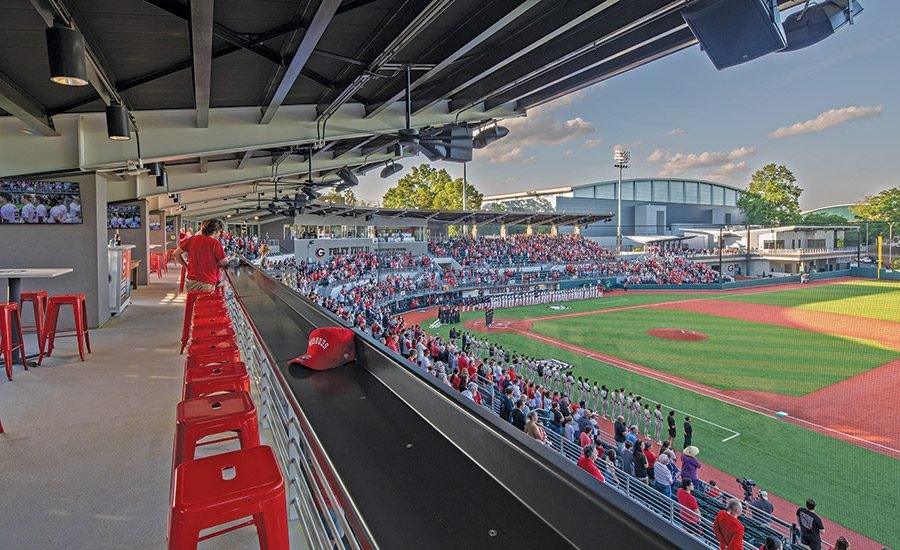
Last year, the design-build project team of Turner Construction and HKS Architects completed a two-phase, $45 million renovation of Foley Field at the University of Georgia. The project broke ground in June 2023 and was slated for opening day in 2025. Schenko says Turner currently has three projects under construction at UGA.
Turner has seen some high-profile opportunities in the residential market. Last year, it outbid 1072 West Peachtree for the Rockefeller Group. When completed this spring, the 60-story mixed-use building will be the fifth-tallest skyscraper in the city and the tallest built in Atlanta in more than three decades. Situated on a site of just over an acre, the team was able to stack a 40-level residential tower on top of 10 levels of offices on a 10-level base of parking with ground floor retail space.
Schenko notes that the demand for mission-critical work is having an impact on other sectors, drawing labor and other resources away from institutional and commercial work. “With mission-critical work driving mechanical, electrical and plumbing trade capacity, it’s causing a ripple effect across the market, which is seeing some price increases,” he adds. “This has led to a project that could have been [estimated] at $200 per square foot to now increase another $50 to $75 per square foot. This causes some projects to slow down or not move forward.”
Material price increases, in part due to tariffs, are also part of the equation. Equipment lead times are also affected by data center demand, including generators and large air handlers. While recent market uncertainty has stabilized somewhat, Schenko says contractors still need to get clients to “get over some of the sticker shock of where the market is right now in terms of pricing.”
