


High-resolution images from dash cameras and other in-vehicle tools are gaining traction with state transportation departments as they use them to study highway assets such as guardrails, signage and bands to make better-informed maintenance decisions.
Bentley Systems announced on February 5 that the Alabama Department of Transportation (ALDOT) has begun using Blyncsy, which collects images from high-resolution vehicle cameras and applies artificial intelligence to analyze road conditions.
Most DOTs, more than 80 percent, have deployed or are considering adopting Blyncsy, says Mark Pittman, director of transportation AI at Bentley. Last year, the Hawaii Department of Transportation provided 1,000 of the cameras to drivers in its Eyes on the Road program. “They have a significant shortage of inspectors,” says Pittman. “By using Blyncsy, their rail inspection time has been reduced to every 12 hours” consistently, despite the islands’ diverse and often remote geographies.
According to Bentley, Blyncsy’s AI models achieve 97% accuracy, providing the reliable database needed for accurate financial planning.
“To strengthen our performance-based budgeting, we need consistent and quantified data to produce condition assessments across all districts,” Morgan Musick, ALDOT’s assistant maintenance management engineer, said in a news release. “This technology helps give us an objective snapshot of our road network, allowing us to adjust budgets based on actual asset conditions and ensure that funding goes to the right maintenance activities.”
A partnership in Ohio
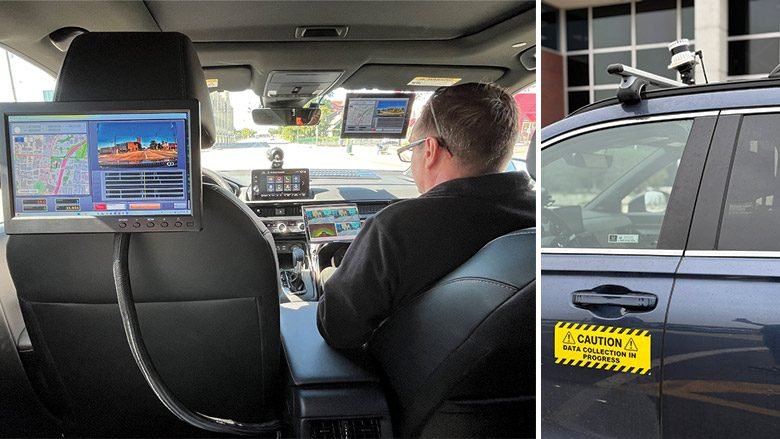
Blyncsy is one of the tools being used by the Ohio Department of Transportation (ODOT) in a pilot project with the University of Cincinnati that also uses LIDAR and other sensors in two vehicles provided by Honda.
“Ohio DOT has 49,000 miles of lane to maintain,” says Jodie Bare, project manager for Parsons, the systems integrator. “They have to inspect critical assets every two weeks. It’s two people getting into a car, one with a clipboard.” The duo must tackle city traffic or remote rural hikes and then enter the data into various systems, he notes.
Looking for quick answers on construction and engineering topics?
Try Ask ENR, our new intelligent AI search tool.
Ask ENR →
Data from the various tools identifies potential problems such as potholes, pavement roughness, and striping and marking defects. These conditions are displayed on intuitive dashboards and translated into maintenance tickets with supporting images. According to Parsons, artificial intelligence further optimized workflows by grouping maintenance activities based on geographic close proximity.
Both vehicles were tested in three counties over two- to three-week periods, says Nicholas Hegemier, ODOT’s managing director of infrastructure and technology. “Inspectors in urban counties, who were supposed to focus on driving, would spend a lot of time going out and looking at one thing, say potholes. Then they’d go back out and look for guardrail damage.” With the combined system, “they were able to reduce that drive to one instance.”
The initial two-year pilot ended last fall. Because the vehicles stayed only a short time in one county, “there were minimal initial benefits, but we found out what they could be,” Hegemier says. The next phase will test them for a whole year, one in a rural county and another in an urban one.
“We had some inconsistencies” in the first phase, he says. “Something looked like a pothole, but it wasn’t. We expect a better representation and more features like size and depth.” ODOT may eventually emulate the Hawaii DOT in real-time crowdsourcing data.
Hegemier notes the partnership with Honda. “For the past 100 years, the [vehicle manufacturers] I’ve made cars to drive on the highways, but I’ve never talked to the DOTs.” But as connected vehicles have come into play, “this is the culmination of all these [subsequent] discussions”.
