


Kalanithi
Construction has never lacked data. What he lacked was clarity.
Today’s jobsites generate enormous volumes of information—drawings, schedules, RFIs, reports—but much of what really matters still lives in the physical world: what was actually installed, where the work is right now, and how jobsite conditions change day-to-day. As projects become more complex and labor harder to find, the gap between what teams think is happening and what actually happens on site has become one of the industry’s biggest sources of risk. This gap is why visual intelligence is emerging as the next big change in construction technology.
Visual intelligence represents a step beyond the traditional capture of reality. For years, photos, videos, and 360° images have helped teams document their workplaces. But documentation alone doesn’t scale and doesn’t solve the real problem. The next step is systems that can automatically organize, understand and act on visual data, turning raw images into usable intelligence that naturally fits the way builders work.
RELATED
AI in building momentum will only continue to grow
At its core, visual intelligence is powered by spatial AI—artificial intelligence models trained not just on images, but on physical context. These systems include the location, sequence and relationships between building elements. They can recognize materials, associate images with 3D building information models and floor plans, and track progress over time. Instead of scrolling through folders of photos or relying on subjective updates, teams get a continuously updated visual record of reality, anchored in space and time.
This change is important because construction is still largely managed through text-based workflows that struggle to accurately reflect field conditions. Progress is debated. Percentage completed is estimated. Problems appear late, often when they are already expensive. Visual intelligence introduces an image-based approach that aligns digital systems with the way builders assess work naturally: by looking.
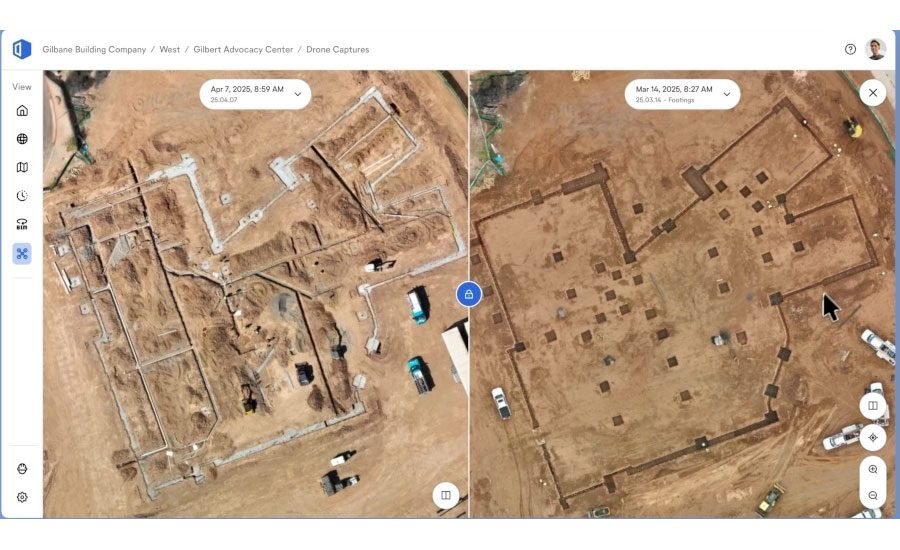
In practice, this means that images can now drive decisions rather than support them. Automated capture, using smartphones, 360° cameras and drones, creates a complete visual history of the job site without overburdening field equipment. The AI then pins each image in the correct location, compares week-by-week progress and highlights where it’s moving forward, stalling or going off plan. This intelligence flows directly into workflows such as progress validation, QA/QC, coordination and billing.
Looking for quick answers on construction and engineering topics?
Try Ask ENR, our new intelligent AI search tool.
Ask ENR →
The impact is tangible. On large, complex projects, teams identify productivity issues much earlier, sometimes at 10% completion instead of 50%, dramatically reducing exposure to downstream costs. Owners and executives get reliable visibility into portfolios without constant site visits. Project teams save hours previously spent walking sites, collecting photos and compiling reports manually, freeing them up to focus on coordination and problem solving rather than data collection.
Importantly, this is not a substitute for human judgment. Build progress remains highly variable and difficult to fully automate. The most effective visual intelligence systems combine artificial intelligence with human expertise, using trained professionals to validate results, refine models and ensure accuracy. This human-in-the-loop approach delivers results that teams trust, while allowing AI to scale where humans alone cannot.
RELATED
VIDEO: The evolution of the role of visual data in construction
As visual intelligence platforms mature, their value increases. Each image captured adds context. Each verified data point improves the underlying models. Over time, systems become more predictive, more autonomous, and better able to address risk before it turns into rework or delay. The result is not only better documentation, but a more reliable operational picture for the entire project team.
The construction industry is under pressure to build faster, safer and with fewer resources. Meeting this challenge will require tools that reflect reality, not abstractions. Visual intelligence does just that by basing digital workflows on what’s actually happening on site.
We’ve spent decades managing construction through reports and memories. The next era will be managed by continuously updated visual truth. For builders navigating increasing complexity, this change is not only useful, but necessary.
Jeevan Kalanithi is co-founder and CEO of OpenSpace in San Francisco, a visual intelligence platform for contractors. Before starting OpenSpace, Jeevan served as an entrepreneur-in-residence at Lux Capital. He sold his first company, Sifteo, to 3D Robotics, where he eventually became the company’s president.
