

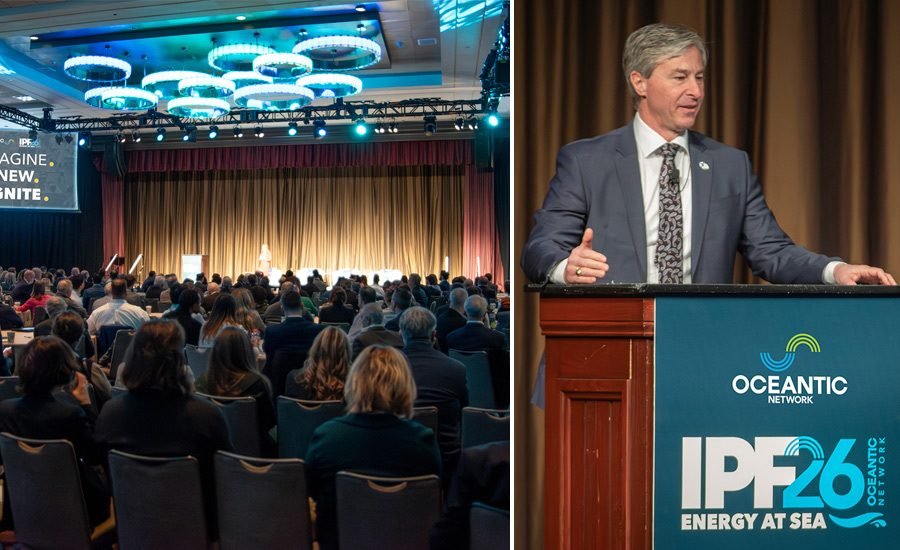

The return of the premier offshore wind development conference in the US in New York City in 2026 was more muted in celebrating the project’s major milestones than likely anticipated at the first event of 2019, as the sector has grappled with the economic realities of launching a new domestic industry and now faces the full force of the Trump administration’s ideology-based retaliation against it.
The estimated attendance of 900 people at the Oceanic Network International Partnering Forum was down from a recent past event of nearly 4,000, with continued uncertainty over federal funding and permit restrictions and a murky outlook for investor support prompting frank discussion about how to proceed going forward.
But the Feb. 9-12 conference also comes on the heels of five federal court decisions that granted restraining orders to stop President Donald Trump’s stop-work edicts against five large East Coast offshore wind projects totaling 6 GW with an estimated $28 billion in investment at stake.
Conference leaders, builders, regulators and advocates relished this clean court victory and highlighted the positive results of offshore wind pilot projects—and the US’s first commercial-scale operational effort—in generating energy on land-based grids.
South Fork Wind, the first utility-scale offshore wind facility in US waters, which began commercial operation in late 2024 off New York, generated power 90% of the hours and 362 days in 2025, ending the year with a capacity factor of 46.3%. “This is remarkable production from a wind turbine site,” Mikkel Maehlisen, head of U.S. offshore generation for developer and operator Orsted, told attendees.
Turbines at the nation’s first permitted wind project, the 800 MW Vineyard Wind in Massachusetts, which has sent 579 MW of power to the state grid since last year, are at generating capacity “up to 75 percent … when the grid needed it most,” added Liz Burdock, CEO of Baltimore-based Oceantic Network. the sponsor of the conference. “Action will matter more than rhetoric.”
“Reimagining is not retiring”
But even without federal involvement for the first time and with signs of project scaling back, state officials, industry executives and other industry participants expressed a commitment to advancing offshore wind and increasing investor, supply chain and workforce confidence.
Looking for quick answers on construction and engineering topics?
Try Ask ENR, our new intelligent AI search tool.
Ask ENR →
“We are designing a new model for offshore wind. Reimagining is not going backwards,” Burdock said. “Reviving requires action. The industry must come forward with solutions.” He added that stopping projects already in operation or under construction “has real consequences.”
Despite the withdrawal of federal support, private investors have not abandoned the sector. “Clean energy has the speed and time to market that hyperscalers need,” Benjamin Bielawski, portfolio manager and senior research analyst at Duff & Phelps Investment Management Co., told Barron’s. February 12 webinar. He said clean energy still has a big benefit in powering data centers directly. “We know there’s demand, it’s just a matter of time. We’re not building renewables fast enough, and the US could be short in the next three years.”
Janice Schneider, a partner at the law firm Latham & Watkins LLP who represented several developers in their recent victories against Trump’s orders, noted the impact of the rulings: “That we’re 6-0 against the government, [including a 2025 ruling in an earlier lawsuit against one project] it will make it harder for agencies to make decisions that have stranglehold control [on offshore wind]”, he said.
The rethinking of the strategy comes as the administration’s anti-wind measures are likely to continue. While the mother has no intention of formally appealing the removal orders, Interior Secretary Doug Burgum said in a Feb. 11 interview with Bloomberg that the agency “absolutely” will, claiming that offshore wind turbines are at risk of attack by “autonomous submarines.” Burgum denied the work stoppage order is part of a federal “ideological attack” on offshore wind. The Trump administration had also cited the turbines’ interference with radar systems in its stop-work order, although other countries have found ways to mitigate any effects on those systems.
Concerns over the expiration of tax credits in last year’s OBBB budget law could delay or cancel up to 75% of US onshore and offshore wind projects after 2027, years earlier than originally set out in the Inflation Reduction Act of 2022, a new report from Enverus Intelligence Research said. “Without tax credit benefits, the levelized cost of energy for new projects [some] it is estimated to almost double,” the report said.
“America is blessed with access to capital. How do we make it stable,” said Christina Baworowsky, senior vice president of Citizens for Responsible Energy Solutions, a right-leaning nonprofit. “We’re working to educate Republicans so they understand what these projects are doing … that they’re producing electricity.”
New York moves the needle
With New York leading the U.S. in offshore wind commitment with three contracted projects, Doreen Harris, president of the New York State Energy Research Administration, noted that 150 turbines will generate power as the region expects to see a 25 percent growth in its energy load. But New York ended its last competitive solicitation last year as Trump’s attacks escalated, with no contracts awarded and bids withdrawn.
Harris noted that a new request for information from NYSERDA seeks to expand its project portfolio to include state co-investment for pre-development efforts. The RFI admits that past project development actions “have eroded investor confidence with many developers and supply chain partners slowing or halting project development or even causing developers to exit the market.”
The state has already launched a $300 million competitive financing effort to help ports maintain flexibility for future offshore wind and regulations finalized Feb. 12 to reduce the schedule and cost of grid modernization projects, with permitting time reduced by up to 50 percent, officials said.
“We know the market has been tested. We have adjusted our approach but we have not abandoned the mission.” Harris said. “Offshore wind is not just about clean energy, it’s about economic competitiveness.”
Acknowledging the pitfalls in adapting some of Europe’s offshore wind procurement processes and costs, Georges Sassine, NYSERDA’s senior vice president of large-scale resources, pointed to new state efforts to “pause” its model, “de-risk the project framework, continue to build and scale meaningfully when we can.”
Will Hazelip, president of National Grid Ventures, noted that the projects were going well until the cost inflation related to COVID-19 kicked in. “When things are going well, it’s easy to ignore risk, and offshore wind has a lot of risk. It’s been highlighted that some of the frameworks we had in place weren’t fit to manage all these risks.”
Kent Herzog, senior managing director at Burns & McDonnell, added: “We wanted offshore wind, but we also wanted low prices, minimal exposure to risk, fast lead times and one-off procurement that didn’t require long-term coordination,” an unattainable mix “for a first-of-its-kind industrial system,” he added.
Despite the mea culpas, “I’m an absolute believer in this market,” said Tim Fischer, global executive director of wind at Denmark-based engineering firm Ramboll, which has also worked extensively on projects in China. “Offshore wind is a global industry. We need to find disruptive solutions until the market reopens. What can we do differently in the US?”
Meanwhile, Canada is aiming to fill gaps in the supply of US offshore wind power, as Nova Scotia signed a supply agreement this month with Massachusetts, particularly from the province’s developing Wind West project. The $60 billion effort is estimated to produce 5 GW of power by 2033 in its first phase, with bi-national collaboration on market coordination, grid integration and supply chain development.
With up to 60 GW of offshore wind potential in the province. “We cannot take our tides or winds elsewhere,” Nova Scotia Premier Tim Houston told the conference. “We intend to use them responsibly and strategically.” He pointed to the regulatory system in place in Canada, adding that Wind West could have the capacity to meet 25% of the country’s energy needs.
“We’re about to launch our first call for bids to license the first offshore wind projects in Canada, and we’re moving forward with Wind West to build the transmission infrastructure to send this clean energy to markets,” Houston said. “Our agreement with Massachusetts signals to developers that their clean energy markets are solidifying, giving them even more confidence to invest in our new offshore wind industry.”
