

Institutional capital continues to flow into mature U.S. toll roads, even as higher borrowing costs reshape underwriting assumptions for new revenue-risk projects.
That shift was underlined on February 13, when UK-based infrastructure asset manager and investor John Laing Group agreed to acquire American Roads from Netherlands-based global infrastructure investment manager CVC DIF. Terms were not disclosed and the companies did not provide an expected closing date.
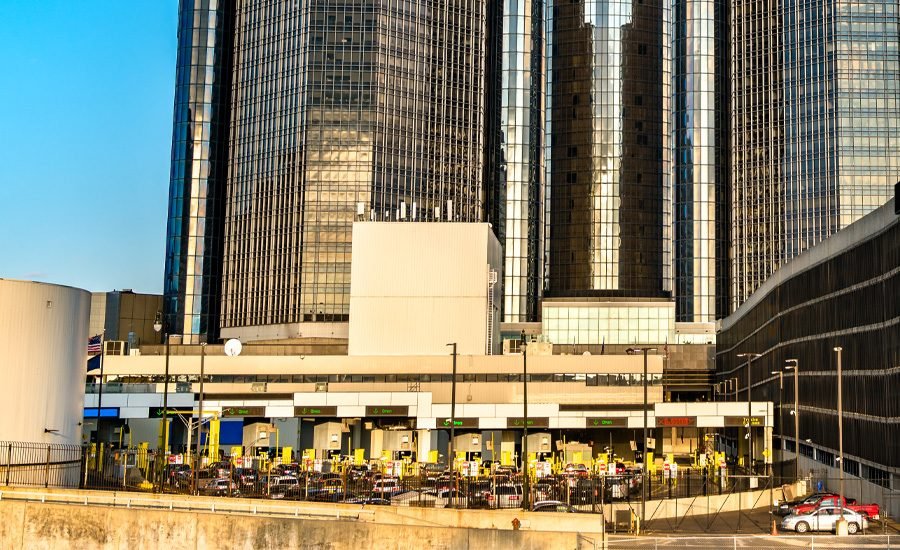
Announcing the transaction, John Laing said it had agreed to acquire “an established U.S. transportation platform that includes four operating toll assets in Michigan and throughout Alabama.” The portfolio includes the Detroit-Windsor Tunnel, Ontario and three toll bridges in Alabama: Tuscaloosa Bypass, Emerald Mountain Expressway and Montgomery Expressway.

The map highlights toll rates on Alabama’s interstates, showing $2.00 near Tuscaloosa on I-20/59 and the $3.00 and $4.00 segments around Montgomery on I-65 and I-85.
Google Maps/ENR
CVC DIF described the assets as “three bridges in Alabama with perpetual operating rights, as well as the concession-lease of the US side of the Detroit-Windsor tunnel, a strategically important cross-border tunnel,” highlighting the long-term operational framework built into the platform.
The platform serves about 7 million trips annually, CVC DIF said. Public disclosures from American Roads indicate that the Detroit–Windsor Tunnel alone carries more than 4 million vehicles per year, and Alabama’s bridges account for several million additional crossings.
Rather than a divestiture of a single asset, the transaction transfers ownership of an operating company with diversified traffic exposure and established cash flow.
A person familiar with the Detroit-Windsor tunnel who spoke in the past characterized the sale as a financial transaction involving the operating company, not a change in public ownership or day-to-day control. The cities of Detroit and Windsor each retain ownership of their respective halves of the tunnel, the source said, with American Roads serving as Detroit’s contractor under a long-term operating agreement. “It’s really just a transactional acquisition on paper,” the source said, adding that the change of investor does not disrupt the tunnel’s operations.
Looking for quick answers on construction and engineering topics?
Try Ask ENR, our new intelligent AI search tool.
Ask ENR →
The Detroit-Windsor Tunnel concession runs through 2040 under its current U.S. lease, leaving approximately 14 years of operating term remaining from the transaction date of 2026. This defined revenue horizon influences underwriting because it determines the time frame for servicing debt and generating capital returns.
Alabama’s bridges operate on fixed user fee toll programs with electronic collection programs. Public fare schedules show incremental adjustments; for example, the Montgomery Expressway implemented an increase of approximately 50 cents for passenger vehicles in 2024, bringing the standard fare to about $2.00, reflecting periodic price resets rather than dynamic pricing based on congestion.
Because the underlying ownership structure remains unchanged and the transaction involves the operating company rather than a transfer of municipal assets, the person said the deal does not alter the cities’ roles or the tunnel’s status as a U.S. port of entry.
RELATED
Trump threatens to block opening of Gordie Howe Bridge
The tunnel also works in an immediate change corridor.
ENR previously reported that the publicly funded Gordie Howe International Bridge, also between these US and Canadian cities, was formally posted by US Customs and Border Protection as an official port of entry effective March 2. The six-lane bridge, now substantially complete, will add new cross-border capacity to the same Detroit-Windsor corridor. President Donald Trump has publicly threatened to block its opening, adding to political uncertainty as the project moves toward commissioning.
According to 2024 border traffic statistics released last February by the Association of Bridge and Tunnel Operators, total crossings at the Detroit-Windsor Tunnel increased 4.25% year over year to 3,870,608 vehicles. Car traffic increased by 4.22%, while truck volume fell by 5.96%. Crossings across the corridor totaled 30.93 million vehicles, up 6.52% from 2023, but still 8.4% below 2019 levels.
For investors underwriting the Detroit-Windsor Tunnel concession, that recovery trajectory, combined with traffic still below pre-pandemic benchmarks, frames the issue of capacity as the six-lane Gordie Howe Pass prepares to enter service. The new bridge represents an imminent increase in supply that could influence traffic distribution and toll revenue yield.
Unlike the revenue-risk Detroit-Windsor Tunnel Concession, the Gordie Howe International Bridge is structured as an availability-based public-private partnership backed by the Canadian government, insulating its debt from traffic volume risk, according to an April 2025 S&P Global Ratings report on concessionaire Bridging North America. This structural distinction means that the new bridge’s debt service does not depend on toll revenue performance, although it adds competitive capacity to the corridor.
A rebooted capital market
The acquisition takes place in a markedly different capital environment than the one that supported high infrastructure valuations in 2020 and 2021. As benchmark rates rose from 2022 onwards, project finance spreads widened and leverage assumptions tightened.
In a January 2026 cost of capital outlook, law firm Norton Rose Fulbright reported that some project finance loans are priced approximately 450 to 600 basis points above the guaranteed overnight funding rate, materially higher than during the very low rate cycle. At these levels, higher annual debt service can compress free cash flow to equity, unless traffic growth or toll adjustments offset the increase.
Federal credit data also shows a moderation in new toll financing with revenue risk. According to the U.S. Department of Transportation’s Office of Build America, three Transportation Infrastructure Innovation and Financing Act toll financings reached financial close in fiscal year 2021, compared to one in fiscal year 2022 and one in fiscal year 2023, before rising to two in fiscal year 2024. pipeline for new toll projects at risk of revenue.
Municipal capital markets have also remained active, with the Municipal Securities Regulatory Board reporting $580.2 billion in total bond issuance by 2025, including $23.1 billion for freeways, expressways and streets.
The outlook for the sector at the start of 2026 points to more stable conditions than to expansion. S&P Global Ratings has estimated that toll transactions are likely to stabilize around historical growth rates in 2026-2027, maintaining a “stable” outlook for most toll facilities and emphasizing disciplined capital planning in a higher rate environment.
Within this framework, John Laing’s purchase of American Roads looks less like a cyclical outlier and more like an allocation geared toward defined concession ownership, observable toll-setting behavior and diversified traffic exposure—assets positioned to generate predictable cash flow even as capital markets demand greater underwriting discipline.
