

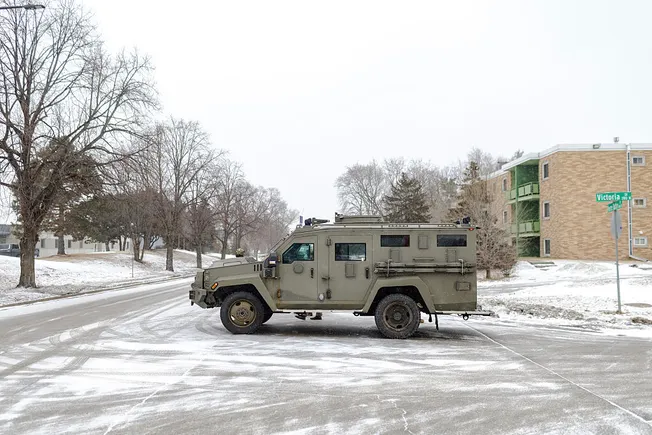
At the end of 2025, the Minneapolis-based Centerspace management team took stock of immigration enforcement actions in their hometown.
The crackdown, which drew national scrutiny after the January murders of Renée Good and Alex Pretti, had begun months earlier. Despite the turmoil in the city, Centerspace President and CEO Anne Olson said the REIT has so far seen very few interactions with U.S. Immigration and Customs Enforcement agents at its properties.
“We have a system where [enforcement actions are] reported,” Olson said. “And it’s really limited to just a couple of communities where we’ve seen some disruption, and that disruption would be from rent to resident jumps. But so far, it’s had really minimal impact.”
However, Olson noted that in January, Minneapolis had little turnover and few people looking for apartments. So far, it’s “hard to know if there’s any real impact,” Olson said. “We’ll see more of that once we get the rental season underway.”
While Minneapolis has been the most recent hot spot for ICE’s immigration surge, it hasn’t been the only city affected by the crackdown. And, as the numbers are beginning to show, the apartment industry has not been immune to the agency’s actions. In certain types of products and in certain locations, the impact has been far from minimal, forcing some operators to take steps to educate their employees and residents.
Population impacts
Household formation drives demand for apartments. And right now, fewer people are coming into the country to fill apartments, especially at the lower end of the market.
From mid-2024 to mid-2025, US population growth was only half that of the previous year, increases by only 1.8 million people during the 12 months, according to data from the United States Census Bureau. The foreign-born population grew by 1.3 million during the period, a 54% drop from the same period a year earlier.
“Information from multiple sources shows either a markedly slower growth in the foreign-born population or an actual pullback in the immigrant population,” LeaseLock Chief Economist Greg Willett told Multifamily Dive in emailed comments.
According to Willett, national housing numbers still don’t show a slowdown in housing starts and rental demand. However, individual neighborhoods with large immigrant populations show deteriorating conditions.
“Apartment vacancies began to rise rapidly in the latter half of 2025 in select submarkets in Texas, Florida, Arizona and Southern California,” Willett said.
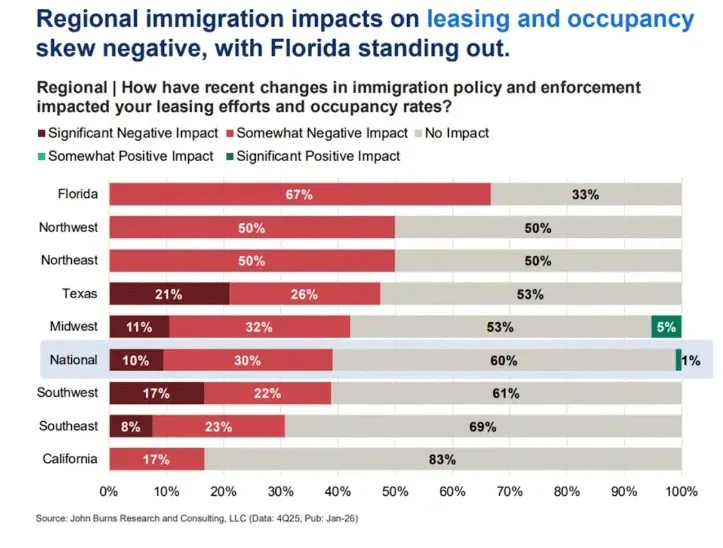
A recent survey by Irvine, Calif.-based John Burns Research & Consulting shows similar trends. In Florida, 67 percent of apartment operators said the impacts of immigration on rent and employment were somewhat negative, according to data reviewed by Multifamily Dive.

Jay Lybik
Permission granted by Jay Lybik
In Texas, 26% of respondents reported a somewhat negative impact and 21% reported a significant negative impact. In the Southwest, 17% noted a significant negative impact and 22% saw a somewhat negative impact.
Jay Lybik, senior director of market research at Continental Properties, told Multifamily Dive that he believes the weakness in the Sun Belt is being affected by lower immigration, both legal and illegal, in addition to financial stress on lower-income households.
“Everyone keeps talking about how the oversupply at the top end of the market is helping to drive down Class C rents in Phoenix, Austin and San Antonio,” Lybik said. “I don’t believe it. I’m saying Class C rents are going down in these markets because a lot of households at that price point can’t afford rent or, in the case of immigrants, some are leaving the U.S. directly.”
Class C concerns
By 2025, John Burns’ team suspected that small multi-family properties and scattered single-family homes would be most affected by immigration crackdowns. However, what it found was that larger properties, meaning older Class C assets, are also seeing occupancies drop following ICE raids.
Willett said he is seeing similar trends, adding that problems in the industry could make Fannie Mae and Freddie Mac hesitant to finance real estate transactions.
“The pattern is particularly pronounced in lower-tier Class C properties, a segment of the product mix that has already faced headwinds from consumer price inflation that is reducing the purchasing power of a cash-strapped tenant group,” Willett said.
Class C properties face other problems. They have been particularly hard hit in recent years, with rising interest, insurance and tax costs and stagnant rents.
Optional subtitle
Permission granted by John Burns Research and Consulting in partnership with the National Apartment Association
“Anecdotally, the conversations I’m having are, ‘We’re trying to sell a Class C deal. Loans that originated in 2021 are coming due. We’ve been facing supply-side issues on the operation side, and now we’re getting hit with this demand issue from immigration,'” said Chris Nebenzahl, vice president of lease research at Burvine, Calif.-based John Multinvine. Immersion. it’s really putting some people in a bit of a bind from an employment point of view.”
Job losses due to immigration enforcement could be “the straw that breaks the camel’s back,” Nebenzahl said.
“Where you have 85% occupancy, 78% economic occupancy and the loan is being viewed, I think lenders will say, ‘Yeah, the staff is done.’ Either sell and get what you can or we’ll get your keys back,” Nebenzahl said.
all or nothing
The only saving grace for some older properties is that ICE operations can be hit or miss. Nebenzahl said that in many cases, the impact of ICE raids on apartment occupancy can be an all-or-nothing proposition in a certain submarket or even a specific property.
“If there are rumors of an ICE presence in the area, you could see 10 percent occupancy overnight or in a very short period of time,” Nebenzahl told Multifamily Dive. “On other properties, they say, ‘We don’t have a problem.’

Anthony Luna
Permission granted by Coastline Equity
Anthony Luna, CEO of Coastline Equity, a commercial real estate advisory and property management firm that manages 1,000 units in Southern California, observed the trend in two buildings it operates in Long Beach, California, in an area with a historically more Latino population.
“When the raids started, we saw evictions increase to levels we’ve never seen before, and it happened in the middle of summer, which was really unusual,” Luna told Multifamily Dive last year.
After the raids began, Luna said rents dropped and moves jumped in Long Beach, especially in areas populated by more immigrant or Latino communities.
“There’s just this fear throughout the community, both among immigrants and residents,” Luna said. “There’s a lot of ICE activity. It’s happening almost every day, where they’re raiding Home Depots, car washes, etc.”
Manage ICE requests
Amid community fears, property managers are taking steps to protect residents.
When ICE raids became a reality in Southern California, Luna gathered his employees for a legal crash course focused on the warrants. Traditionally, entering a residence required a warrant, which is signed by a judge. But under ICE’s interpretation of the law, they can try to enter with a simple administrative order, according to the National Apartment Association.
“We showed them what a court order is and what an ICE warrant is, one of their self-produced warrants,” Luna said. “We’ve done some training. We’ve given them talking points. We’ve explained how they should lock down the building if there’s ICE activity in and around the community.”
“If there are rumors of the presence of ICE in the area, you could see that 10% of the occupation goes down during the night or in a very short period”.

Chris Nebenzahl
Vice President of Rental Research at John Burns
The National Apartment Association’s resources provide that landlords either consent to ICE searches or refuse. However, a refusal could lead to forced entry. “In these situations, it is prudent for property owners not to attempt to interfere with law enforcement. Instead, they should carefully document the events and contact counsel,” according to the NAA.
Luna also made it clear to staff, especially those at the front desk or answering phones, that they are not to give out information about the tenant or the rental application without a warrant. “They need to escalate to the appropriate team member if these types of calls or demands come in,” Luna said.
Luna took special care to protect rental request data requests.
“You have no idea who you’re looking for if you’re looking at rental applications,” Luna said. “You’re just trying to get as much data as possible.”
Click here to sign up to receive multifamily and apartment news like this article in your inbox every weekday.
