

.webp?t=1772057593)
A month after a collapsed pipeline north of Washington, D.C., spilled about 240 million gallons of sewage into the Potomac River and possibly 300 to 400 million in what could be the largest sewage spill in U.S. history, efforts are progressing to clean up the damaged section and begin repairs despite weather and other impacts.
More questions remain about the time and investment needed to restore critical infrastructure and reduce environmental impacts, even with a disaster declaration on Feb. 22 and new assistance from the U.S. Army Corps of Engineers and other federal agencies.
The January 19 sinkhole in Montgomery County, Maryland, occurred in a 72-inch section of the day. Potomac Interceptor operated by the District of Columbia Water and Sewer Authority (DC Water). Along the river near the I-495 Beltway crossing, the 1960s-era pipeline is part of a regional system that carries 60 million gallons of wastewater daily from areas of northern Virginia and Maryland to the city’s Blue Plains Wastewater Treatment Plant. Officials have not released the cause of the collapse, which they say is under investigation.
Since the spill, DC Water has said subsequent spills have been largely contained with a temporary diversion system that uses eight high-capacity pumps to route sewage flow about ½ mile around the break through a dry, clay-lined section of the historic C&O Canal and back into the pipeline. Despite increased flow from two major snowstorms and multiple rain events in recent weeks, DC Water reports no overflows since February 8th.
“I’m sure DC Water is acting very aggressively to try to fix this, but there are still a hundred questions about what’s the impact on the C&O Canal, what’s the impact on the Potomac River,” Maryland Rep. Jamie Raskin (D) said at a Feb. 26 DC Water briefing in Bethesda, Maryland.
After President Donald Trump’s initial social media criticism of local officials over the collapse and the line’s response, despite his claims that the pipeline is on federal property, he approved Mayor Muriel E. Bowser’s (D) request on Feb. 18 for federal repair and cleanup in Washington, DC. The Corps and the Federal Emergency Management Agency have joined the effort, which already includes the US Environmental Protection Agency. The latter is involved to prevent additional overflows until the pipeline is repaired, he said in a statement.
The rock blockade was removed on February 26
Contractors have perfected a managed approach to take individual pumps offline during periods of low flow for preventive maintenance, while the Corps implements measures to contain and divert stormwater from the collapse and diversion zone and assist in other areas of project execution. Drinking water is not affected by the spill because the dams in that system are several miles upstream, said Col. Francisco Peña, who heads the Corps’ Baltimore district.
Looking for quick answers on construction and engineering topics?
Try Ask ENR, our new intelligent AI search tool.
Ask ENR →
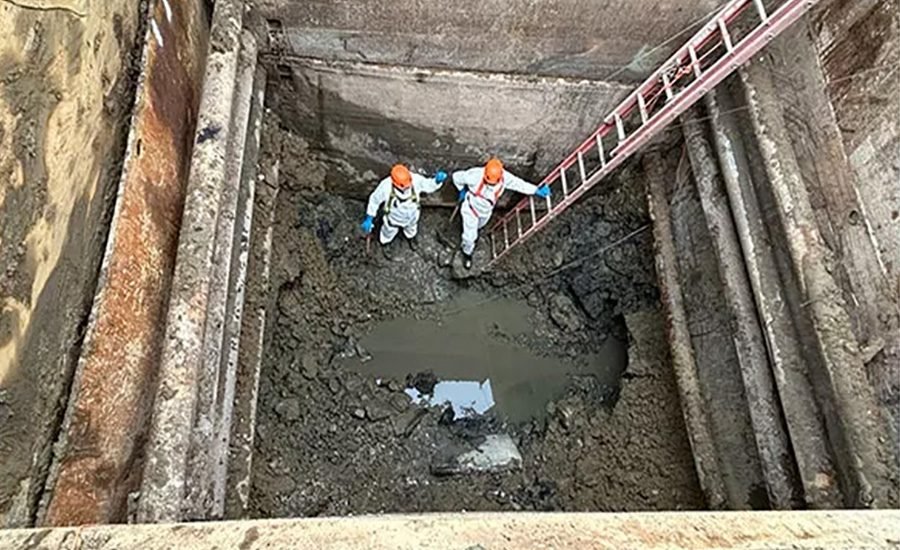
With a temporary steel bulkhead completely isolating the damaged section, inspectors found a large blockage of rock and debris about 30 feet away from the break, DC Water said. The blocks, originally used as construction fill, likely entered the pipe during the initial collapse. The pipe section was deemed structurally compromised and unsafe for workers, so crews excavated a new 30- to 40-foot section to create another access point.
Contractors cut the crown of the pipe to provide direct access to the blockage, and DC Water said on February 26 that the blockage has been removed by hand and machine, but some large rocks and boulders remain in other sections of the pipe and may require additional excavation to remove them. The company said it now intends to fully develop an emergency repair strategy that could take up to six weeks to complete before the bypass system can be decommissioned.
“An environmental restoration plan is being developed in coordination with federal, state and local regulators and will be released to the public when approved,” he said on Feb. 24.
An agency spokesman said the cost of both the remediation and environmental cleanup has now reached about $20 million, according to multiple media reports.
Long term vision
DC Water has not responded to ENR’s requests for information about the contractors involved in the response, or how the incident may affect the scope and cost of the agency’s current and long-term efforts to upgrade infrastructure, including an ongoing $625 million, ten-year program to rehabilitate sections of the Potomac Interceptor.
The agency has said the 2,700 linear foot section where the break occurred was earmarked for rehabilitation, with work to accelerate once emergency repairs to the pipeline are complete. Estimated to take nearly a year, the project will use sliding methods where possible, while other areas of the pipeline will be reinforced and reinforced with a high-strength geopolymer liner.
Bowser said in a Feb. 18 letter to Trump and FEMA that he is asking for “100 percent reimbursement of the costs incurred by the district” and DC Water, to avoid the impact on taxpayers. In media comments, he said “disclosure from the president’s team … would indicate to me that they support the request.”
But according to DC Emergency Management Director Clint Osborn’s comments at a Feb. 25 public briefing at DC Water headquarters, reported locally by WTOP News, the declaration does not allow the city or DC Water to recoup money already spent on repairs. It clarified earlier statements that the federal government would cover 75 percent of the utility company’s total repair and cleanup costs would only apply when U.S. agencies directly perform the work assigned through the emergency declaration. “We will continue to work through the preliminary damage assessment process with FEMA this week to determine if we can convince [the agency] and the White House to upgrade us to a major disaster declaration, which would get us reimbursement,” he said.
“How the cost will be borne and allocated is still being worked out,” DC Water and its four county customers — Montgomery and Prince George’s in Maryland, and Fairfax and Loudoun in Virginia — said the utility’s spokesman.
Meanwhile, a 14-member group of regional House members said it is seeking additional funding for interceptor repairs and upgrades, and related work on other U.S. wastewater treatment systems. of the House on February 24. “The failure of the Potomac Interceptor is an acute crisis for our region.”
The lingering effects of the spill on the river’s water quality remain to be determined. Sampling by DC Water and state agencies has shown that levels of E. coli and other bacteria downstream of the overflow is gradually decreasing, although it continues to fluctuate, with health advisories issued, according to data released by DC Water.
Betsy Nicholas, president of the Potomac Riverkeeper Network, said the overall response to DC Water’s collapse has been good, and its independent testing shows water quality downstream largely meets recreational contact standards despite occasional spikes in high flows and ice melt. But he warned that “testing should continue”, especially as warmer weather draws people to coastal areas.
Another concern is that, like other infrastructure agencies, DC Water lacks the resources to address other parts of its infrastructure system that may be in danger of failing. “Hopefully, this incident will be the thread to prevent similar incidents in the future,” Nicholas said.
“It’s important to note … that this incident does not reflect a systemic failure in the Potomac Interceptor,” David Gadis, CEO and CEO of DC Water, told regional government officials on Feb. 23, though he described it as a “known vulnerability” because of its age. [it] to get where we need to get.”
DC Water will hold another public meeting on the status of the project at 7pm on February 26 at Walt Whitman High School in Bethesda, Maryland, which will be streamed live.
