

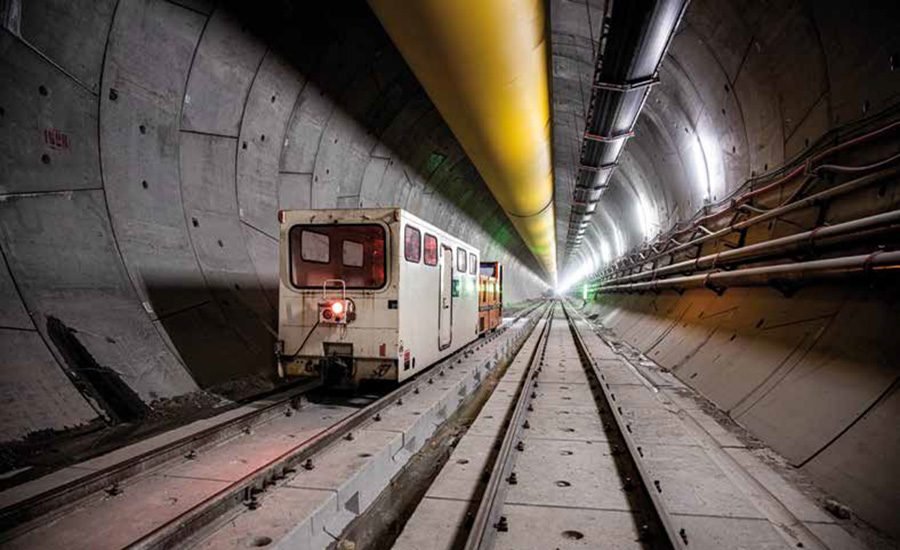
The Brenner base tunnel has completed the last two TBMs. When TBMs Olga and Wilma complete their remaining combined 6 km under the Austrian Alps, mechanized excavation will be complete on the 55 km, $11.5 billion rail tunnel connecting Innsbruck and Fortezza, and one of Europe’s most technically challenging infrastructure projects will move fully into its systems phase ahead of its scheduled 2028 opening.
BBT SE reported in early February that Olga had reached the 4km mark in the east main tunnel of site H53 Pfons-Brenner, halfway through its 7.6km northbound run. Wilma has passed 5km in the west main tunnel. Together, the machines have built more than 9 km of tunnel, leaving less than 6 km between them.
“With only 3.6 kilometers to dig, Olga is coming down the final stretch,” said BBT SE.
The Brenner Base Tunnel runs 55 km between Innsbruck and Fortezza, 64 km including the Innsbruck bypass. The project is jointly financed by Austria and Italy, with co-financing from the European Union through the Trans-European Transport Network program. All tunnels built as part of this program, including main tubes, exploration, access, ventilation and emergency tunnels, total approximately 230 km.
RELATED
Brenner base tunnelers conquer peaks and valleys of the Alps
However, some of the most significant engineering achievements that made this project possible lie far from the H53 units, below 5 to 8 m of cover under the Isarco River near Fortezza, where engineers advanced four shallow tunnels without diverting the river or lowering the water table.
Digging under a living river
The Isarco River Underpass is the southernmost section before the base tunnel connects to the existing Verona-Brenner railway line. The route passes under the river, the A22 motorway, the SS12 state road and an active rail corridor, all with minimal overhead.
The designers opted for underground construction instead of a cut-and-cover offset to reduce environmental impact and avoid interference with surface infrastructure. This choice highlighted the challenge: excavating through saturated soils beneath active infrastructure without lowering the groundwater level.
Looking for quick answers on construction and engineering topics?
Try Ask ENR, our new intelligent AI search tool.
Ask ENR →

A geological longitudinal section shows rock formations between Innsbruck and Fortezza along the alignment of the $11.5 million Brenner Base Tunnel under the Alps. The 55 km rail link passes through quartz phyllite, Bündner shales and complex fault zones that shaped the excavation strategy.
Image courtesy of BBT SE.
Geologically, the alignment changes from solid granite to loose alluvial and fluvial deposits—gravels, sands, and silts that carry measurable groundwater flow. The excavation, therefore, had to proceed in hydrostatic conditions.
Once dehydration was eliminated, permeability reduction became the main structural tool. Engineers used jet grouting to build a reinforced soil envelope around the excavation. Field tests showed column diameters close to 2 meters, with the treated soil reaching compressive strengths in excess of 5 MPa and permeability decreased by several orders of magnitude.
Pumping tests confirmed the seal before the headers were advanced. Where access was available, jet grouting was carried out from the surface, allowing ground improvement to continue independent of excavation and minimizing downtime under the freeway and state highway.
RELATED
Great progress for the Brenner Base Tunnel through the Alps
Freezing the ground, not the river
The lowest section, directly below the Isarco River, required artificial freezing of the ground. Jet grouting could reduce permeability and strengthen the soil envelope, but could not provide the necessary temporary structural stability under only a few meters of cover with live water above.
Each breakthrough required dozens of grouting and freezing holes. Liquid nitrogen was circulated through probe systems to freeze saturated soils into temporary structural cylinders, strong enough to withstand excavation.
Once the frozen ground reached the target strength, excavation proceeded in controlled 1m increments with immediate support installation behind the face. The freeze then transitioned into a brine-based maintenance phase to maintain soil temperatures throughout.
The objective was clear: to preserve groundwater levels and avoid interference with the flow of the river. With only a few meters of cover, even small settlements could have affected the riverbed or the infrastructure above. The margin of error was small.
A defining feature of the larger tunnel system is a continuous exploration tunnel located approximately 12 m below and between the two main tubes. During construction, it provided early geological data. When in use, it will serve as a permanent drainage conduit under the alpine overburden reaching up to 1,720m, a long-term safety feature built into the design from the start.
From excavation to operations
When Olga and Wilma reach their destinations, the project will move on to the commissioning and installation of systems across the entire 55 km alignment. This phase includes the installation of ballastless track, traction power systems, safety equipment for crossings and the implementation of European Train Control System Level 2 signaling, along with ventilation, drainage and emergency infrastructure.
The tunnel’s relatively flat longitudinal grade of approximately 0.4% to 0.7% will allow longer and heavier freight trains to travel under the Alps without the steep climbs required on the current Brenner line. This profile is key to the project’s goal of increasing rail capacity along the Scandinavian-Mediterranean corridor and shifting freight traffic from trucks to trains.
Systems integration will determine operational readiness and ultimately whether the tunnel delivers the promised performance gains.
The toughest engineering test

The map shows the alignment of the Brenner Base Tunnel between Innsbruck, Austria and Fortezza, Italy, forming the central Alpine link on the EU’s Scandinavian-Mediterranean rail corridor.
Image courtesy of BBT SE.
The Brenner Base Tunnel is the central element of the EU’s Scandinavian-Mediterranean corridor. The February announcement showed steady progress.
The most consequential engineering test was solved years earlier: permeability was reduced by about five orders of magnitude in treated areas; cylinders of frozen soil were built under a flowing alpine river; and the excavation proceeded under full hydrostatic pressure without draining the valley floor.
The biggest challenge was never getting the final breakthrough. Instead, it was to demonstrate that a transalpine rail artery could be built under a living river, through saturated alluvium and under active infrastructure, without changing the groundwater regime that supports the valley above.
That test has already been passed.
