

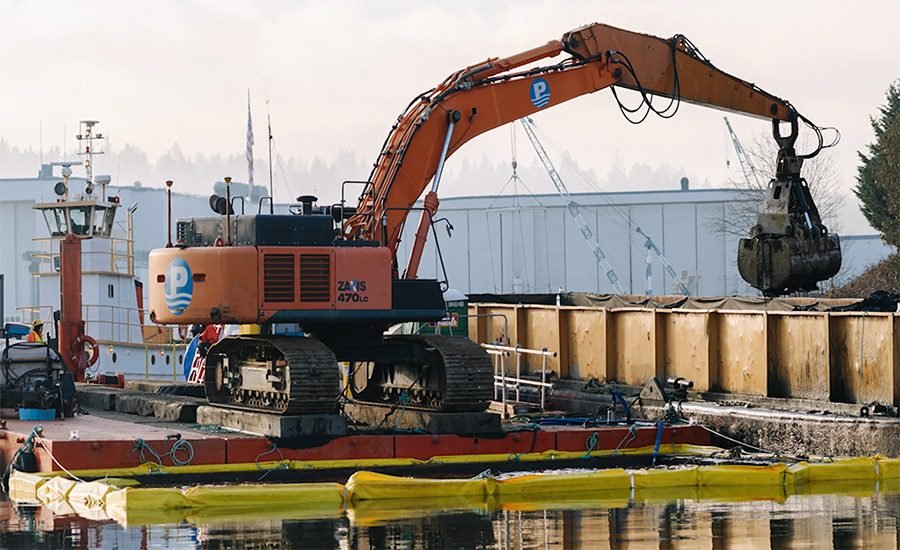
A proposed $668 million settlement filed in federal court would secure long-term funding for the continued cleanup of contaminated sediment in Seattle’s Lower Duwamish Waterway, one of Pacific Northwest more industrialized river corridors.
Announced March 4 by the U.S. Environmental Protection Agency, the U.S. Department of Justice and the state of Washington, the settlement resolves the sharing of costs among more than 100 responsible parties related to historic pollution along a five-mile waterway that flows into Elliott Bay. The settlement splits the cleanup costs among those responsible, while the first phase of the river cleanup effort is already underway.
The proposed consent decree requires the Lower Duwamish Waterway Group (Boeing, the City of Seattle and King County) to design and implement the in-water cleanup remedy selected by EPA in its 2014 Record of Decision, with the federal agency maintaining oversight authority. The decree also maintains EPA’s authority to step in and perform the work if required cleanup obligations are not met.
“This agreement finally ensures the large-scale cleanup of the Lower Duwamish Waterway,” Jeffrey A. Hall, deputy administrator of EPA’s Office of Enforcement and Enforcement, said in announcing the agreement.
“The cost-sharing agreement resulting from negotiations between many parties shows that this administration will follow through on its promise to accelerate the cleanup of hazardous pollutants while ensuring that responsible parties are held accountable,” Hall added.
The EPA estimates that the cleanup will take at least 10 years to complete. The agency’s 2014 cleanup plan estimated the selected remedy would cost about $342 million, with the larger settlement reflecting cost-sharing among responsible parties, as well as long-term implementation and monitoring.
The consent decree was filed in the U.S. District Court for the Western District of Washington and must go through a 30-day public comment period before a federal judge can approve the settlement.
Looking for quick answers on construction and engineering topics?
Try Ask ENR, our new intelligent AI search tool.
Ask ENR →
Large-scale sediment remediation
EPA’s cleanup plan targets contaminated sediments in approximately 412 acres of the Lower Duwamish Waterway, with active remediation planned for approximately 177 acres of river bed.
The agency has identified at least 41 hazardous substances in river sediments, including polychlorinated biphenyls, arsenic, carcinogenic polycyclic aromatic hydrocarbons, dioxins and furans.
Emma Pokon, EPA Region 10 administrator, said the effort is expected to provide both environmental and economic benefits for Seattle’s industrial waterfront.
“Cleaning up this waterway will improve resident use, support safer fishing, protect wildlife and foster a vibrant industrial core in the heart of Seattle,” Pokon said.
The plan combines dredging, sediment cap engineering and natural reclamation enhancement to deal with pollution built up over more than a century of industrial activity. Dredging or partial dredging will be conducted on approximately 105 acres of contaminated sediment, while engineered sediment caps will be installed on another 24 acres. Enhanced natural reclamation measures are planned for about 48 hectares and around 235 hectares of river bed will be treated through controlled natural reclamation as cleaner sediments gradually bury the remaining pollutants over time.
The EPA identified pollution from decades of shipbuilding, aircraft manufacturing, steel production, municipal outfalls and other industrial activities along the river corridor and estimates that the cleanup will remove approximately 960,000 cubic meters of contaminated sediment from the waterway.
RELATED
Lessons from the Hudson River PCB Cleanup Project
Construction already underway
Cleanup construction began on the upper section of the waterway in late 2024 and is expected to continue through early 2027 as part of a phased remediation plan that divides the river into upper, middle and lower cleanup sections. Cleanup will move downstream through these segments as dredging, capping and monitoring activities proceed.

The diagram illustrates how a barge-mounted shell dredger removes contaminated sediment from a riverbed and transfers it to a bottom barge during environmental cleanup operations.
Diagram courtesy of the Federal Repair Technologies Roundtable
King County oversees the upstream project, which covers about two miles between Duwamish Waterway Park and the South 102nd Street Bridge. Seattle-based Pacific Pile & Marine is the construction contractor for the phase, performing dredging operations, installing sediment plugs and placing clean material to help accelerate the natural recovery of the river bed.
Because the Lower Duwamish provides habitat for migrating salmon and other fish species, construction activities on the water are restricted to the seasonal windows of October through February. Cleanup tasks must also be coordinated with ongoing shipping and industrial operations along the waterway.
Previous sediment removal projects addressed some of the most contaminated areas of the river, including a 2003-04 dredging effort near the Diagonal/Duwamish Combined Sewer Outfall that removed about 68,000 cubic yards of PCB-contaminated sediment and covered a seven-acre section of the riverbed.
Washington State Department of Ecology Director Casey Sixkiller stressed that sorting out how cleanup costs would be divided between responsible parties is key as the project moves forward.
“Resolving the question of who will pay for the work is critical, especially now that the final stages of active cleanup have begun,” Sixkiller said.
RELATED
Cleanup of New York’s Gowanus Canal Superfund site begins in earnest
Legacy of the Industrial Corridor
The Lower Duwamish has served as Seattle’s primary industrial waterway since the early 20th century, supporting shipyards, aircraft manufacturing, steelmaking, and chemical production facilities.
The EPA added the waterway to the national Superfund priority list in 2001 after investigations confirmed widespread sediment contamination linked to decades of industrial activity.
The cleanup is combined with a broader source control program led by the Washington Department of Ecology to reduce the level of pollutants entering the waterway from the surrounding watershed, a roughly 20,000-acre drainage basin that contributes runoff to the Lower Duwamish.
Acting Assistant Attorney General Justin Heminger of the Justice Department’s Environment and Natural Resources Division said the settlement marks an important milestone in the long-running cleanup effort.
“The Duwamish is a vital asset to Seattle and the surrounding community,” Heminger said. “By filing this settlement with the court today and seeking public comment, we are taking a big step toward restoring the Lower Duwamish.”
